Knowing when to replace a water softener starts with confirming what’s wrong. Weak performance doesn’t automatically mean the entire system has failed. Testing, service history, and a written diagnosis give you a firmer answer.
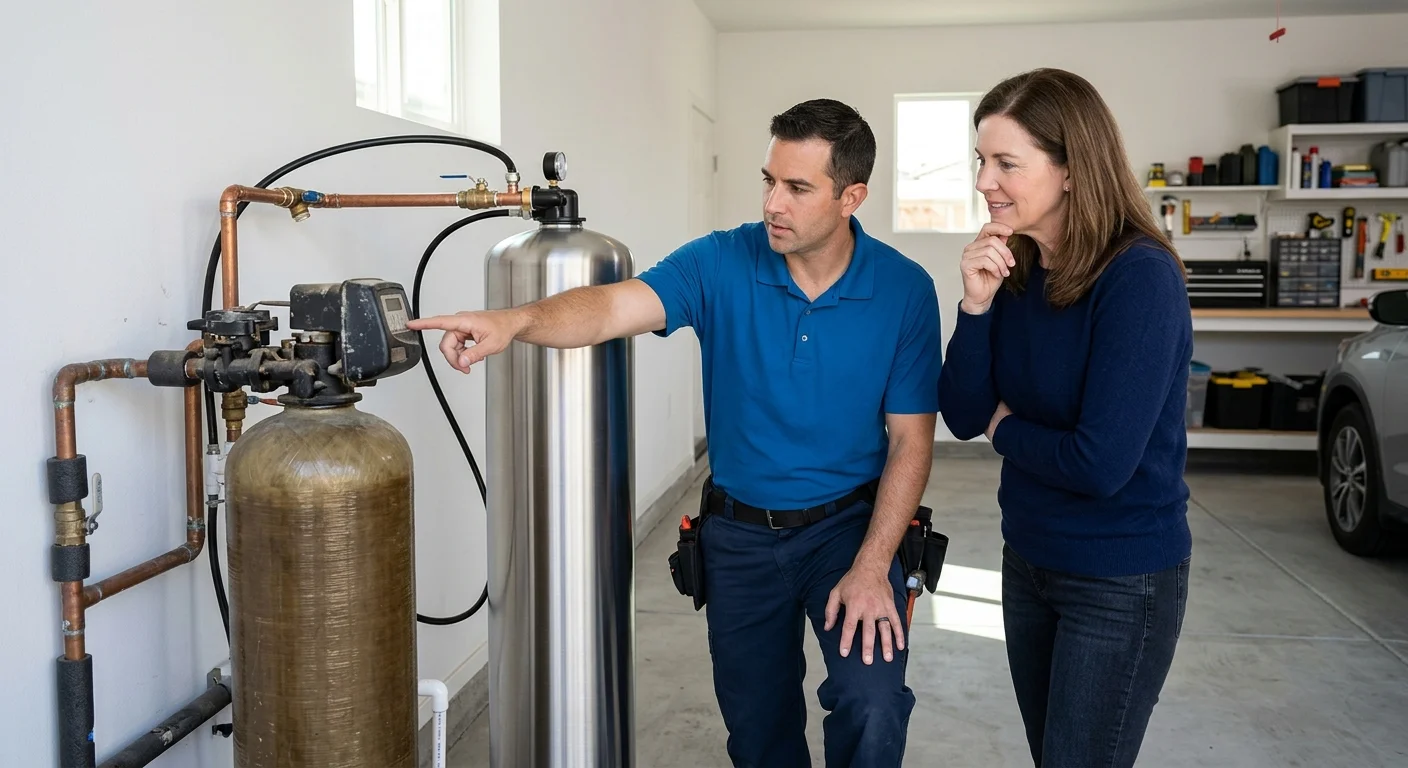
Confirm the problem before replacing equipment
Start with the water, not the equipment’s age. Record the changes you’ve noticed and where they occur. Look for recurring residue, changes in soap performance, an unexpected taste, or untreated results from a hardness test. Note whether every fixture is affected or only one.
Check the basic information a pro will need. Write down the equipment brand and model. Photograph the display, valve, bypass position, and any visible leaks. Record the salt level if the system uses salt. Don’t disassemble pressurized plumbing or electrical controls.
Next, compare raw and treated water during the same visit. Testing both sides helps show whether the equipment is changing the water as intended. Our guide to checking whether a water softener is working can help you organize those observations before service.
Local water conditions matter. The City of San Diego Public Utilities Department reports that city drinking water averages about 16 grains per gallon, or 276 ppm. It can range from 16 to 18 grains per gallon, or 272 to 284 ppm, depending on water demand and location within the city.
That figure applies only to the City of San Diego system. It isn’t a countywide number. Don’t apply it to Oceanside, Chula Vista, an East County district, or a private well. Check your current utility report and test the water at the property.
A failed test doesn’t answer the repair-or-replace question by itself. It confirms that the current setup needs diagnosis. That prevents an equipment purchase based only on residue, appearance, or guesswork.
Separate serviceable faults from system-wide decline
A serviceable fault is limited enough for a licensed pro to identify and address. The pro might find a control setting, bypass position, connection, valve component, or maintenance issue that needs attention. The diagnosis should name the fault and explain how the proposed work addresses it.
Some symptoms deserve focused troubleshooting. A unit that keeps cycling or draining needs a different inspection from one with low pressure. A sudden change after maintenance also deserves a different review from gradually weaker treated-water results.
Existing guides on a softener that keeps running or draining and low pressure after a water softener can help you describe the problem. They shouldn’t replace testing at the home.
Replacement becomes more reasonable when a licensed pro documents broader decline. That could mean several independent faults, repeated loss of treatment performance, or parts that can’t be confirmed as available for the exact model. Ask the pro to show which conditions apply. Don’t accept equipment age alone as proof.
Confirm the exact model, current condition, parts availability and manufacturer documents before deciding to replace equipment. Age alone does not establish that a particular system has reached the end of its useful service.
A proper water softener repair and replacement assessment should separate the immediate fault from the condition of the remaining equipment. If the treatment goal has also changed, review the available hard water solutions before choosing another system.
The useful distinction is simple. Repair addresses a documented, limited problem. Replacement addresses a system that no longer offers a sensible path back to measured performance.
Compare repair history with current performance
Past repairs provide context, but only when the records are specific. Gather invoices, service notes, model information, and manufacturer documents. Mark which component was serviced and whether the original symptom returned.
Then compare that history with current test results. A repair that corrected an unrelated issue shouldn’t count as evidence that today’s fault will repeat. Likewise, a recurring symptom deserves closer attention even when different explanations were previously offered.
Ask for two written scopes when both choices remain viable. The repair scope should identify the fault, proposed work, parts, and any applicable warranty terms. The replacement scope should identify the equipment, tank material, control, installation work, and any ongoing maintenance needs. Verify every warranty with the party providing it.
Compare written repair and replacement proposals for the documented scope, including parts, labor and any related installation work. Our San Diego water softener repair cost guide explains what information to collect when reviewing a quote.
Don’t compare only the totals. Compare what each option is intended to correct. Look for excluded plumbing work, uncertain parts, separate disposal charges, and maintenance requirements. Ask whether the quoted work depends on another inspection.
Regular records make this process easier. Keep test results, model details, and completed service together. The water softener maintenance guide provides a practical framework for tracking the system without inventing a replacement deadline.
The best decision follows documented performance. Past spending alone doesn’t prove that another repair is wise. Equipment age alone doesn’t prove replacement is necessary.
Check plumbing, pressure, and water changes
A softener sits within a larger plumbing system. The symptom you notice may involve the equipment, nearby plumbing, one fixture, or the incoming supply. Check that context before approving replacement.
Tell the pro whether the change affects hot water, cold water, or both. Note whether pressure changed throughout the house or at one faucet. Share any recent plumbing work, fixture changes, shutoffs, leaks, or adjustments near the system. These details help define what needs inspection.
A licensed pro can compare conditions with the equipment in service and in bypass. The pro should handle that test when you’re unsure how the bypass operates. Report what changed, but don’t treat the observation as a complete diagnosis.
Water source changes also matter. San Diego County includes many separate service areas, plus properties using private wells. Hardness varies by service area and season. The City of San Diego figure doesn’t establish conditions at a North County, South Bay, or backcountry property.
Use the San Diego County Water Authority as a starting point for regional water information. Then find the current consumer confidence report from the utility serving the address. A private-well property needs testing tied to that well, not a nearby city’s published figure.
Bring current test results to the equipment discussion. If untreated water has changed, the existing setup may need a different adjustment or treatment plan. If untreated water is consistent but treated performance has changed, that gives the pro a different pattern to investigate.
Also confirm the original treatment goal. A softener decision should address measured hardness. Concerns about taste, odor, or another water characteristic may call for a separate evaluation. Replacing one piece of equipment without defining the target can leave the original complaint unresolved.
What to ask a licensed pro before deciding
A clear diagnosis should survive direct questions. Ask what was tested, where samples were taken, and what the results showed. Request the untreated and treated readings in writing. Confirm which symptom the proposed work is meant to correct.
Then ask about the equipment itself:
- Is the fault limited to one serviceable component?
- Were the settings, bypass, connections, and current water conditions checked?
- Are replacement parts confirmed for this exact model?
- What other known problems remain after the proposed repair?
- What manufacturer documents support the recommendation?
- What maintenance will each option require?
- Which warranty terms apply, and who provides them?
- What work is excluded from the written scope?
If replacement is proposed, compare materials through written specifications. Ask whether the tank is stainless steel or fiberglass with a plastic liner. Don’t rely on an unsupported durability label. Request the manufacturer, model, material, and warranty documents.
If a salt-free option is discussed, ask for the exact model and written operating information. Confirm whether it uses salt, sodium, or brine discharge rather than relying on a broad product label. The recommendation should match the measured water and your stated treatment goal.
Ask who will perform the contracted work. Verify the contractor’s status through the California Contractors State License Board license check. Make sure the name on the proposal matches the party responsible for the installation or repair.
Filter Pros San Diego arranges the free in-home water test and connects homeowners with separately licensed Water Filtration pros. The homeowner chooses the pro, signs the contract with that pro, and pays that pro directly.
A replacement recommendation should explain why repair no longer makes sense. A repair recommendation should explain what remains usable. If either explanation depends on an unconfirmed price, lifespan, or warranty, request supporting documents before deciding.
When to call us
Call when testing shows weak performance, faults keep returning, or you need an independent repair-versus-replacement assessment. We’ll arrange testing and connect you with a licensed Water Filtration pro, while you contract with the pro directly. Call us at (858) 400-6508 to set up a free in-home water test.