White scale on a Mira Mesa shower door does not mean the whole-house cartridge failed. A point-of-entry filter and a softener treat different things. The filter can change what you taste, smell, or see at every tap, and the calcium and magnesium that make San Diego water hard still ride through unless a separate softener or conditioner is on the line.
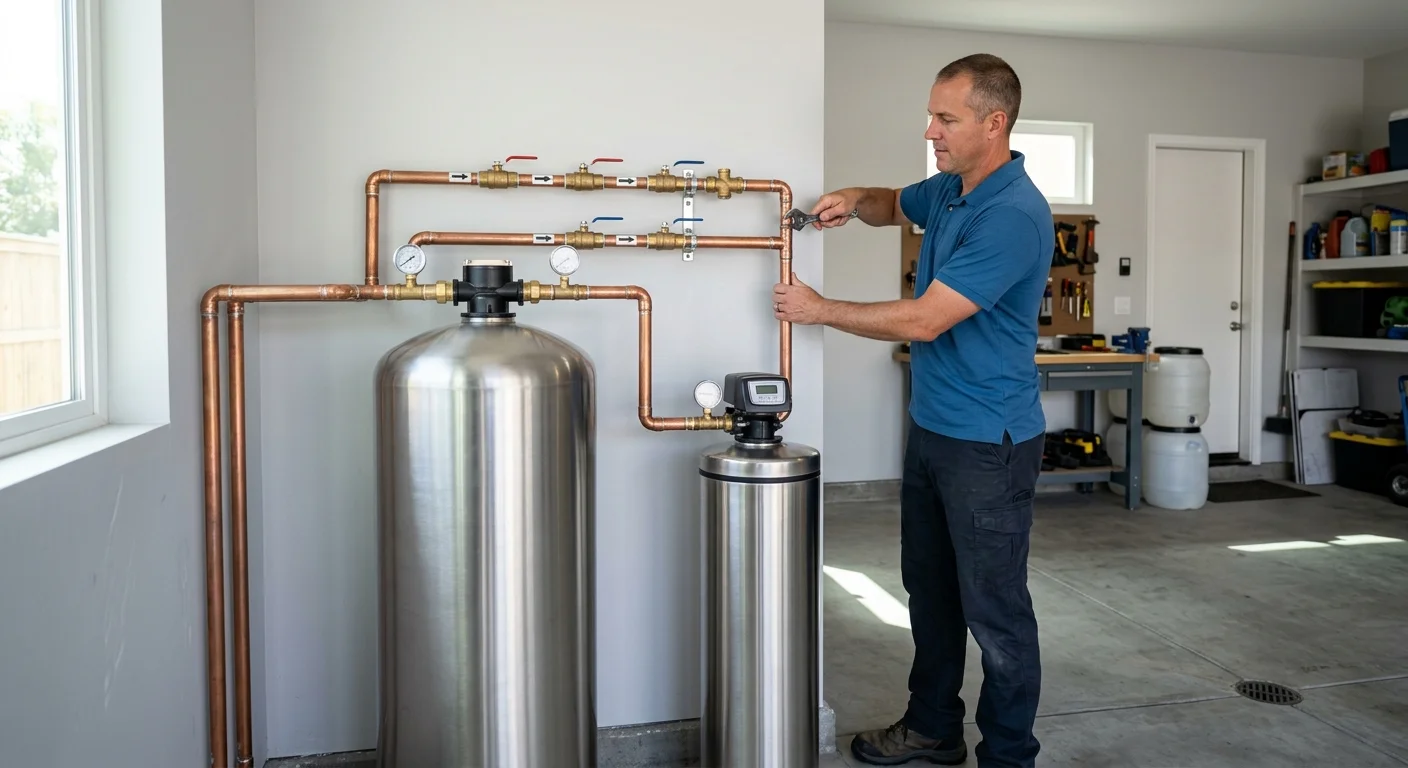
Hardness and filtration are different jobs
Hard water is dissolved calcium and magnesium. Those ions are small. They stay dissolved until heat or evaporation leaves them as crust on glass, valves, and heating surfaces. Helix Water District puts the hard-water line at 10 grains per gallon or more. The imported Colorado River and State Water Project supply that much of the county buys averages about 14 grains, per Helix. That is a statement about the imported supply, not a reading from your kitchen tap.
The City of San Diego publishes its own figures, and they are not a countywide average. On the City Public Utilities plumbing page, drinking water typically averages about 16 grains per gallon, or 276 ppm, and can range from 16 to 18 grains (272 to 284 ppm) depending on demand and the area of the City. The City’s 2025 Consumer Confidence Report lists different plant totals for that reporting year: Alvarado averaged 13.8 grains (11.9 to 15.8), Miramar 14.1 (11.7 to 16.6), Otay 14.2 (11.7 to 15.8), and purchased treated water 8.5 (3.18 to 13.6). Those are two City publications covering different measurements. Neither describes a private well in Ramona, Alpine, or the backcountry. Confirm the serving utility for the address before you treat a number as yours.
The U.S. Geological Survey classifies hardness as calcium carbonate: 0 to 60 mg/L is soft, 61 to 120 is moderately hard, 121 to 180 is hard, and over 180 is very hard. That is classification guidance. It is not a home-safety rating and it does not tell you which tank to buy.
Filtration is a different job. A whole-house water filtration system is a point-of-entry device. Water passes through media or cartridges as it enters the house, then moves on to showers, laundry, and the heater. What it is allowed to claim depends on the exact model’s certification, not on the words “whole house.” NSF/ANSI 42 covers certified aesthetic reduction claims. NSF/ANSI 53 covers specified health-effect contaminant claims. NSF/ANSI 44 is the standard for ion-exchange softeners that reduce calcium and magnesium hardness. NSF/ANSI 58 covers reverse osmosis. A listed standard is not a ranking, and it does not mean every contaminant is reduced. Read the model’s certified reduction claim.
So the mix-up has a clean answer. A water filter does not remove hardness unless it is actually a softener, certified under NSF/ANSI 44, or another device with a verified hardness claim. A carbon stage, a sediment cartridge, and a refrigerator filter are not that device. Softened water can still need filtration. Filtered water can still be hard. If both problems show up at the same address, they are still two problems.
What a point-of-entry filter is built to change
Point-of-entry treatment sits on the main line after the meter, so every downstream fixture sees the same water. Point-of-use devices treat one selected tap. The EPA’s home-treatment guidance is blunt on this: identify the concern first with the serving utility’s report and appropriate testing, because no single technology removes every contaminant. Compare scope, the exact certified reduction claims, maintenance, and water use. Then match the hardware to that list.
A typical whole-house stack starts with a sediment stage that catches grit and rust flakes before they chew up later media. Carbon stages are often sold for taste and odor. That is an aesthetic job when the model carries an NSF/ANSI 42 claim for the substance named on the label. Health-effect claims need NSF/ANSI 53 for the specific contaminant listed. Do not assume a carbon tank reduces hardness, fluoride, or every chemical named in a blog. Verify the model.
That is why a refrigerator filter does not soften water. It is a small point-of-use cartridge on one dispenser. It is not an ion-exchange resin bed sized for household hardness. If the ice tastes better after you change it, you still have the same grains per gallon in the shower and the water heater.
Whole-house filtration is the right conversation when the complaint is house-wide: chlorine or chloramine smell in the steam at a Pacific Beach shower, visible particles after a main break, or a utility report you want treated at every tap. It is the wrong conversation when the only complaint is chalk on the glass. Scale is hardness. Sediment and disinfectant taste are not.
Reverse osmosis is another mismatch for this search. NSF/ANSI 58 covers RO. Most home units are point-of-use at the kitchen. They produce treated water and reject water, and performance is model-specific. An under-sink RO can change drinking water without touching the washer or the tankless heater. The comparison of those two scopes lives on our reverse osmosis vs. whole-house filtration page. This page’s job is narrower: a whole-house filter is not a softener.
Ownership cost is media and cartridges, not a one-time tank. EPA tells shoppers to include manufacturer maintenance and replacement-filter costs when they compare systems. A neglected sediment can starve later stages and drop pressure. That still does not convert the filter into a hardness solution.
What softening or salt-free conditioning is for
A traditional softener uses ion exchange. Resin takes calcium and magnesium out of the water and puts sodium or potassium ions in their place. NSF/ANSI 44 is the certification to compare, along with the model’s rated working capacity and water and salt efficiency. EPA’s May 2026 softener guide says to size from measured hardness and household water use, and to leave irrigation out of that math when the yard should stay on untreated water. Oversizing can waste water. Demand-initiated regeneration follows actual use and hardness instead of a fixed timer.
That is what a water softener does. It reduces the hardness minerals that leave white film on fixtures, dull laundry, and scale inside heaters. Navien’s tankless maintenance notes say hard water may require more frequent flushing of heat exchangers, and that anti-scale or softener systems can reduce mineral buildup. Those are Navien’s terms for its own equipment. Other brands write their own manuals. The point for this search is simpler. Scale is a hardness problem. A carbon filter does not take its place.
Salt-free conditioning is not the same machine. EPA is explicit: salt-free conditioning does not remove hardness ions. Evaluate the exact scale-reduction claim, not a promise of softened water. EPA also points shoppers to IAPMO/ANSI Z601 when they compare salt-free scale-reduction performance. That is a test protocol, not a Filter Pros certification and not a claim that any one model is certified. Minerals stay in the water. Soap behavior and the hardness number on a test strip can stay in the hard range even when a conditioner is installed to limit scale. The side-by-side of those two paths is already on water softener vs. salt-free conditioner. Use that page when you are choosing between them. Use this one when you were hoping the whole-house filter already did the job.
Sodium is part of salt-based softening, not filtration. University of Nebraska–Lincoln Extension estimates about 8 mg/L of sodium added for each grain per gallon of hardness removed. People on restricted sodium diets should talk with a physician. Many homes take drinking and cooking water from a kitchen cold line that bypasses the softener. Potassium chloride is an option in some units, with professional guidance. None of that turns a filter into a softener.
If the house has both hardness and a filtration concern, the honest layout is two stages, each picked for one job. Pairing, order, and bypass details belong on installing a softener and filter together. Do not buy a bigger filter and hope the scale stops.
For hard water solutions in this county, start with a number from your tap, then pick ion exchange, salt-free conditioning, or a paired stack. The hardware follows the test.
How to confirm hardness at your tap
Symptoms help you ask better questions. They do not replace a measurement. Chalk on a South Bay glass shower door, spots on Encinitas dishware, poor lather, and scale in a water heater all point at hardness. Rust-colored staining is a different clue. The EPA secondary guideline for iron is 0.3 mg/L, tied to rusty color, sediment, metallic taste, and reddish or orange staining. That is an aesthetic guideline, not a universal onset point and not a hardness reading.
A TDS meter is not a hardness test. Total dissolved solids lump many ions together. EPA’s secondary TDS guideline is 500 mg/L for aesthetic and technical concerns. It is not a drinking-safety cutoff and it does not name calcium or magnesium. USGS notes that specific conductance can approximate dissolved solids, and that the relation varies with water composition. If you need hardness, test for hardness.
Start with the serving utility’s current report. The San Diego County Water Authority explains wholesale supply and quality at the regional level. Your retail bill names the agency that actually serves the meter: City of San Diego, Helix, or another district. Read that agency’s Consumer Confidence Report for the current year. Do not copy a neighbor’s number from a different plant or a different city. Do not treat the City’s 16-grain typical figure as a well result. Private wells are their own source. CDC guidance for wells is annual testing for total coliform, nitrate, TDS, and pH, through a state-certified laboratory, plus extra tests that local health or environmental staff say fit the location.
A strip or drop kit at the tap is a screening step. It tells you whether you are looking at hardness or at something else. It is not a design sheet for a tank. Filter Pros San Diego arranges a free in-home water test so a licensed pro can read hardness and the other concerns on site before anyone sizes equipment. Ask what the visit actually measures. Do not treat a screening as a contaminant-safety clearance.
If you already have a whole-house filter and the glass still spots, the filter is probably doing its own job. Test hardness on the raw side and the treated side. If the grains barely move, you do not have a spent cartridge problem. You have a missing softening or conditioning stage.
When a separately licensed pro should size treatment
EPA’s selection logic is the whole method: name the treatment goal, compare point-of-entry and point-of-use, read the exact certified claims, and plan maintenance. A licensed water-treatment pro turns that into pipe, drain, bypass, and a tank that fits the house. Filter Pros San Diego does not install the equipment, pull the permit, or hold the trade license. We answer the phone, run the free in-home test, and connect you with a separately licensed pro. You contract with that pro and pay that pro. Confirm a California license on the CSLB license check before work starts.
Sizing a softener from a guessed grain count is how homes end up with short cycles or wasted regen water. EPA says measure hardness and household use, skip irrigation when that water should stay hard, and prefer demand-initiated regeneration. A filter is sized to the concern and to household flow, then maintained on the manufacturer’s media schedule. Those are two worksheets.
Permits are local. The City of San Diego lists water-softener installation among qualifying Simple No-Plan Plumbing/Gas Permit work for eligible properties. Scope and historic-property rules change the route. That is City guidance, not a countywide rule, and it is not evidence of a softener ban. Other cities and the unincorporated county set their own processes. Ask the pro which counter they will use for your address.
Septic properties need one extra call. EPA advises checking with the septic manufacturer or local service provider about overload, warranty, and performance before a softener goes in. That is a check, not a requirement to install a conditioner on every septic lot.
Well homes in the backcountry should not borrow City plant numbers. Test first, then match treatment to what the lab actually found. A sediment stage may protect later equipment. It still will not take hardness out.
Once hardness and filtration are both on the list, have the licensed pro lay out one point-of-entry train with a bypass, not two unrelated gadgets fighting for the same closet. The test decides whether you need a filter, a softener, a salt-free conditioner, an under-sink RO, or a pair. The catalog does not.
When to call us
Call when the shower glass still spots after a whole-house filter change, when you cannot tell hardness from chlorine taste, or when you want a licensed pro to size treatment from a real tap reading. Filter Pros San Diego will set up the free in-home water test and connect you with a separately licensed water filtration pro for the work. Call us at (858) 400-6508 to set up a free in-home water test.