White crust on a Vista shower door after a hot inland week is the usual buying moment. Vista hard water treatment is a household decision: read the utility on the bill, measure the tap, then have a separately licensed pro size the system. A stain bottle on the glass leaves the incoming water unchanged.
Identify the provider on a Vista water bill
Vista sits inland along SR-78, between Oceanside and Escondido. Your serving water retailer is printed on the bill. That name is the one that publishes the report for your street.
We could not confirm a published hardness number for Vista Irrigation District, the City of Vista, or any other Vista retailer from the agency reports we hold. Skip any countywide average. The City of San Diego Public Utilities site says drinking water in that city typically averages about 16 grains per gallon, or 276 ppm, and can range from 16 to 18 gr/gal depending on demand and area. That figure is the City of San Diego system. It describes neither a Vista tap nor a private well.
Find the utility name on the bill. Then open that utility’s current Consumer Confidence Report. San Diego County Water Authority is the wholesale agency many North County retailers buy from. Helix Water District, writing about the imported supply the county purchases, says water at 10 or more grains per gallon is considered hard, and imported Colorado River and State Water Project water averages about 14 grains. That is a statement about the imported supply. Your kitchen faucet still needs its own reading.
If the property is on a private well, the CCR does not apply. The well needs its own test through a state-certified lab. CDC well guidance includes annual testing for total coliform, nitrate, TDS, and pH, plus any extra tests local health staff recommend for the location.
Once you know who serves the house, you can read how hardness is discussed across San Diego and still treat every city number as belonging to that city only.
Measure hardness at the household tap
Treatment follows a number from this house.
USGS classifies hardness as calcium carbonate: 0–60 mg/L is soft, 61–120 is moderately hard, 121–180 is hard, and over 180 is very hard. Its calculator uses about 17.1 mg/L per grain per gallon. That is classification guidance. It is not a safety certificate, and it does not predict appliance life.
EPA’s home-treatment guidance says to set goals from the serving utility’s report and from appropriate testing. No single device removes every contaminant. A TDS meter tracks dissolved solids in a rough way. USGS notes that specific conductance depends on which ions are present. Hardness is calcium and magnesium. Confirm it with a hardness test.
EPA also says to size a softener from measured hardness and household water use, and to exclude irrigation demand when that water will not go through the unit. Oversizing can waste water. Demand-initiated regeneration responds to actual use and hardness instead of a fixed timer.
Filter Pros San Diego arranges a free in-home water test, then connects you with a separately licensed Water Filtration pro. You contract with that pro and pay that pro. The visit is a starting measurement at the tap. It is not a laboratory clearance of every contaminant, and it is not a medical finding.
A home hardness kit can flag the problem before anyone visits. Treat the kit as a screen. The licensed pro should still confirm the number before they size a tank.
Inland North County heat, scale, and housing
Inland Vista is a different house than a coastal Encinitas lot. Summer heat along SR-78, Melrose, and Sycamore dries mineral spots onto glass, tile, and car paint in a hurry. That is a climate effect on how scale looks. It is not a published ranking of which city has harder water.
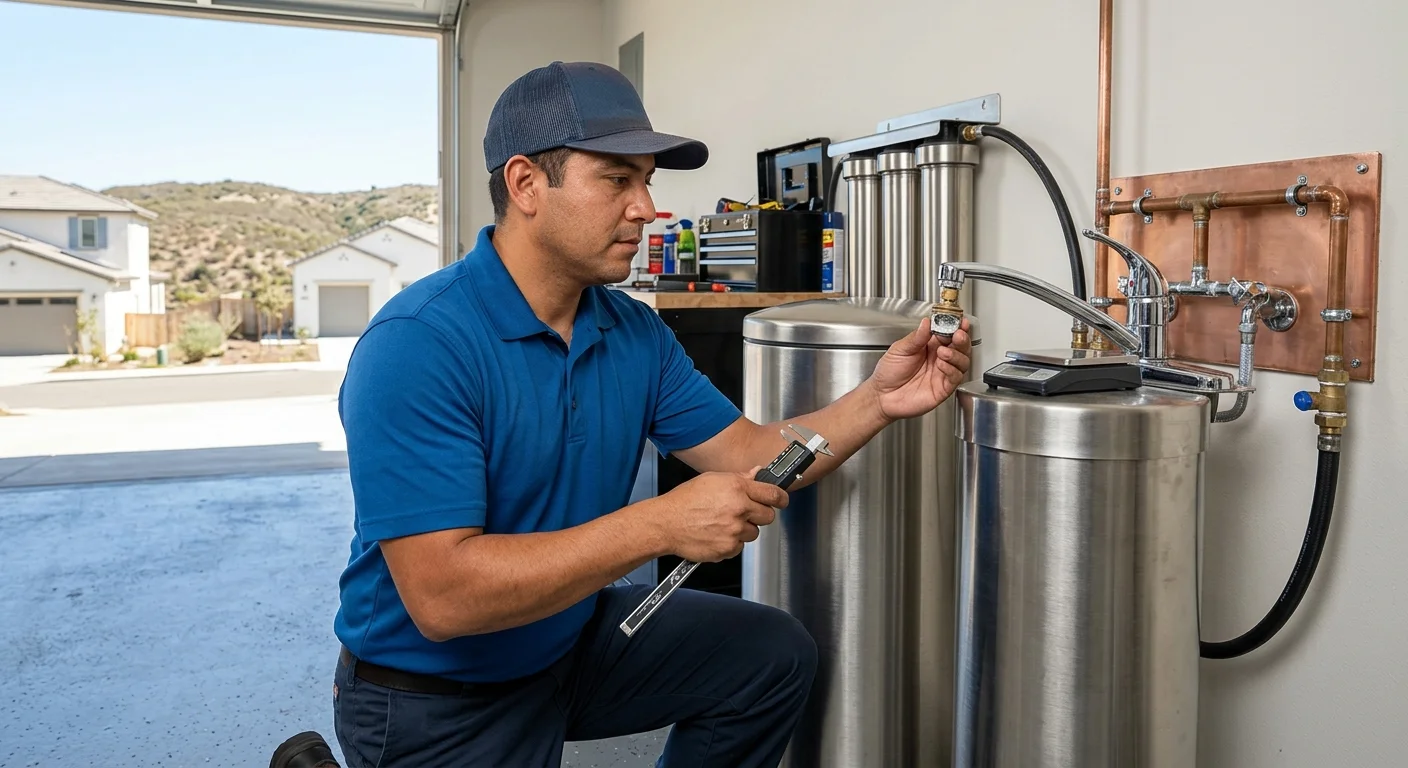
A lot of housing in Shadowridge, downtown along Santa Fe, and the 78 corridor is two-story tract with the water heater in the garage. That garage is where a whole-house unit usually lands: next to the heater, with a drain nearby if the job is a salt-based softener, and with room to service a bypass. Tight garages, finished walls, and storage along the slab change the layout. The licensed pro has to see the space.
Scale shows up first on faucet aerators, glass shower doors, and dishwasher residue. Navien, writing about its own tankless heaters, says annual maintenance includes flushing heat exchangers, that hard water may need more frequent service, and that anti-scale or softening equipment can reduce mineral buildup. Those are Navien terms. Other brands publish their own manuals. Skipping the heater’s maintenance rules can void that brand’s warranty.
Stopping new buildup at fixtures means treating the water that feeds the house. Wiping glass and soaking shower heads is cleanup. Cleanup is useful. The supply still needs a system if the spots keep returning.
Car windows are a separate surface. Irrigation overspray and wash water leave spots even when indoor plumbing is treated. We could not confirm a verified finding that WD-40 removes mineral spots from glass. Follow the product label, test a small area, and keep chemicals off tint and coatings unless the maker says they are compatible. For household glass and fixtures, wipe the mineral film as it appears, then treat the supply so the film builds more slowly.
If the house is on septic, EPA advises checking with the septic manufacturer or local service provider before a salt-based softener, because of overload, warranty, and performance questions. We could not confirm a softener restriction in Vista. Ask the City of Vista building counter, or County staff if the parcel is unincorporated, for the current rule on your address.
Softening versus salt-free versus filtration
Match the tool to the problem.
Ion-exchange softening is the path that removes calcium and magnesium hardness. NSF/ANSI 44 covers ion-exchange softeners that reduce that hardness. Compare the exact model’s certification, rated working capacity, and water and salt efficiency. EPA notes that salt-free conditioning leaves hardness ions in the water. Evaluate the exact scale-reduction claim. EPA also points to IAPMO/ANSI Z601 when you are comparing salt-free scale-reduction claims. That is a standard to ask about. It is not a certification we claim for a Filter Pros model.
Salt-free PF1025 conditioning means no salt, no sodium, no bags to haul, and no brine discharge. That matters in a Vista garage where a salt pallet next to the water heater is a chore, and on lots where a brine line is awkward. Read the salt-free water conditioning path if brine or sodium is the constraint, and compare both options in water softener vs salt-free conditioner.
Filtration is a different job. NSF/ANSI 42 covers certified aesthetic reduction claims. NSF/ANSI 53 covers specified health-effect contaminant claims. NSF/ANSI 58 covers reverse osmosis. A standard is not a ranking, and it does not mean every contaminant is reduced. Verify the exact model’s certified reduction claim.
Point-of-entry systems treat water entering the residence. Point-of-use devices treat a selected tap. A kitchen RO unit leaves the water heater untreated. A whole-house conditioner does not replace a drinking-water claim on a certified RO. EPA’s WaterSense consumer page for point-of-use RO says labeled units demonstrate at most 2.3 gallons of reject water per gallon treated under its criteria. That is a label criterion. EPA also gives national examples of five or more reject gallons per treated gallon for some RO units, and up to ten for inefficient ones. Those are national examples, not a promise for a Vista install.
The tanks the pros we send work with are medical-grade stainless steel, rather than fiberglass with a plastic liner. Ask to see the tank spec before you sign.
For the house-wide mineral problem, start at hard water solutions. Keep irrigation off that system when the EPA sizing logic says to exclude it.
University of Nebraska–Lincoln Extension notes that ion-exchange softening adds sodium at about 8 mg/L for each grain per gallon of hardness removed. People on restricted sodium diets should talk with a physician. Drinking and cooking water is often taken from a kitchen cold line that bypasses the softener. That is a design question for the installer. It is not medical advice from us.
Questions for the separately licensed pro
Filter Pros San Diego is the referral desk. The homeowner contracts with a separately licensed Water Filtration pro and pays that pro. Confirm the license on the CSLB license check before work starts.
Ask where the unit will sit in the garage, and how the bypass works. A bypass routes water around the unit so the house still has water when the system is isolated. Valve types differ. Leave a stuck handle alone. Confirm bypass by running a cold tap. Follow the exact model manual.
Ask whether irrigation is excluded. Ask where the drain goes if the unit regenerates. Ask whether the kitchen cold line will bypass a salt-based unit. Ask for the exact NSF/ANSI standard and reduction claim on the model they propose, including NSF/ANSI 44 for a softener.
Permits are local. The City of San Diego lists water-softener installation among Simple No-Plan Plumbing/Gas Permit work for eligible properties in that city. Scope and historic-property rules change the route. That guidance is City of San Diego jurisdiction. We could not confirm Vista’s current permit path from the sources we hold. Call the City of Vista building counter, or the County if the parcel is unincorporated, and ask before anyone cuts in.
Ask about maintenance in writing: salt type if it is a softener, filter changes if it is filtration, and what the manufacturer requires for a salt-free unit. Persistent drain flow on a softener can indicate a malfunction. Stay off wet electrical parts, and leave pressurized assemblies closed.
Bring the water bill, the CCR if you have it, and any well lab report. The pro sizes from those plus the tap measurement.
When to call us
Call when scale is showing on Vista fixtures, when a tankless heater is due for descaling, or when you are choosing between a softener, salt-free conditioning, and filtration and want a measured tap first. Filter Pros San Diego runs the free in-home water test and connects you with a separately licensed pro. You contract with that pro directly. Call us at (858) 400-6508 to set up a free in-home water test.