The kitchen glass and the shower in a San Diego home are not the same water problem. Drinking more tap water has not been shown to treat eczema. Water that sits on your skin in a long, hot shower is a different exposure, and that is the one a hardness test can actually describe.
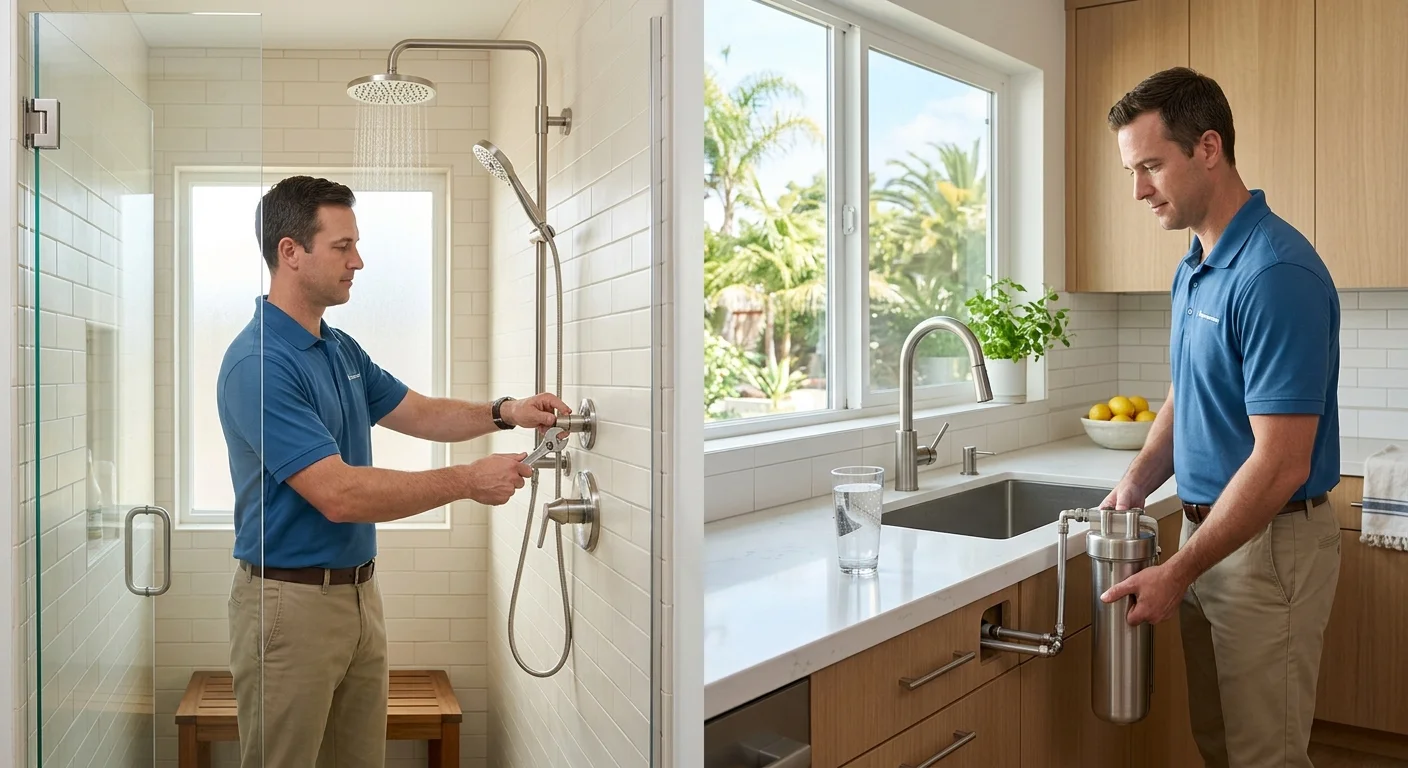
Drinking water and shower water are different exposures
You swallow kitchen tap water in seconds. You stand in shower water for minutes. Those minutes put heat, soap, and dissolved minerals on skin that may already be dry or inflamed.
That split is why does drinking water help eczema is a different question from shower water vs drinking water eczema. Hydration supports the body. It is not a verified stand-in for topical care. It is not a verified stand-in for changing the stall.
City of San Diego Public Utilities says drinking water in the City typically averages about 16 grains per gallon, or 276 ppm. The City also says the figure can range from 16 to 18 grains (272 to 284 ppm) depending on water demand and the area of the City. Confirm the serving utility for your address. That City figure is not a countywide average. It does not describe private wells.
Helix Water District says water with 10 or more grains of hardness is considered hard. Helix also says imported water from the Colorado River and State Water Project averages 14 grains. That is the imported supply the region buys, not a promise about one tap in La Mesa, El Cajon, or Lemon Grove.
USGS classifies hardness, as calcium carbonate, this way: 0–60 mg/L is soft, 61–120 is moderately hard, 121–180 is hard, and over 180 is very hard. The City’s 276 ppm figure sits in that very hard USGS class. Classification is not a rash diagnosis.
A kitchen filter changes the glass. It leaves the shower alone. Searches for filtered water and eczema often collapse those two jobs into one product. Point-of-use devices treat a selected tap. Point-of-entry systems treat water entering the residence. EPA’s home treatment guidance says no single technology removes every contaminant.
If tight, itchy skin shows up after you rinse, that is contact with wash water. Our note on dry skin after showering in San Diego stays on that stall exposure. A missed glass at lunch is a different story.
Coastal north county marine air and inland summer heat do not rewrite the lab report. Otay, Miramar, and Alvarado are different City plants. A condo in Mission Valley and a house on a well near Ramona are not on the same supply. Name the agency. Then test the tap you actually use.
What research can and cannot say
Our approved sources do not include a clinical trial that proves extra drinking water improves eczema. We will not invent one. If a wellness site tells you extra glasses will clear a flare, that is not EPA, NIH, or California Water Boards material we can cite.
The study we can cite is about softeners, and it still does not promise relief. In 2011, PLOS Medicine published an observer-blind randomized trial of 336 children aged 6 months to 16 years with moderate or severe eczema. They lived in English hard-water areas. One group used an ion-exchange softener plus usual care for 12 weeks. The other used usual care alone. There was no between-group difference in the primary eczema severity outcome. There was no between-group difference in topical corticosteroid or calcineurin-inhibitor use. Families knew their assignment, so parent-reported secondary scores could be biased. The trial does not prove prevention. It does not apply to every age, every filter, or every San Diego address.
That work measured household softening, which changes water that hits skin in the bath. It did not test reverse osmosis drinking water. It did not test a pitcher. It did not set an optimum intake in ounces.
Questions such as what drink is good for eczema, or what clears eczema up fast, are medical questions. A water-treatment page cannot answer them with a recipe. The same is true of folk routines, including a so-called 3 minute rule. We could not confirm that rule in EPA, NIH, or California Water Boards sources. If your dermatologist wants short showers and an immediate moisturizer, follow that clinician. Traditional remedies used in other countries sit in that same medical visit. They are outside what a San Diego tap test can answer.
FDA regulates bottled water as a packaged food, including sanitary processing and testing requirements. Some bottled water comes from municipal sources and may receive additional treatment. That fact does not rank bottled water above San Diego tap for eczema. It does not give a contaminant-free guarantee.
For the household-water version of this topic, use does a water softener help eczema. Keep this page on the glass versus the stall.
What a hardness or tap test can confirm
A test answers what is in the pipe. It does not answer what a rash needs.
Start with the current Consumer Confidence Report from the agency that bills you. The San Diego County Water Authority is the regional wholesaler’s public water-quality door. Retailers still publish their own reports. City of San Diego’s 2025 Consumer Confidence Report (Public Water System 3710020) lists total hardness in grains per gallon by plant: Alvarado averaged 13.8 (range 11.9 to 15.8), Miramar 14.1 (11.7 to 16.6), Otay 14.2 (11.7 to 15.8), and purchased treated water 8.5 (3.18 to 13.6). Name the 2025 report when you quote those rows. They are not a well result. They are not every building. They are not the same measurement as the City plumbing page’s typical 16-grain figure.
EPA’s secondary drinking-water guideline for total dissolved solids is 500 mg/L. That number is about taste, staining, and technical effects. It is not a universal safety cutoff. A conductivity or TDS reading is not a calcium-and-magnesium hardness test. USGS notes that specific conductance depends on the type and concentration of ions.
Iron has an EPA secondary guideline of 0.3 mg/L, tied to rusty color, sediment, metallic taste, and reddish or orange staining. That is an aesthetic guideline, not an eczema threshold.
CDC guidance for private wells is annual testing for total coliform, nitrate, TDS, and pH at a state-certified laboratory, with extra tests as local health or environmental staff advise. Harmful or suspected contamination means use another safe source and follow the health department. Boiling does not remove chemical contamination. We do not have a verified count of well homes in the county. Ask what serves your meter.
NSF/ANSI 42 is for certified aesthetic reduction claims. NSF/ANSI 53 is for specified health-effect contaminant claims. NSF/ANSI 44 is for ion-exchange softeners that reduce calcium and magnesium hardness. NSF/ANSI 58 is for reverse osmosis systems. Verify the exact model and the exact certified reduction claim. A certification is not a performance ranking. It does not cover every contaminant.
Our free in-home water test is a starting measurement at the taps you drink from and the taps you wash in. Compare those two. Many ion-exchange softeners leave the kitchen cold line on bypass, so cooking and drinking water never go through the resin. University of Nebraska–Lincoln Extension estimates sodium is added at about 8 mg/L for each grain per gallon of hardness removed. A 10-grain example in that guide yields about 80 mg/L added sodium. People on restricted sodium diets should consult a physician. For this page, the bypass is the practical lesson: the glass and the shower can disagree.
If chlorine or chloramine smell is what you notice, the disinfectant is identified in the utility report. CDC notes that chlorine and chloramine can smell and taste different. Smell is not a medical clearance. It is not proof the shower is causing eczema.
When to talk with a medical professional
Filter Pros San Diego does not treat medical conditions. We test water, answer the phone, and connect you with separately licensed Water Filtration pros. The homeowner contracts with that pro and pays that pro.
Talk with a medical professional when eczema is new, spreading, infected, or not following the plan you already have. Children’s skin needs a clinician, not a product category. Diet, allergy, and drink questions belong in that visit. They do not belong on a hardness strip.
Do not stop a prescribed cream because a blog mentioned hydration. Do not start a supplement because a search ad promised a drink that heals skin. Those claims are not in our verified ledger.
If the stall is the trigger you notice, say that clearly at the dermatology visit. Bring the utility report if you have it. A clinician can speak to bathing time and moisturizer. A licensed water pro can speak to point-of-entry hardware. Those are different jobs.
Choose treatment only after you know the water
Choose hardware only after you know which tap you are trying to change.
EPA’s home treatment guidance says to identify the treatment goal from the serving utility’s report and from appropriate testing. Compare point-of-use and whole-house scope, the exact certified reduction claims, maintenance, and water use.
If the goal is the drinking glass, point-of-use reverse osmosis or under-sink filtration may be the conversation. CDC notes RO may reduce fluoride. NSF/ANSI 58 treats fluoride reduction as an optional exact-model claim. The City of San Diego FAQ describes a fluoride adjustment target of 0.7 ppm. That is a City target, not a countywide tap concentration. Other retailers and blends differ. Check the current report.
If the goal is the shower, you need water that enters the residence, not only the kitchen sink. That is the lane for hard water solutions and for a water for sensitive skin and eczema service visit. Neither service is a medical treatment. EPA’s May 2026 water-softener guide says to size from measured hardness and household water use, and to exclude irrigation demand when that water should not be softened. Oversizing can waste water. Demand-initiated regeneration follows actual use and hardness rather than a timer. Compare the model’s NSF/ANSI 44 certification, rated working capacity, and water and salt efficiency. Salt-free conditioning does not remove hardness ions. Evaluate the exact scale-reduction claim, not a promise of softened water.
City of San Diego lists water-softener installation among qualifying Simple No-Plan Plumbing/Gas Permit work for eligible properties. Scope and historic-property rules affect the route. That is City jurisdiction guidance. It is not a countywide permit rule. It is not evidence of a softener prohibition.
Onsite septic adds another check. EPA advises asking the septic manufacturer or local service provider about overload, warranty, and performance before installing a softener.
The licensed pro you hire should appear on the CSLB license check. The pros we connect you with are licensed and insured. Filter Pros San Diego is a referral brand. We do not pull the permit. We do not own the truck.
When to call us
When you want the glass and the shower measured, not guessed, start with testing. If the numbers support treatment, a licensed Water Filtration pro takes the install contract. Call us at (858) 400-6508 to set up a free in-home water test.