You drop a handful of freezer ice into a lemonade in Clairemont, and the first sip tastes like a swimming pool. The kitchen faucet can taste milder after a long run. The cubes sat in the ice bin and in a thin fridge line, so they hold the disinfectant that was in that water.
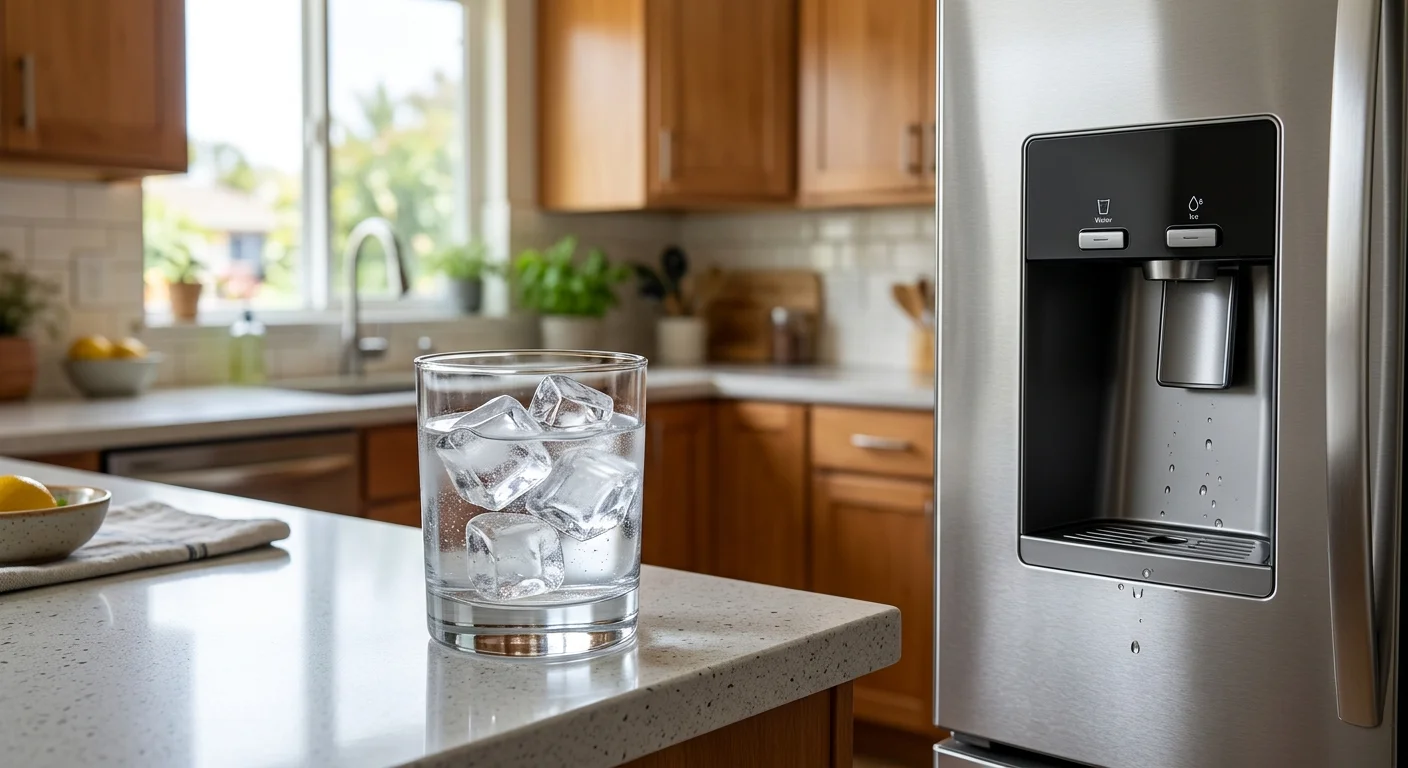
Ice concentrates whatever is in the freezer line
An ice maker fills a small mold from a supply line that sits still between batches. That quiet slug of water is what freezes. A kitchen faucet gets a flush when you fill a pitcher. The ice line keeps a short column of water in plastic tubing behind the fridge. When the mold opens, that column becomes the cube. When the cube melts in a drink, you taste it all at once.
That is the usual reason San Diego ice tastes like tap water while a flushed sink glass tastes milder. You are tasting two servings from the same house. One moved. One sat.
Line length changes the sitting time. In a Pacific Beach apartment the fridge tubing may be a few feet. In a rambling El Cajon or Alpine house the small valve that taps the cold line can sit on a long run through a garage. That extra sitting time makes the ice taste more like the line.
Porous ice also takes on freezer air. Fish, onions, and coffee share airflow with the ice bin on many single-evaporator refrigerators. If the cubes smell like dinner, dump the bin, seal the food, and wipe it with mild soap. Do that before you shop for treatment.
Stale ice tastes like the bin. Cubes that sat through a week of door openings pick up odor even when the tap is fine. Hollow, tiny, or very slow ice points at the appliance: a restricted fill, a failing maker, or a kinked line. Read the model’s ice-maker section for those symptoms.
A new fridge supply line can add its own flavor for a short stretch. Dump the first few batches. Keep the hookup on the cold line. The owner’s manual is the authority for that connection. A chlorine taste that survives a clean bin and a fresh batch is coming from the water in the tube.
Chlorine and chloramine at the tap versus in ice
San Diego County is a map of retail water agencies. A Clairemont or Mira Mesa kitchen on the City of San Diego system reads a different Consumer Confidence Report than a La Mesa, El Cajon, or Lemon Grove kitchen served by Helix Water District. The San Diego County Water Authority wholesales imported Colorado River and State Water Project water to many of those agencies. The blend at your meter still belongs to the retailer, the season, and the plumbing in the house.
Utilities disinfect drinking water with chlorine or with chloramine. The CDC notes that chlorinated water can taste and smell different from water treated with chloramine. The current report is how you tell which disinfectant your supplier used, how much they measured, and which byproducts they listed.
This page does not assign one disinfectant to every San Diego County tap. City of San Diego Public Utilities publishes water-quality information for its own system. Other retailers publish theirs. If ice cubes taste like chlorine, start in the disinfectant section of that report.
Chlorine and chloramine disinfect water in the pipes. A pool-like taste is an aesthetic complaint. The EPA sets federal drinking-water limits under the Safe Drinking Water Act. California’s Division of Drinking Water adds state limits.
Ice makes the same disinfectant easier to notice. You melt a cube that formed from line water, often with only a small fridge cartridge in the way, or with none.
Our guide to chlorine taste in San Diego tap water covers the glass from the faucet. If the faucet, the fridge paddle, and the ice all taste the same, the disinfectant is in the house supply. If only the ice is off, work the bin, the freezer odors, and the fridge filter next.
Why a fridge filter may still leave a taste
A refrigerator cartridge is a point-of-use device on a tiny line. NSF/ANSI 42 covers certified aesthetic reduction claims, including chlorine taste and odor on models that actually carry that claim. NSF/ANSI 53 covers specified health-effect contaminant claims. Verify the exact model’s certified reduction list.
San Diego ice makers keep a chlorine bite when the cartridge is expired, installed in bypass, or certified for a different disinfectant than the report lists. Chloramine is a different chemical from chlorine. A filter that lists chlorine taste reduction may omit chloramine.
Cartridge sizing, bypass plugs, and replacement intervals are in our refrigerator water filter guide for San Diego. Follow the model’s interval, or the indicator, whichever the manual uses. Heavy use and mineral load can clog a small carbon block sooner.
The City of San Diego publishes a typical hardness around 16 grains per gallon, or 276 ppm, with a range of 16 to 18 gr/gal (272 to 284 ppm) depending on area and water demand. That figure is the City system only. Helix Water District describes imported Colorado River and State Water Project supply as averaging about 14 grains, and treats 10 grains or more as hard. Both help explain why a small fridge cartridge can load up.
A clogged fridge filter starves the ice maker. Low ice, slow paddle water, and a disinfectant taste can arrive together.
If the fridge sits downstream of a salt-based softener, ice can pick up a salty or chemical note from sodium added during ion exchange. University of Nebraska-Lincoln Extension estimates about 8 mg/L of sodium added for each grain per gallon of hardness removed. That is an estimate, not a measured San Diego tap result. People on sodium-restricted diets should consult a physician. Some ice-maker manuals prefer an unsoftened cold line for the fridge. Follow the appliance manual. A fridge cartridge treats the dispenser and ice line only.
What a drinking-water test can confirm
Taste is a clue. The EPA’s home-treatment guidance is to identify the goal from the serving utility’s report and from appropriate testing. No single technology removes every contaminant. A TDS reading does not identify chlorine or chloramine. The EPA secondary guideline for dissolved solids is 500 mg/L. It addresses aesthetic and technical concerns, and it is not a disinfectant measurement.
Start with the current Consumer Confidence Report. Then test water that actually feeds the ice maker. A kitchen cold line and a fridge line can differ when the tubing is old, long, or heat-soaked behind a cabinet.
Filter Pros San Diego arranges a free in-home water test and connects you with a licensed water-filtration pro. You contract with that pro directly. The test is a starting point for hardness, taste complaints, and treatment scope. It is not a state-certified laboratory panel, and it does not clear water as medically safe.
Private wells are a separate path. The CDC recommends annual testing for total coliform, nitrate, TDS, and pH through a state-certified lab, plus whatever the local health department adds for the site. Boiling does not remove chemical contamination. Match treatment to the identified problem, then test again before you rely on the result.
Ask the serving utility which disinfectant is in use right now. City of San Diego customers can start at the Public Utilities water-quality pages. Other retailers post their own reports and notices. If the current report does not make the disinfectant clear, say that to the pro.
A licensed plumber or appliance tech handles ice-maker parts, leaky fridge valves, and kinked tubing. A licensed water-filtration pro handles treatment on the drinking line. Confirm a contractor license on the CSLB license lookup.
Treatment choices after you have a result
Once you know whether the ice taste is disinfectant, freezer odor, a spent fridge cartridge, or something else, match the tool to the problem. EPA guidance is to compare point-of-use and point-of-entry scope, the exact certified reduction claims, maintenance, and water use. Point-of-use devices treat a selected tap. Point-of-entry systems treat water entering the residence.
For a chlorine or chloramine taste in ice and drinking water, treat the kitchen drinking line. Chlorine and chloramine removal is the service category for that aesthetic problem. Confirm the model’s NSF/ANSI 42 claim. Confirm whether chloramine is on the label when the report lists chloramine. Some homes feed the ice maker from that treated drinking line, or they make ice from the drinking faucet.
Reverse osmosis drinking water is a point-of-use option under NSF/ANSI 58. It produces treated water and reject water. EPA WaterSense describes labeled units that demonstrate at most 2.3 gallons of reject water per gallon treated under its criteria. That is a label criterion, not field performance for every install. Compare models at EPA WaterSense. The certified claim on the exact unit is the claim that matters.
A whole-house carbon system treats water as it enters the residence, so showers and the fridge line both see it. The pros we send install whole-house equipment with medical-grade stainless steel tanks. Many competing tanks are fiberglass with a plastic liner. Ask about tank material when a pro scopes a house filter.
Salt-free conditioning targets scale. Ion-exchange softeners reduce calcium and magnesium under NSF/ANSI 44. If ice sits on a softened line and tastes salty, talk with the pro about a drinking-water bypass for the fridge.
Treat the water that fills the mold, keep the bin clean, and replace the small fridge filter on the model’s interval. The free in-home test is how we start that sequence.
When to call us
Call when ice and tap water both taste like disinfectant, when a new fridge filter left the cubes unchanged, or when you want a licensed water-filtration pro to scope a drinking-water or chloramine-removal system after a test. Filter Pros San Diego sets up the free in-home water test and connects you with that pro. Call us at (858) 400-6508 to set up a free in-home water test.