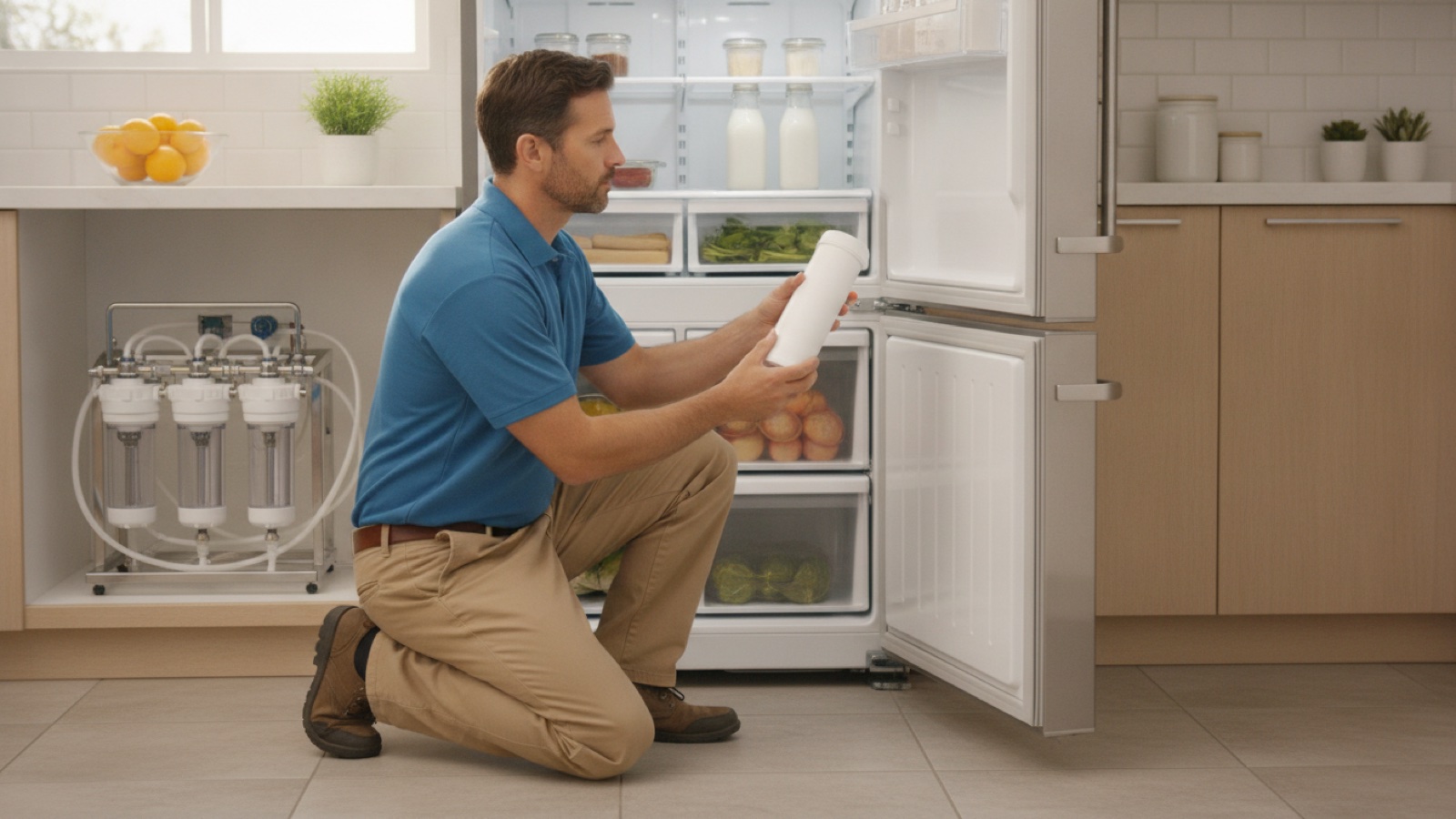
A refrigerator water filter improves taste, but it is not full water treatment for a San Diego home. Nearly all fridge filters are small carbon cartridges certified for chlorine taste and odor. They don’t soften San Diego’s hard water, they don’t lower dissolved solids, and most models aren’t certified to remove PFAS. If your only goal is better-tasting cold water, a fridge filter does that job. If you want the water actually treated, it’s the wrong tool.
What does a refrigerator water filter actually remove?
A refrigerator water filter removes chlorine taste, odor, and some particulates, because it’s a small block of activated carbon. Water passes through the cartridge on its way to the dispenser and ice maker, and the carbon grabs a share of the compounds that make tap water taste like a swimming pool.
What a given cartridge is proven to remove comes down to its NSF/ANSI certification, printed on the box or the manufacturer’s spec sheet. The marketing on the front doesn’t count. The certification table does.
| Certification | What it covers | Common on fridge filters? |
|---|---|---|
| NSF/ANSI 42 | Chlorine taste, odor, particulates (aesthetic only) | Yes, nearly all |
| NSF/ANSI 53 | Health contaminants like lead and cysts | Some OEM models |
| NSF/ANSI 401 | Trace pharmaceuticals and some emerging compounds | A minority |
| NSF/ANSI 53 or P473 with PFOA/PFOS claim | Specific PFAS reduction | Rare, model-specific |
Two practical notes for San Diego homes. First, most local supplies are disinfected with chloramine rather than plain chlorine, and a small cartridge with a couple seconds of contact time only takes the edge off it. Here’s how chlorine and chloramine differ in San Diego water. Second, counterfeit cartridges are a real problem on marketplace sites. A fake filter carries no certification at all, so buy OEM or a cartridge you can verify in NSF’s listing database.
What a fridge filter can’t do in San Diego
A refrigerator filter can’t fix the three things San Diego homeowners most often want fixed: hardness, dissolved solids, and PFAS.
Hardness is the big one. San Diego County water runs hard, which the U.S. Geological Survey classifies as very hard. Carbon doesn’t touch dissolved calcium and magnesium, so your fridge water carries the same minerals as the tap. That’s why ice from a “filtered” dispenser still clouds up and why the dispenser nozzle grows white crust. The full county picture is in is San Diego water hard?, and fixing it is softener or conditioner territory, not a cartridge.
Total dissolved solids stay put too. If you’ve measured your water with a TDS meter, the reading before and after a fridge filter is nearly identical. Only membrane treatment, like reverse osmosis drinking water systems, meaningfully lowers TDS.
PFAS is the one people assume filters handle. Most fridge cartridges carry no PFAS certification, and the few that do are specific models with a printed PFOA/PFOS reduction claim. San Diego utilities monitor PFAS and levels are low, but if removing it is your goal, see PFAS in San Diego drinking water and use equipment certified for the job, like a dedicated PFAS removal system.
What does a refrigerator water filter cost in San Diego?
An OEM refrigerator cartridge costs $40 to $70 and manufacturers say to replace it every six months, so a fridge filter runs $80 to $140 a year. That surprises people, because it’s in the same range as maintaining equipment that treats the water far more thoroughly.
| Option | Upfront cost | Yearly filter cost | What you get |
|---|---|---|---|
| Refrigerator filter | $0 (built in) | $80 to $140 | Better taste at one dispenser |
| Under-sink reverse osmosis | $300 to $900 installed | $60 to $150 | Low-TDS, PFAS-reduced drinking water at the sink |
| Whole-house filtration | Varies by system | Varies | Treated water at every tap |
Run the math over five years. The fridge cartridge habit costs $400 to $700 and never treats more than taste. An under-sink reverse osmosis system often lands within a few hundred dollars of that over the same stretch while actually removing dissolved solids and PFAS, and many households then feed the fridge line from the RO tank, so ice and dispenser water get the good water too.
When is a fridge filter enough, and when do you need more?
A fridge filter is enough when taste at the dispenser is your only complaint. If any of the following sound familiar, the fix lives upstream of the refrigerator:
- White scale on the dispenser, cloudy ice, or spotted glassware means hard water. Start with hard water solutions or a softener.
- You want drinking water with low TDS or verified PFAS reduction. That’s reverse osmosis drinking water at the kitchen sink.
- Chlorine or chloramine taste bothers you at every tap, not just the fridge. That’s whole house water filtration.
- You don’t actually know what’s in your water. Test before buying anything.
At Filter Pros San Diego, every recommendation starts with a free in-home water test, so you find out your actual hardness and TDS numbers before spending money. The network covers all of San Diego County, from Oceanside down to the border, and there’s no pressure to buy equipment your water doesn’t need. Call (858) 400-6508 to schedule one.
Frequently asked questions
Do refrigerator water filters remove PFAS?
Most don’t. Nearly all fridge filters are certified only under NSF/ANSI 42 for chlorine taste and odor, which says nothing about PFAS. A handful of OEM cartridges carry a specific NSF-verified PFOA/PFOS reduction claim, so check the exact model’s certification sheet. For verified removal, a certified reverse osmosis or dedicated PFAS system is the reliable route.
Do fridge filters soften hard water?
No. Softening removes dissolved calcium and magnesium, and carbon cartridges can’t do that. San Diego water arrives hard and leaves your fridge dispenser just as hard. Only ion-exchange softening or template-assisted conditioning changes the mineral picture.
How often should I replace a refrigerator water filter in San Diego?
Every six months is the standard manufacturer interval, and San Diego’s heavy mineral load is a reason not to stretch it. A spent cartridge stops removing chlorine taste and can start slowing flow to the dispenser and ice maker. If the filter light is on or flow has dropped, it’s past due.
Is refrigerator filter water as good as reverse osmosis water?
No. A fridge filter improves taste but leaves dissolved solids nearly unchanged, while reverse osmosis removes most TDS along with lead and PFAS. If you put a TDS meter on both, the difference shows immediately. Many homes feed the fridge from an under-sink RO system to get RO-quality ice and dispenser water.
Do refrigerator filters work against chloramine?
Only partially. San Diego utilities disinfect with chloramine, which is more stable than chlorine and needs more carbon contact time than a small cartridge provides. A fridge filter softens the taste edge, but full removal takes catalytic carbon with real contact time, the approach used in chlorine and chloramine removal systems.