White crust on a Bostonia shower door is an equipment decision. El Cajon hard water treatment starts with the retailer on the water bill. Next comes a hardness reading at your own tap. A separately licensed installer then sizes equipment to that reading. Filter Pros San Diego arranges a free in-home water test and the referral. You contract with that pro, and you pay that pro.
Identify the provider on an El Cajon water bill
El Cajon is a city. It is not one water system by default. Flip the bill and read the utility name printed on it. That retailer is the authority for the meter at that address.
Helix Water District publishes the East County hardness language we can cite. On its water-quality FAQ, Helix says water with 10 or more grains of hardness is considered hard. The same page says imported water from the Colorado River and the State Water Project averages 14 grains of hardness. Treat those sentences as supply guidance. They are not a lab result from your kitchen faucet. They are not a hardness number for every El Cajon lot. If the bill names Helix, start with that FAQ. If it names another retailer, use that retailer’s current water-quality report.
Do not copy the City of San Diego onto an El Cajon tap. The City’s plumbing page says drinking water in San Diego typically averages about 16 gr/gal, or 276 ppm, and can range from 16 to 18 gr/gal depending on demand and the area of the City. That figure is for the City of San Diego’s system only. It does not describe East County retail service. Our explainer on whether San Diego water is hard keeps those City figures attached to City addresses.
Wholesale imported water moves through the San Diego County Water Authority. Retail districts then deliver it to the meter. The Authority’s site is useful for the regional picture. The name on your El Cajon bill still wins for the house.
Wells sit outside that chain. This page cannot say how many El Cajon properties use private wells. Confirm the source for the address. Well water needs tests through a state-certified laboratory. A district consumer confidence report does not describe well chemistry.
Measure hardness at the household tap
The bill tells you who treated the water. A tap test tells you what reached the house. Those are not the same number. Equipment should follow the tap.
The U.S. Geological Survey classifies hardness as calcium carbonate. 0 to 60 mg/L is soft. 61 to 120 is moderately hard. 121 to 180 is hard. Over 180 is very hard. USGS uses about 17.1 mg/L per grain per gallon. That is classification guidance. It is not a drinking-water safety certification. It does not predict heater life or a treatment outcome for your plumbing.
EPA’s home-treatment guide is direct. Identify the goal with the serving utility’s report and with appropriate testing. No single technology removes every contaminant. Do not transplant another city’s data onto your street. Do not treat a City of San Diego plant table as an El Cajon result.
A TDS meter is not a hardness test. Specific conductance can approximate dissolved solids, and USGS notes that the relation varies with the mix of ions. Calcium and magnesium need a hardness test. A conductivity estimate is not a constituent-specific laboratory analysis.
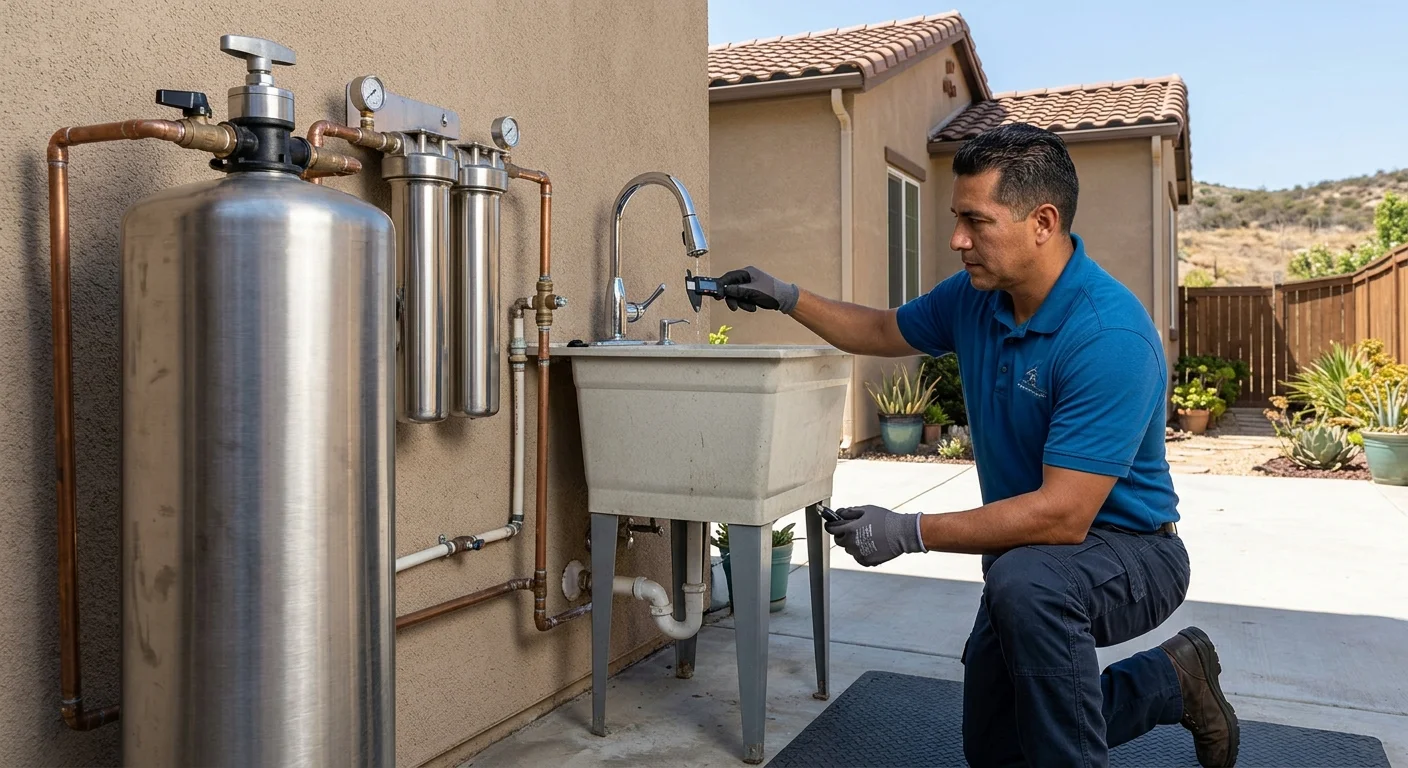
Filter Pros San Diego can arrange a free in-home water test. Ask the visiting pro what the test covers. It is not a full laboratory panel. It is not a contaminant-safety clearance. If you need a certified lab result, use a state-certified laboratory and keep that address on the report.
Size from measured hardness and from household water use. EPA’s water-softener guide says to exclude irrigation demand when that water will not pass through the unit. Oversizing can waste water. Demand-initiated regeneration responds to actual use and hardness, rather than a fixed timer. Compare the exact model’s NSF/ANSI 44 certification, rated working capacity, and water and salt efficiency.
Take the reading at a cold tap. Note whether a softener, conditioner, or under-sink filter is already in line. Test the untreated side if a bypass is present. A bypass routes water around the softener so household water continues while the unit is isolated. Valve styles differ. Follow the model manual. Do not force a stuck handle.
East County heat, older plumbing, and scale
El Cajon sits inland, east of La Mesa, in a valley that loses the coastal marine layer. Summer afternoons run hotter here than they do in Encinitas or Coronado. That heat does not prove the tap is harder than the coast. No verified public ranking puts East County taps above the coast. What the heat changes is how scale shows up on glass, chrome, and heating surfaces.
Spots dry faster on shower doors. Tank heaters and tankless units run longer on hot days. Irrigation clocks run harder in July and August along Main Street, Bostonia, and the hills above Greenfield Drive. Those extra outdoor gallons should stay off a softener. EPA says to size from indoor use and measured hardness, and to leave irrigation out when that water will not be treated.
A lot of El Cajon housing is mid-century tract. Garage utility walls hold older tank heaters. Some houses still have copper. Some still have leftover galvanized. Newer remodels add tankless units on the same hard supply. White crust on a shower door, a clogged aerator, and a rumbling heater are the usual signs. They are clues. They are not a grain count. Measure before anyone sells a tank.
Tankless heaters are sensitive to scale. Navien’s maintenance notes say annual flushing of heat exchangers is part of upkeep, and that hard water may require more frequent service. Navien’s NHW-SE warranty language voids coverage for improper maintenance, including scale buildup and damage from hard-water deposits. Those are Navien terms. Other brands publish their own manuals and warranties. Follow the unit on the wall.
Hard water solutions for an El Cajon house have to respect that mix: Helix’s imported-supply guidance when Helix is the retailer, hotter inland drying, and plumbing that may be decades old. A coastal bungalow with new PEX is a different install even when the wholesale water started in the same river.
Iron staining is a separate complaint. EPA’s secondary guideline for iron is 0.3 mg/L. It is associated with rusty color, sediment, metallic taste, and reddish or orange staining. That guideline is aesthetic. It is not a hardness reading. If the stain is orange rather than white, say so on the test visit so the pro does not size for calcium alone.
Softening versus salt-free versus filtration
Ion-exchange softening removes calcium and magnesium and replaces them with sodium or potassium. NSF/ANSI 44 covers ion-exchange softeners that reduce that hardness. Compare the exact model’s certification, rated working capacity, and efficiency. A standard is not a performance ranking. It does not establish reduction of every contaminant. Water softener installation is the path when the goal is actual hardness removal at the tap.
Sodium is added during sodium-chloride softening. University of Nebraska-Lincoln Extension estimates about 8 mg/L of sodium for each grain per gallon of hardness removed. That guide’s 10 gpg example yields about 80 mg/L of added sodium. People on restricted sodium diets should talk with a physician. Drinking and cooking water is often taken from a kitchen cold line that bypasses the softener. Some units can use potassium chloride instead of sodium chloride, with professional guidance. This is an estimate of added sodium from hardness removed. It is not a measured El Cajon tap result.
Salt-free conditioning does not remove hardness ions. EPA says to evaluate the exact scale-reduction claim, not a promise of softened water. EPA also points to IAPMO/ANSI Z601 when you compare salt-free models. No salt means no brine discharge and no bags to haul. It also means the water is not softened in the ion-exchange sense. Read water softener vs salt-free conditioner before you pick a path. Salt-free water conditioning is the service category when you want that no-salt route.
Filtration is a third job. NSF/ANSI 42 covers certified aesthetic reduction claims. NSF/ANSI 53 covers specified health-effect contaminant claims. NSF/ANSI 58 covers reverse osmosis. Point-of-entry systems treat water entering the residence. Point-of-use devices treat a selected tap. An RO system produces treated water and reject water. Performance and efficiency are model-specific. EPA’s WaterSense RO page describes labeled units that demonstrate at most 2.3 gallons of reject water per gallon treated under its criteria. That is a label criterion, not every system’s field performance.
Ask what tank the installer proposes. Stainless steel vessels are the build we point homeowners toward. Many packaged systems use fiberglass with a plastic liner. The material choice belongs in the written scope.
If the property uses onsite septic, EPA says to check with the septic manufacturer or the local service provider before a softener goes in. Do not assume El Cajon bans softeners. No verified ordinance is on file for this city. Ask the City of El Cajon building counter about the current permit path for the address. The City of San Diego’s simple no-plan plumbing list does not govern El Cajon.
Questions for the separately licensed pro
You are hiring an installer. You are not hiring a brand truck. Check the license on CSLB’s license lookup before anyone opens a bypass.
Ask what hardness they measured at the untreated tap, in grains and in mg/L. Ask which serving utility is on the bill, and whether they read that utility’s current report. Ask whether irrigation will stay on a hard-water line.
Ask whether the unit is NSF/ANSI 44, and what certified claim is on that exact model. If the proposal is salt-free, ask what scale-reduction standard is on the label. Salt-free equipment should not be sold as ion removal.
Ask where the kitchen cold line sits: softened, conditioned, or bypassed. Ask what tank material they will set, stainless or fiberglass. Ask who pulls any City of El Cajon permit if one is required for this property.
Ask what salt type the manual wants, and how they watch for a salt bridge. A hardened crust can leave a gap between salt and water so brine never forms. Ask how isolation works if the unit leaks: bypass first, then the supply shutoff. Do not handle wet electrical parts. Do not open a pressurized tank.
Maintenance and replacement-filter cost belong in the written scope. EPA says to include manufacturer maintenance requirements and replacement-filter costs when you compare ownership cost. Filter Pros San Diego does not set the installer’s price. The quote you sign is the installer’s quote.
When to call us
Call when scale is showing on glass, aerators, or a heater, and you want a hardness reading before anyone sells a tank. Filter Pros San Diego arranges the free in-home water test and refers you to a separately licensed Water Filtration pro. Call us at (858) 400-6508 to set up a free in-home water test.