A La Mesa kitchen tap is where most families decide on a water filtration system. You want better taste at the glass, not a guess pulled from a countywide average. Start with the name on your water bill, then match a point-of-use filter to a real test of that tap.
Identify the provider from a La Mesa water bill
La Mesa sits in East County, inland of downtown San Diego, on the hills around Mount Helix, Grossmont, and Lake Murray. That setting is real geography. It is not a hardness number, and it is not a contaminant list. Your serving water retailer is. Pull last month’s bill and read the agency name before you shop for an under-sink drinking water filter.
Helix Water District is the named retailer for La Mesa, El Cajon, and Lemon Grove in our verified claims file. Still confirm it on paper. Annexed streets, master-metered buildings, and a few edge addresses can list a different retailer. If the bill names Helix, use Helix’s current consumer confidence report for that reporting year. If it names another agency, use that report. Do not borrow City of San Diego plant tables and treat them as a La Mesa tap.
Helix publishes a hardness rule of thumb, not a street-by-street reading. Water at 10 or more grains per gallon is considered hard. Imported water from the Colorado River and the State Water Project averages about 14 grains, according to Helix Water District. That 14-grain figure describes the imported supply the county buys. It does not describe your kitchen faucet, a private well, or a seasonal blend at one address.
The San Diego County Water Authority is the wholesaler behind much of that imported mix. Your retailer treats, blends, and delivers it. Hardness also changes with demand and source mix, so a single East County number would be a guess. We do not publish an unverified La Mesa grains-per-gallon figure for that reason.
If you are on a private well, the bill will not rescue you. Wells are a different water. Use a state-certified laboratory, and ask County environmental staff which extra tests fit the location. The CDC recommends annual well testing for total coliform, nitrate, TDS, and pH. An under-sink cartridge sized for city chlorine taste will not stand in for well treatment.
Write the retailer name on a note and keep it with the report. The licensed pro you hire later should work from that paper, not from a blog post about a neighboring city.
Match drinking-water goals to a tap test
Name the job before you name the hardware. EPA’s home-treatment guidance is plain on this: identify treatment goals from the serving utility’s report and from appropriate testing. No single technology removes every contaminant. A La Mesa drinking water filter that tastes fine can still miss a health-effect claim you care about. A unit sold for “everything” is marketing, not a certified reduction list.
Start with what you actually notice at the kitchen. Chlorine or chloramine can change taste and smell compared with untreated water. CDC notes that difference, and it also notes that the current disinfectant belongs in the utility report, not in a countywide assumption. White scale on a kettle is a hardness clue, not a tap result. A TDS meter is a dissolved-solids clue. EPA’s secondary TDS guideline is 500 mg/L for aesthetic and technical concerns. It is not a drinking-safety cutoff, and it does not prove a contaminant is absent.
NSF labels are how you keep the next step honest. NSF/ANSI 42 covers certified aesthetic reduction claims, such as taste and odor. NSF/ANSI 53 covers specified health-effect contaminant claims. NSF/ANSI 58 covers reverse osmosis systems. A standard is not a performance ranking. It does not establish reduction of every contaminant. Verify the exact model’s certified reduction claim before anyone orders a tank.
Filter Pros San Diego arranges a free in-home water test and a referral. Ask the visiting pro what that test actually measures. Do not treat a screening as a state-certified lab panel, and do not treat it as medical clearance. If you need a specific health-effect analyte, use a state-certified laboratory and keep the chain of custody. Match treatment to the identified problem. Test again after install if the claim matters enough to pay for.
People searching “best for the money” are usually mixing two bills. One is the equipment. The other is replacement cartridges, a drain line, and the time a licensed installer spends in a tight cabinet. EPA’s November 2024 guide to selecting home treatment describes pitcher and tap filters as typically under $100, reverse osmosis and distillation as tending to cost a few hundred dollars and possibly needing professional installation, and point-of-entry systems as costing thousands and generally requiring professional installation. Those are EPA’s broad categories, not a Filter Pros price, not a La Mesa installed quote, and not a Costco SKU. Get the replacement-filter cost in writing before you compare “value.”
Plan cabinet, faucet, and drain space
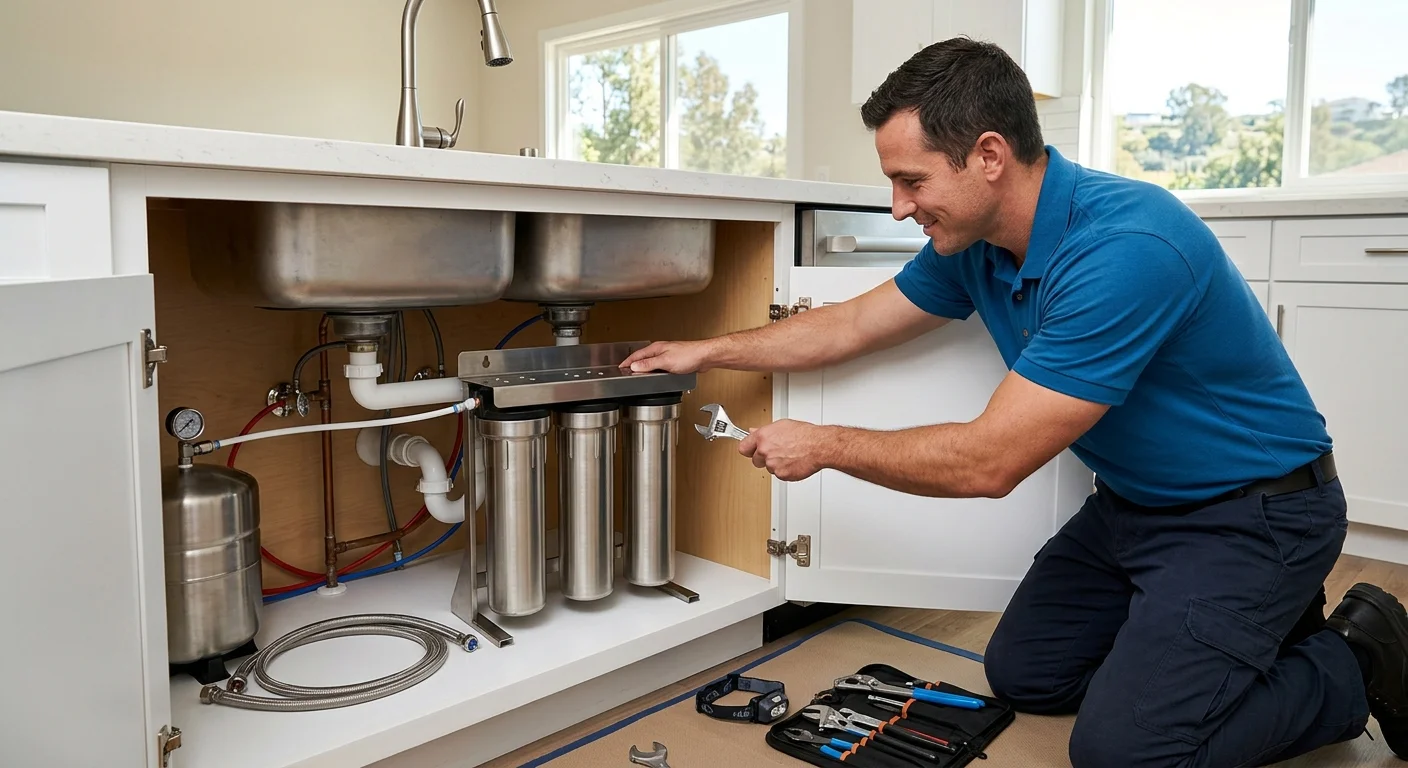
An under-sink unit lives in the kitchen cabinet, not in a marketing photo. Open the doors under the La Mesa sink you actually use. Measure width, depth, and height with the trash can, recycling bin, and cleaning bottles still in place. Older Village and Grossmont kitchens often share that space with a garbage disposal, a dishwasher line, and two angle stops. Hillside cabinets on Mount Helix can be shallower than a ranch layout near Lake Murray. The licensed pro has to see the same clutter you live with.
Filter-only housings are the smaller footprint. Reverse osmosis adds a membrane, a storage tank, a drain connection, and usually a dedicated faucet. That tank is the piece that surprises people. It needs a flat, dry pad and room to service later. Kinked tubing is a common no-water complaint on RO units, so leave a path that does not pinch behind the disposal. Crystal Quest lists clogged pre-filters, low feed pressure, kinked tubing, storage-tank air charge, and auto shut-off faults among typical no-flow causes. Treat those as that manufacturer’s troubleshooting categories. The exact model manual controls pressure specs and which parts a homeowner may touch.
You will also decide how drinking water leaves the cabinet. Some homes add a small faucet through the sink deck. Some tee a fridge line. Drilling a finished stone deck is a judgment call for the installer and for you, not a blog instruction. If you rent, cabinet work and a new hole may violate the lease. A countertop unit is a different product. This page is about a plumbed under-sink water filter in a La Mesa kitchen.
Drain routing matters for RO. The unit produces treated water and reject water. EPA’s WaterSense consumer page states labeled units demonstrate at most 2.3 gallons of reject water per gallon treated under its criteria. That is a label criterion, not every system’s field performance. EPA also gives national examples of five or more reject gallons per treated gallon, and up to ten for some inefficient units. Compare the exact model’s efficiency. Do not promise a household savings figure from a label.
A La Mesa-specific plumbing-permit rule for under-sink filters could not be confirmed in our claims file. The City of San Diego lists some simple no-plan plumbing work, including water-softener installation on eligible City properties. That is City of San Diego guidance. It is not a La Mesa rule and it is not a countywide permit. Ask the separately licensed pro to check with the City of La Mesa building department before anyone cuts pipe. For how a typical San Diego install visit is sequenced, read our water filter installation guide.
Filter-only versus reverse osmosis under the sink
Point-of-use treatment is for the tap you drink from. Point-of-entry treatment is for water entering the house. If the complaint is showers, laundry, and a water heater, an under-sink cartridge will not fix the rest of the plumbing. That comparison belongs on our whole-house vs under-sink water filter page, not restated here. If the complaint is coffee, cooking, and a pitcher you are tired of filling, stay at the sink.
A carbon filter and an RO system are not interchangeable. Carbon is often the right tool for aesthetic chlorine taste when the certified claim matches. RO is a different process, with a membrane, stored product water, and a waste stream. We already unpacked that choice on carbon filter vs reverse osmosis. Use that page for the mechanics. Use this one for the La Mesa decision: what your Helix (or other) report plus a tap test say you need at one faucet.
NSF/ANSI 58 is the RO standard to look up on the exact model. Fluoride reduction, if you want it, is an optional claim on that listing. CDC says RO may reduce fluoride. That is not a blanket removal percentage. Do not buy “99.99% of contaminants.” That phrase is manufacturer marketing, and it is not a verified claim we will repeat.
RO can lower treated-water pH in treatment applications, according to EPA’s technology overview. Household output still depends on the model, the feedwater, and maintenance. If you cook from that tap every day, taste the product water after the first filter set, not after a showroom demo.
Whole-house cost questions show up next to this search. EPA groups point-of-entry systems in the thousands, with professional installation as the usual path. That is still not a quote. If you later add whole-house filtration, ask about medical-grade stainless steel tanks instead of fiberglass with a plastic liner. If scale around the house is the issue and you do not want salt, salt-free PF1025 conditioning means no salt, no added sodium, no bags to haul, and no brine discharge. Salt-free conditioning does not remove hardness ions. EPA says evaluate the exact scale-reduction claim, not a promise of softened water. An under-sink drinking unit does not replace that whole-house job.
For a dedicated drinking line, the service path is reverse osmosis drinking water. Size, tank, and drain details stay with the licensed installer and the model manual.
Questions for the separately licensed pro
Filter Pros San Diego answers the phone, schedules the test, and connects you with a separately licensed water-filtration pro. You contract with that pro. You pay that pro. California makes it a misdemeanor to advertise licensed construction work without holding the license, so we do not pretend the brand pulls the permit or turns the wrench.
Bring the water bill, the current consumer confidence report, and any lab results. Then ask questions that force a specific answer.
Ask which NSF/ANSI standard and which reduction claims the exact model carries. Ask to see the listing, not a brochure summary. Ask what the first-year replacement filters cost, and how often the manufacturer wants them changed. Ask where the drain saddle or air-gap faucet will land, and how you will know the reject line is not leaking into the cabinet. Ask whether the kitchen cold line for drinking will bypass any future softener, which is a common layout when someone is watching sodium. University of Nebraska–Lincoln Extension estimates about 8 mg/L of sodium added per grain per gallon of hardness removed by ion-exchange softening. That is an estimate of added sodium, not a measured La Mesa tap, and it is not medical advice.
Ask the pro to show a CSLB license in their own name. “Licensed” is the word we can stand behind. We do not claim a secret vetting program. Ask who files any permit the City of La Mesa actually requires, because we could not confirm that local rule here. Ask what happens if the unit sits unused during a long trip, and who services a leak at the tank, the faucet, or the drain.
If they pitch a whole-house add-on in the same visit, keep the scopes separate. Drinking water at one sink is one contract. Entry filtration or conditioning is another. Compare EPA WaterSense RO efficiency only on labeled models, under the label’s test conditions. Do not let a sales script turn a national example into your house’s waste ratio.
Write the answers down. A good La Mesa install is boring on paper: named water, named claims, named cabinet, named licensee.
When to call us
Call when you want a La Mesa kitchen tap matched to a real test, not a catalog default, and when a licensed water-filtration pro should plan the faucet, drain, and housing. Filter Pros San Diego sets up the free in-home water test and the referral. The installer you hire does the licensed work. Call us at (858) 400-6508 to set up a free in-home water test.