Scale on a Clairemont shower door and chlorine taste at the kitchen sink are two different jobs. A water softener and a whole-house filter can share the same main line, but they do not treat the same thing. Pairing them is a point-of-entry layout, sized from a real test, not a drinking-water gadget swap.
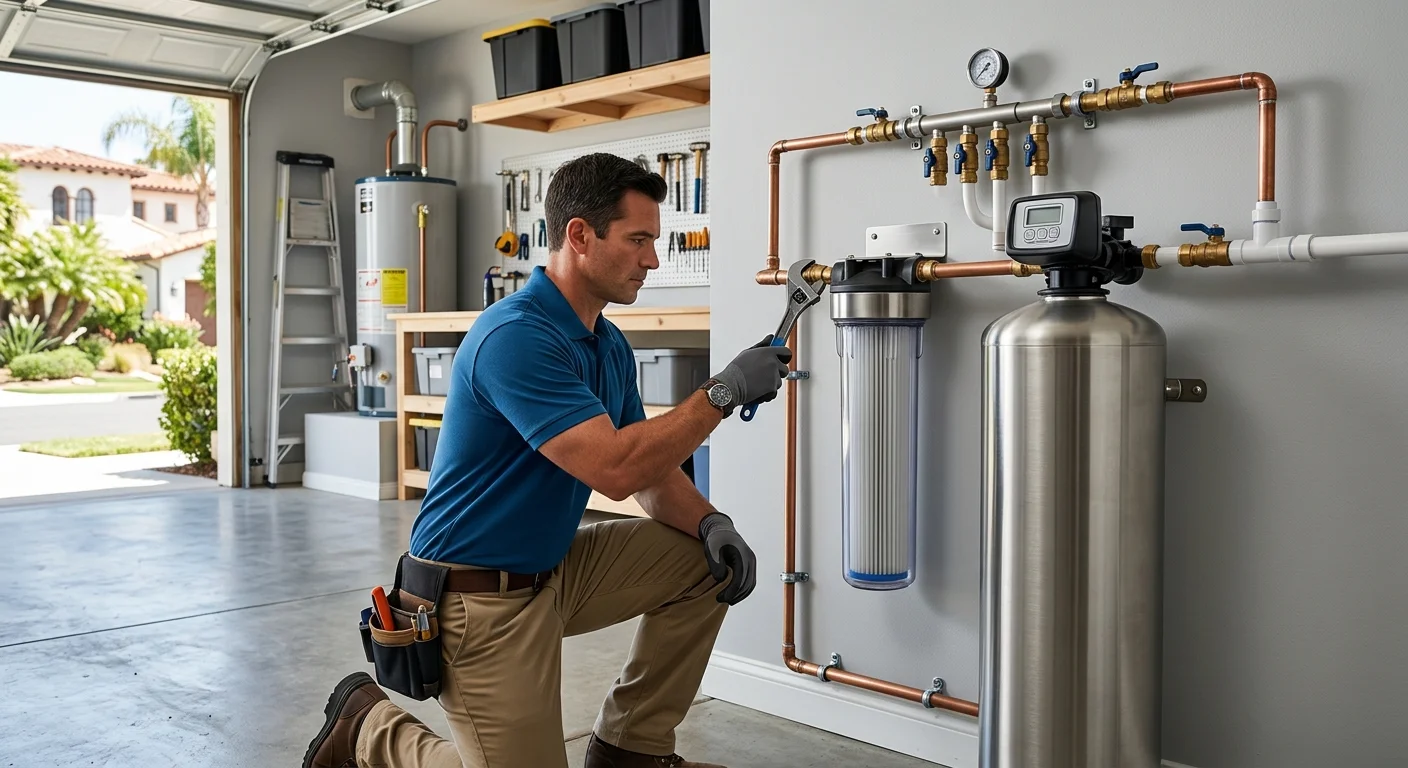
Hardness and tap contaminants are different jobs
City of San Diego Public Utilities says drinking water in the City typically averages about 16 grains per gallon, or 276 ppm. It can run 16 to 18 gr/gal, or 272 to 284 ppm, depending on demand and where you live in the City. That figure is for the City of San Diego system only. It is not a countywide number, and it does not describe a private well.
The City’s 2025 Consumer Confidence Report for Public Water System 3710020 also lists plant-level total hardness in grains per gallon. Alvarado averaged 13.8 (11.9–15.8). Miramar averaged 14.1 (11.7–16.6). Otay averaged 14.2 (11.7–15.8). Purchased treated water averaged 8.5 (3.18–13.6). Those are 2025 plant and purchased-water rows, not a tap result for every address. The older plumbing-page typical of about 16 gpg is a different City publication covering a different measurement.
Helix Water District, which serves East County cities including La Mesa, El Cajon, and Lemon Grove, says water at 10 or more grains per gallon is considered hard. The imported Colorado River and State Water Project supply the county buys averages about 14 grains. That is a statement about the imported supply, not about any given tap. Confirm the serving utility for the house. The San Diego County Water Authority is a starting point for who wholesales water in the county. The retailer’s current report is the document that matches the meter.
USGS classifies hardness as calcium carbonate: 0–60 mg/L is soft, 61–120 is moderately hard, 121–180 is hard, and over 180 is very hard. Its calculator uses about 17.1 mg/L per grain per gallon. White film on glass, crust in a tankless heater, and soap that will not lather are hardness symptoms. They are not a chlorine taste. They are not a lab result for a named contaminant.
An ion-exchange softener certified to NSF/ANSI 44 is built to reduce calcium and magnesium hardness. That standard is not a performance ranking. It does not establish reduction of every other substance in the pipe. A whole-house filter is a different box. NSF/ANSI 42 covers certified aesthetic reduction claims, such as taste and odor. NSF/ANSI 53 covers specified health-effect contaminant claims on the exact model label. A carbon tank does not become a softener. A softener does not become a certified chlorine or metals filter because it shares a bypass. Verify the model’s listed reduction claim before you buy either stage.
EPA’s home-treatment guidance is direct. Identify the treatment goal from the serving utility’s report and appropriate testing. No single technology removes every contaminant. That is why a combined water softener and filter installation exists. You are stacking two jobs, not doubling one.
What a combined point-of-entry setup is for
Point-of-entry treatment sits on the line after the meter and the main shutoff, before the water heater and the rest of the house. Showers, laundry, toilets, and the heater all see treated water. Irrigation and hose bibs are often left on untreated tees. EPA says to size a softener from measured hardness and household use, and to exclude irrigation demand when that is appropriate. Oversizing can waste water. Salt-softened water is also a poor match for plants and lawns.
A common sequence on city water is a sediment or carbon stage first, then the softener. The filter catches grit. When the exact carbon model carries a certified aesthetic claim, it can address chlorine taste and odor as well. That order also keeps debris off the resin. Putting the softener first leaves the resin taking the dirt load. Manufacturer manuals control the actual order. A licensed pro reads both manuals, then cuts the line once.
On a private well the chain can be longer. Iron, sediment, and pH work belong upstream of a softener when a test shows they are present. The EPA secondary guideline for iron is 0.3 mg/L and is tied to staining and metallic taste, not a universal health cutoff. Iron also shortens resin life. An acid neutralizer can add hardness as it raises pH, so the softener belongs after that stage if both are used. None of that is a diagnosis for a specific Ramona, Valley Center, or Alpine well. CDC well guidance is to use a state-certified laboratory and ask local health authorities which extra tests fit the location. The annual tests it names are total coliform, nitrate, TDS, and pH.
Salt-free conditioning is a third path, not a silent swap for NSF/ANSI 44 softening. EPA is clear: salt-free units do not remove hardness ions. Evaluate the exact scale-reduction claim, including IAPMO/ANSI Z601 where it applies, not a promise of softened water. No salt bags, no brine discharge, and no sodium added by ion exchange. University of Nebraska–Lincoln Extension notes that ion-exchange softening adds about 8 mg/L of sodium for each grain per gallon of hardness removed. People on sodium-restricted diets should talk to a physician. Kitchen cold water is often taken from a line that bypasses the softener.
Tank construction is a separate choice from treatment chemistry. The pros we send can walk stainless tanks versus fiberglass tanks with a plastic liner. We do not invent a lifespan for either. Demand-initiated regeneration, which responds to use and hardness rather than a fixed timer, is the EPA-described approach for a salt-based unit. Compare the exact model’s NSF/ANSI 44 certification, rated working capacity, and water and salt efficiency. Those ratings live on the model paperwork, not in a blog post.
EPA’s November 2024 home-treatment guide groups point-of-entry systems as costing thousands and generally requiring professional installation. That is an attributed national category, not a Filter Pros quote and not a San Diego installed price. The licensed pro writes the actual number after seeing pipe, drain, power, and access. Water softener installation and whole-house water filtration are the two service paths that make up this plant. You contract with the pro directly.
Space, drain, and bypass needs in a garage
Most San Diego houses sit on slab. The garage wall by the water heater is the usual plant room. A Mira Mesa tract home, a Chula Vista two-story, and an Encinitas coastal lot often share that layout even when the water chemistry does not. Two treatment tanks plus a brine tank need a level floor, a nearby drain, a grounded outlet for the control valve, and room to reach valves from more than one side. Coastal marine air and inland summer heat both hit garage equipment. Shade, a slab that stays dry, and service clearance matter more than a pretty corner.
A bypass is not optional convenience. Culligan describes it as routing water around the softener so the house still has water while the unit is isolated. Valve types differ: a lever, knobs, a three-valve assembly, or an app. Do not force a stuck handle. Confirm bypass by running a cold tap. Follow the exact model manual. A combined plant should let you isolate the softener, the filter, or both, so a carbon change does not take the showers offline.
The drain line carries regeneration discharge. Persistent flow to the drain can mean a malfunction. Keep electrical connections dry. If you see standing water at the base, isolate with the bypass or the supply shutoff and call the installer. Water at the floor may have come from higher on the valve, the brine tank, the overflow, or another appliance.
City of San Diego Development Services lists water-softener installation among qualifying Simple No-Plan Plumbing/Gas Permit work for eligible properties. Scope and historic-property rules change the route. That is City guidance, not a countywide rule, and it is not a prohibition. A paired filter and softener can change the scope. The licensed pro confirms the jurisdiction, City or county, Encinitas or El Cajon, before cutting pipe. You can verify a contractor license on the CSLB license check.
Do not skip outdoor hose bibs by accident. A garage cut-in that treats the lawn wastes salt and can stress plants. A clean tee for untreated irrigation is part of the layout, not an afterthought. If the property uses a septic system, EPA advises checking with the septic manufacturer or local service provider about overload, warranty, and performance before a softener goes in. That is a conversation, not a local ban. We have not confirmed a San Diego city ordinance that restricts softeners.
How this differs from under-sink reverse osmosis
A whole-house pair treats the incoming line. Reverse osmosis is usually a point-of-use device at one tap. NSF/ANSI 58 covers RO systems. An RO unit produces treated water and reject water. Performance and efficiency are model-specific. EPA’s WaterSense label criterion is at most 2.3 gallons of reject water per gallon treated under its test conditions. That is a label criterion, not field performance for every unit. EPA also gives national examples of five or more reject gallons per treated gallon, and up to ten for some inefficient units. Those are national examples, not a measurement for any installed model.
If the search is drinking water at the kitchen sink, read the comparison of a water softener vs reverse osmosis in San Diego and the split between reverse osmosis and whole-house filtration. Those posts cover the drinking-water choice. This page is the paired point-of-entry plant: a softener plus a whole-house filter on the main.
You can have both. Many houses run a garage softener and carbon tank, then a small RO at the kitchen. The garage pair handles hardness and whole-house taste. The RO is a separate, certified claim at one faucet. Do not expect the garage carbon tank to match an NSF/ANSI 58 drinking-water claim. Do not expect the softener to lower every dissolved solid the way RO can. A TDS reading is not a hardness test, and it is not proof that a contaminant is gone. EPA’s secondary TDS guideline is 500 mg/L and addresses aesthetic and technical concerns. It is not a universal drinking-safety cutoff.
RO can lower treated-water pH in treatment applications. Exact home output depends on the system, feedwater, and maintenance. CDC notes RO may reduce fluoride. NSF/ANSI 58 treats fluoride reduction as an optional exact-model claim. The City of San Diego’s November 2024 water-quality FAQ describes a fluoride adjustment target of 0.7 ppm. That is a City target, not a countywide tap reading.
A pitcher or under-sink carbon filter is also point-of-use. EPA describes basic pitchers and tap filters as typically under $100, and RO or distillation as tending to cost a few hundred dollars and possibly needing professional installation. Those are national categories from the same 2024 guide, not a store shelf in Kearny Mesa and not a Filter Pros price.
Test before you buy two systems
Buy the test, then the tanks. A hardware-store hardness strip is a start. It is not a substitute for the serving utility’s current report, and it is not a well panel.
For City of San Diego addresses, start with Public Utilities’ water-quality pages and the current Consumer Confidence Report. Other retailers publish their own numbers. Helix, Otay, Padre Dam, and private wells are not the City plant table. Do not transplant City plant data to a Fallbrook well or a Lakeside meter on another district.
Filter Pros San Diego arranges a free in-home water test and then refers you to a separately licensed water filtration pro. You contract with that pro, and you pay that pro. The brand does not hold the trade license and does not cut the main. The pro sizes the softener from measured hardness and household use, following EPA’s guidance against oversizing. The pro also matches any filter stage to a documented concern and an exact certified reduction claim.
If you already own one tank, test before you add the second. A working softener with a chlorine taste still needs a filter with the right NSF claim. A carbon tank with scale on the glass still needs hardness treatment, or a documented salt-free scale-reduction claim, not a bigger cartridge.
DIY videos treat a Saturday cut-in as the whole job. A combined plant is shutoff, drain, electrical, bypass, irrigation tees, heater protection, and, in the City, a permit path. Follow the model manuals if you do your own work. For a main-line install, a licensed plumber or water-treatment contractor is the usual route. Check the license. There is no Filter Pros price, grain rating, or flow figure on this page, because those numbers are not a verified brand quote. The written scope from the pro is the number that matters.
When to call us
A paired garage install is licensed plumbing on the home’s main, plus equipment that has to match a real water test. Call us at (858) 400-6508 to set up a free in-home water test. We connect you with a licensed pro who sizes and installs the equipment.