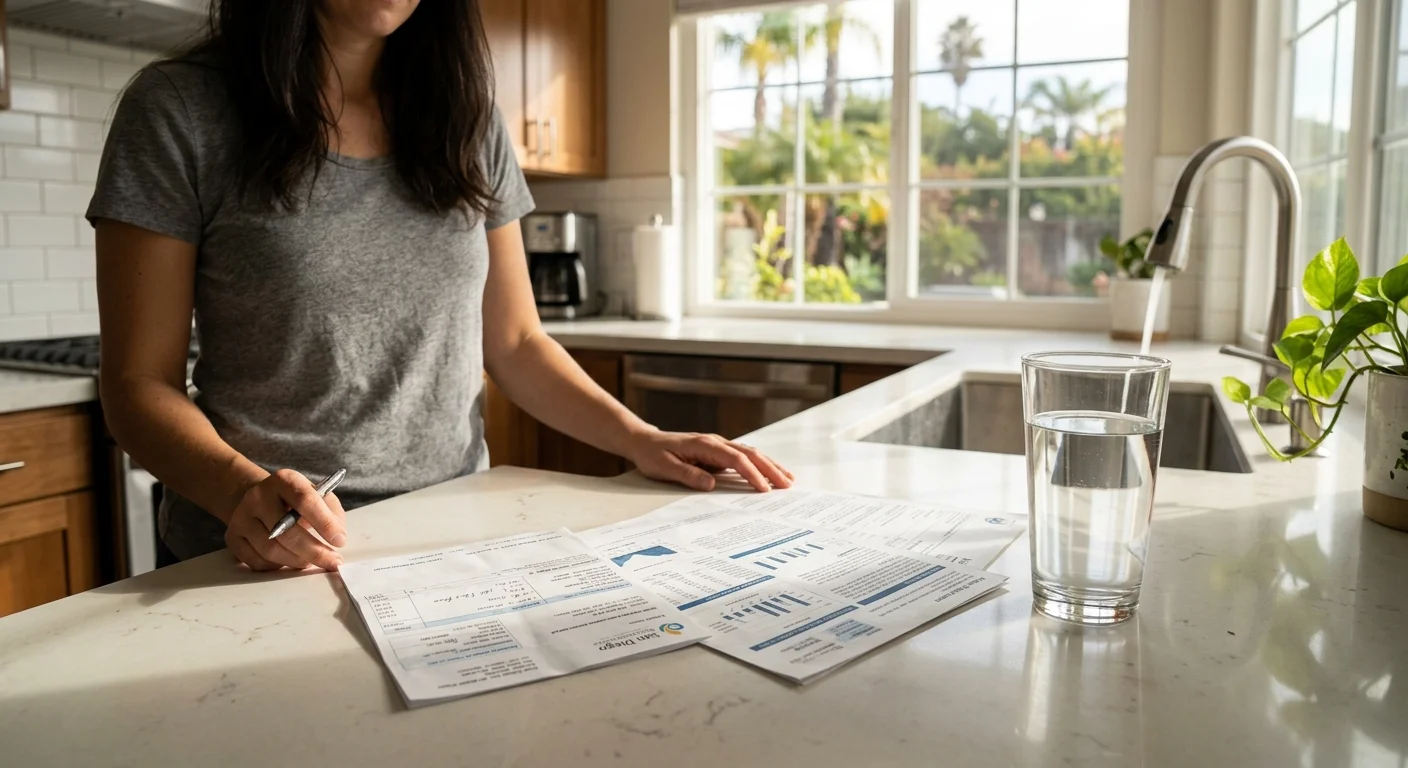
The PDF that arrives with a City of San Diego or Helix bill is a Consumer Confidence Report, not a lab sample from your kitchen faucet. Search results for a San Diego water quality report mix drinking-water tables with Mission Bay bacteria maps and beach models. Open the current report from the utility named on the bill, then decide whether that tap still needs its own test.
Find the current report from the utility on your bill
Look at the retailer name on the bill first. That name tells you which Consumer Confidence Report belongs to the address.
City of San Diego Public Utilities is Public Water System 3710020. If the bill says Helix Water District, you need Helix’s report, not the City’s. Other retailers in the county publish their own reports. Don’t copy a Mira Mesa plant table onto an El Cajon kitchen. The EPA sets federal drinking-water limits under the Safe Drinking Water Act. California’s Division of Drinking Water adds state limits. The retailer CCR shows how that public system compared in the reporting year.
The City posts drinking-water quality materials on its public-utilities water-quality page. The San Diego County Water Authority describes treated regional supply, including Colorado River and State Water Project water. Retailers blend imported water with local sources. The Authority page is useful background. It isn’t the CCR for your meter.
If you rent, ask which utility is on the account. A Pacific Beach condo and a Chula Vista house can sit on different systems. Short-term rentals inherit the building’s retailer. If the property is on a private well, there is no Consumer Confidence Report. Wells aren’t public water systems. A well needs a state-certified laboratory and local health-department guidance, not a citywide table.
Recreational water is the other mix-up. Bay and beach reports answer a different search. Mission Bay bacteria and Coronado shoreline samples aren’t treated drinking water. Live outages and boil notices also sit outside the annual CCR. Those come from the retailer on the bill.
Use the latest year the utility lists. Older files linger in search. The City of San Diego 2025 Consumer Confidence Report is the City document for that reporting year. If a number isn’t in the current report for your retailer, treat it as unconfirmed. Call the utility printed on the bill, or wait for the next posted CCR.
What a consumer confidence report covers
A consumer confidence report San Diego customers receive is the annual public-water-system report. It covers treated water leaving plants and purchased treated water, not every faucet in the city. Learning how to read a CCR water report means reading a table, not a letter grade.
Typical columns include the contaminant name, the Maximum Contaminant Level (MCL), a public-health goal such as a PHG, the detection range, and an average. ND means not detected at that test’s detection limit. An MCL is the legal limit. A PHG isn’t the legal limit. Meeting an MCL isn’t the same as matching a PHG.
The City of San Diego 2025 report is a useful example, and only for that system and year. Hexavalent chromium has a California MCL of 10 ppb (0.010 mg/L) and a PHG of 0.02 ppb. In that 2025 City report, Alvarado, Miramar, and Otay plants were ND. Purchased treated water averaged 0.1 ppb, with a range of ND to 0.4 ppb, still below the 10 ppb MCL. The report notes hexavalent chromium can form from naturally occurring trivalent chromium. Those rows aren’t a result for your kitchen. They’re plant and purchased-water rows for 2025.
Hardness and sodium often sit in the same document with a different meaning. The 2025 City CCR states they have no MCLs. Sodium is generally naturally occurring. Plant hardness in that report, in grains per gallon: Alvarado averaged 13.8 (11.9 to 15.8), Miramar 14.1 (11.7 to 16.6), Otay 14.2 (11.7 to 15.8). Purchased treated water averaged 8.5 (3.18 to 13.6). A separate City plumbing page says typical City drinking water averages about 16 gr/gal (276 ppm) and can range from 16 to 18 gr/gal (272 to 284 ppm) depending on demand and the area of the City. Those are different City publications covering different measurements. Neither is a countywide figure. Neither describes a private well.
Helix Water District, which serves East County cities such as La Mesa, El Cajon, and Lemon Grove, publishes a different statement: water at 10 or more grains per gallon is considered hard, and imported Colorado River and State Water Project supply averages about 14 grains. That’s a statement about imported supply, not about any given tap.
Disinfectant taste belongs in the CCR too. The report should identify whether the system uses chlorine, chloramine, or a seasonal switch, plus byproduct results. That’s how you start on chlorine and chloramine removal without guessing the chemistry. For a broader read of tap water versus the report, see is San Diego tap water safe.
The EPA’s home-treatment guidance is plain: identify treatment goals using the serving utility’s report and appropriate testing. No single technology removes every contaminant. Don’t transplant City plant data to Helix territory, a well, or a building with its own plumbing.
What a citywide report cannot say about your plumbing
The CCR stops at the distribution system the utility samples. Your service line, the building’s pipes, the water heater, a softener, a fridge filter, and a faucet aerator sit after that.
Stagnant water in a vacant rental can taste flat or metallic even when the 2025 plant table looks quiet. Older solder, fixtures, and premise plumbing can add metals the plant never reported at that tap. A water heater can add odor that isn’t in the CCR. A clogged aerator can throw rust-colored flecks that look like a system problem.
The EPA secondary guideline for iron is 0.3 mg/L. That number is about rusty color, sediment, metallic taste, and reddish or orange staining. It isn’t a health MCL, and it isn’t a reading from your kitchen. The federal secondary TDS guideline is 500 mg/L. It addresses aesthetic and technical concerns. A TDS number isn’t proof that contaminants are absent, and it isn’t a substitute for the CCR or a certified lab.
Lead is a plumbing question as much as a plant question. This page doesn’t carry a verified 90th-percentile lead figure for every San Diego retailer. Use the current CCR and any service-line materials your utility publishes for the address. If those documents don’t state a figure, treat it as unconfirmed.
Fluoride is another easy over-read. A City FAQ posted November 2024 describes adjustment to 0.7 ppm. That’s a City target, not a countywide tap concentration and not a legal-limit statement. Other retailers and blends differ. Read the serving provider’s current report.
A CCR also won’t tell you if the dishwasher spots are hardness, if the shower door film is scale, or if the pool smell is chloramine at your house. Those are tap and plumbing observations. They belong in the next step, not in a rewrite of the plant table.
Which U.S. state has the cleanest water isn’t a question a San Diego CCR answers, and this page doesn’t rank states. The useful comparison is your retailer’s current table against EPA and California limits, then your faucet against that table.
Match a concern to a tap-specific test
Match the complaint to a test that can actually see it.
If the CCR shows hardness in the teens of grains at City plants, white scale on fixtures is consistent with that chemistry. USGS classifies hardness over 180 mg/L as very hard. The City plumbing-page typical of about 276 ppm sits in that very-hard band. A free in-home water test can screen hardness at the tap. It isn’t a state-certified laboratory panel, and it isn’t a safety clearance. What an in-home water test can tell you is the scope of that visit.
If the report lists chlorine or chloramine, and the cold tap smells like a pool, that’s a disinfectant question. Carbon treatment is a common next conversation with a licensed pro. Confirm the disinfectant in the current CCR first. Don’t assume every San Diego retailer uses the same residual.
If you need a contaminant the in-home screening doesn’t measure, use a state-certified laboratory. CDC well guidance is a reminder even for people on city water who want lab confirmation: ask which tests fit the location, and don’t treat a DIY kit as a medical or regulatory result. A positive total-coliform result is an indicator, not a full pathogen ID. Boiling doesn’t remove chemical contamination.
Keep the three documents separate. The utility CCR is system-level and covers a prior reporting year. The free in-home screening Filter Pros San Diego arranges is tap-level and isn’t a lab certificate. A state-certified lab report is for analytes the screening can’t cover.
Don’t use a TDS pen as a contaminant test. Specific conductance can approximate dissolved solids, and the relation varies with water composition. It isn’t a substitute for the CCR row you actually care about.
If the worry is Mission Bay, Imperial Beach, or a current outage, stop. Bay recreation data isn’t a tap test. Outages and boil notices come from the retailer, not from last year’s CCR.
When to bring results to a separately licensed pro
Bring the current CCR, any lab pages, and what you notice at the tap. A licensed water-filtration pro matches treatment to a named concern. The EPA is direct: no single technology removes every contaminant. NSF/ANSI 42 covers certified aesthetic reduction claims. NSF/ANSI 53 covers specified health-effect claims. NSF/ANSI 44 covers ion-exchange softeners that reduce calcium and magnesium hardness. NSF/ANSI 58 covers reverse osmosis. A standard isn’t a ranking. Verify the exact model’s certified reduction claim.
Point-of-entry systems treat water entering the residence. Point-of-use devices treat a selected tap. Compare maintenance and replacement-filter costs when you compare ownership. Filter Pros San Diego is a referral brand. It arranges the free in-home test and connects you with separately licensed pros. You contract with that pro directly. Confirm a contractor license on the CSLB license check. The brand doesn’t hold the trade license and doesn’t perform the install. When a whole-house system is on the table, ask the licensed pro about stainless tanks versus fiberglass tanks with a plastic liner.
If hardness is the issue, a salt-based softener and a salt-free conditioner are different tools. Salt-free conditioning doesn’t remove hardness ions. Evaluate the exact scale-reduction claim. If disinfectant taste is the issue, carbon treatment is the usual drinking-water conversation, still tied to the residual named in the CCR.
Skip any pitch that promises to remove 99.99% of contaminants or that quotes a hardness number for a city the agency never published. Those claims aren’t on this site for a reason.
When to call us
If the CCR is clear and the tap still stains, smells, or scales, it’s time for a tap-level screening and a licensed Water Filtration pro, not another year-old PDF. Call us at (858) 400-6508 to set up a free in-home water test.