A home water test shows a limited snapshot of the water sampled. It can guide your next questions, but it can’t identify every possible concern. It also can’t prove that drinking water is safe.
That distinction matters when you’re choosing treatment for a San Diego home. The useful result isn’t the biggest number on a screen. It’s a clearer understanding of what needs verification.
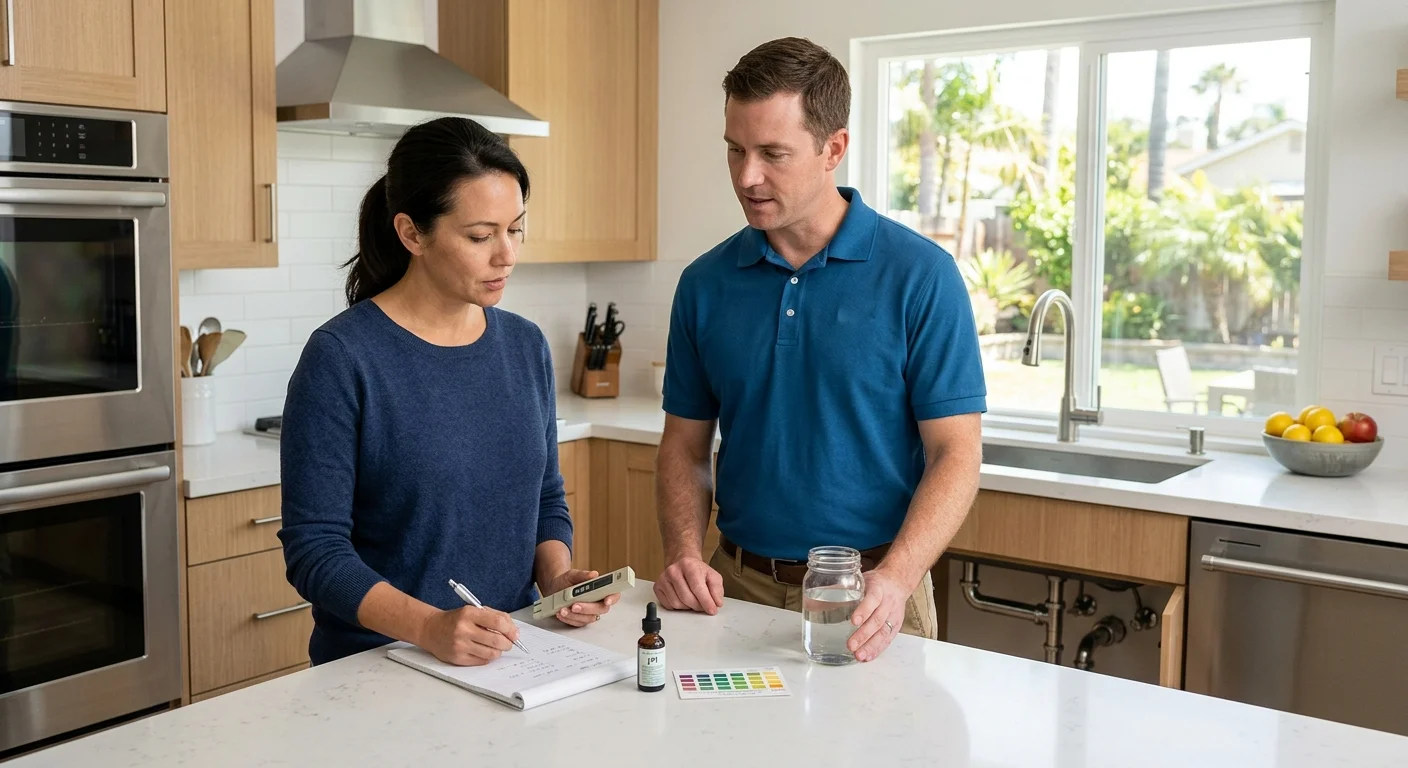
What a basic in-home test may screen
A basic in-home screening checks the water available at one sampling point. It may measure the characteristics included in that specific test. The result reflects that faucet, that sample, and that moment.
That makes the test useful for setting direction. It can help connect a homeowner’s concern with the next sensible step. It may also show whether a result deserves confirmation through another sample or laboratory analysis.
Before testing, write down what prompted the concern. Note the affected faucet and whether the issue appears elsewhere. Visible residue, an unfamiliar taste, or a change at one fixture provides context. Those observations aren’t laboratory findings, but they help frame the screening.
Ask the person conducting the test to explain four things:
- What the screening is designed to check.
- Where the sample was collected.
- How the displayed result should be read.
- What the screening can’t determine.
Don’t assume every test covers the same questions. A strip, meter, or other field tool only speaks to its stated purpose. A result outside the expected range also doesn’t identify its cause by itself.
If mineral buildup is the main concern, start with our guide to testing water hardness at home. If a meter displays dissolved-solids information, read what TDS means in San Diego water before drawing conclusions.
Filter Pros San Diego arranges a free in-home water test. The screening helps define the concern before treatment options enter the conversation.
What it can’t replace from a certified lab
An in-home screening isn’t a laboratory analysis. It shouldn’t be presented as a diagnosis, a health assessment, or proof that water is safe.
A laboratory test is the better path when the question involves a specific contaminant or exposure concern. The requested analysis must match the concern. A general screening result can’t substitute for a report addressing that exact question.
This difference is especially important when a homeowner is responding to a notice, an unusual event, or medical advice. Bring the notice or written concern to the conversation. Don’t rely on memory or ask a basic screening to answer a different question.
The laboratory should explain what it accepts, how to collect the sample, and how results are reported. Follow those instructions exactly. Filter Pros shouldn’t guess at a laboratory’s process, detection limits, or qualifications.
A result also needs context. Check the sample location, collection date, reporting unit, and the reference used for comparison. If any part is unclear, ask the laboratory or the agency responsible for the reference. Don’t convert units or interpret an unfamiliar result by assumption.
For a concern involving lead, read our guide to lead in San Diego drinking water. It explains the local question without treating an unrelated home screening as a substitute for targeted analysis.
The practical rule is simple. Use a home screening to organize the next step. Use appropriate laboratory analysis when the answer depends on a specific substance or safety determination.
How plumbing can change water at the tap
A public water report describes water within a supplier’s reporting system. It doesn’t describe every faucet, fixture, or section of plumbing inside a particular home.
That gap matters when results differ around the property. A sample from the kitchen may not match one from another tap. The difference doesn’t identify a cause, but it tells you where further investigation should focus.
Start with a simple sampling map. Record the faucet, date, and condition being checked. Compare the affected location with another cold-water tap. Keep the collection approach consistent. If the difference repeats, share those notes with the laboratory or licensed pro.
Don’t use a single changing result to diagnose the plumbing. Sampling conditions, the test itself, and the chosen location all need review. A repeatable pattern is more useful than a one-time reading with no notes.
San Diego County also has distinct service areas. Coastal North County, inland North County, central San Diego, East County, and the South Bay shouldn’t be treated as one water system. The approved local record confirms that hardness and source mix can vary by service area and season.
That means a report found for another part of the county may not describe your address. A Chula Vista homeowner shouldn’t assume an Oceanside report applies, or the reverse. Begin with the provider named on the current water bill.
The home screening and the public report answer different questions. One describes a sample at the property. The other provides the supplier’s published system information. Review both before blaming the source water or the home’s plumbing.
How to use the results before choosing treatment
A test result should lead to a treatment objective, not an immediate equipment choice. First, define the problem in plain language. Then decide whether the screening actually addressed it.
Use this sequence before comparing systems:
- Confirm the sample location and test purpose.
- Check whether the result repeats under similar conditions.
- Compare the concern with the current supplier report.
- Request laboratory analysis when the question requires it.
- Ask a licensed pro to explain the proposed treatment goal.
Keep the proposal tied to the documented concern. Ask what part of the water supply would be treated, what result the equipment targets, and how that result would be checked later. Don’t accept a broad promise that one system solves every water question.
The distinction between hardness and dissolved-solids readings is a common point of confusion. Those terms shouldn’t be swapped without evidence. Review the linked guides, then ask which measurement supports the recommendation.
Filter Pros San Diego connects homeowners with separately licensed Water Filtration pros. The homeowner contracts with and pays the selected pro directly. Before signing an installation agreement, verify the contractor through the California Contractors State License Board.
Request the treatment recommendation in writing. It should identify the concern being addressed and the proposed location of treatment. If the recommendation depends on a specific contaminant claim, ask for the supporting laboratory result and applicable authority.
A careful decision may end with more testing. That’s still useful. It prevents a screening tool from being stretched beyond what it can show.
Where to verify local water reports
Start with the water provider shown on your bill. Find its current Consumer Confidence Report and confirm the report year. San Diego’s Consumer Confidence Report is the authority for its reported local hardness and source mix.
Don’t copy a hardness figure from an old article or another service area. The verified record says hardness varies by service area and season. No single countywide number accurately represents every San Diego County home.
The San Diego County Water Authority provides regional water information. Use it as a starting point, then locate the report that applies to your address. If you can’t identify the correct report, ask the provider named on the bill.
Federal drinking water contaminant limits are set by the EPA under the Safe Drinking Water Act. California adds its own limits through the Division of Drinking Water. Those authorities, together with the applicable local report, are the right places to verify a regulatory claim.
Read the report’s date and service-area description before comparing it with a home result. Source information from a previous year may not describe the current mix. A countywide summary may also hide local differences.
Save a copy of the report used during your review. Keep it with the home screening notes and any laboratory results. That gives a licensed pro a clearer record than a screenshot without a source or date.
If a figure, rule, or limit can’t be confirmed in those records, say so. Ask the water provider, laboratory, or relevant agency before making a treatment decision. An unverified number shouldn’t become the basis for buying equipment.
When to call us
Call when a screening result needs context or you’re unsure what testing comes next. Filter Pros San Diego can arrange the test and connect you with a separately licensed Water Filtration pro when treatment needs professional installation.
Call us at (858) 400-6508 to set up a free in-home water test.