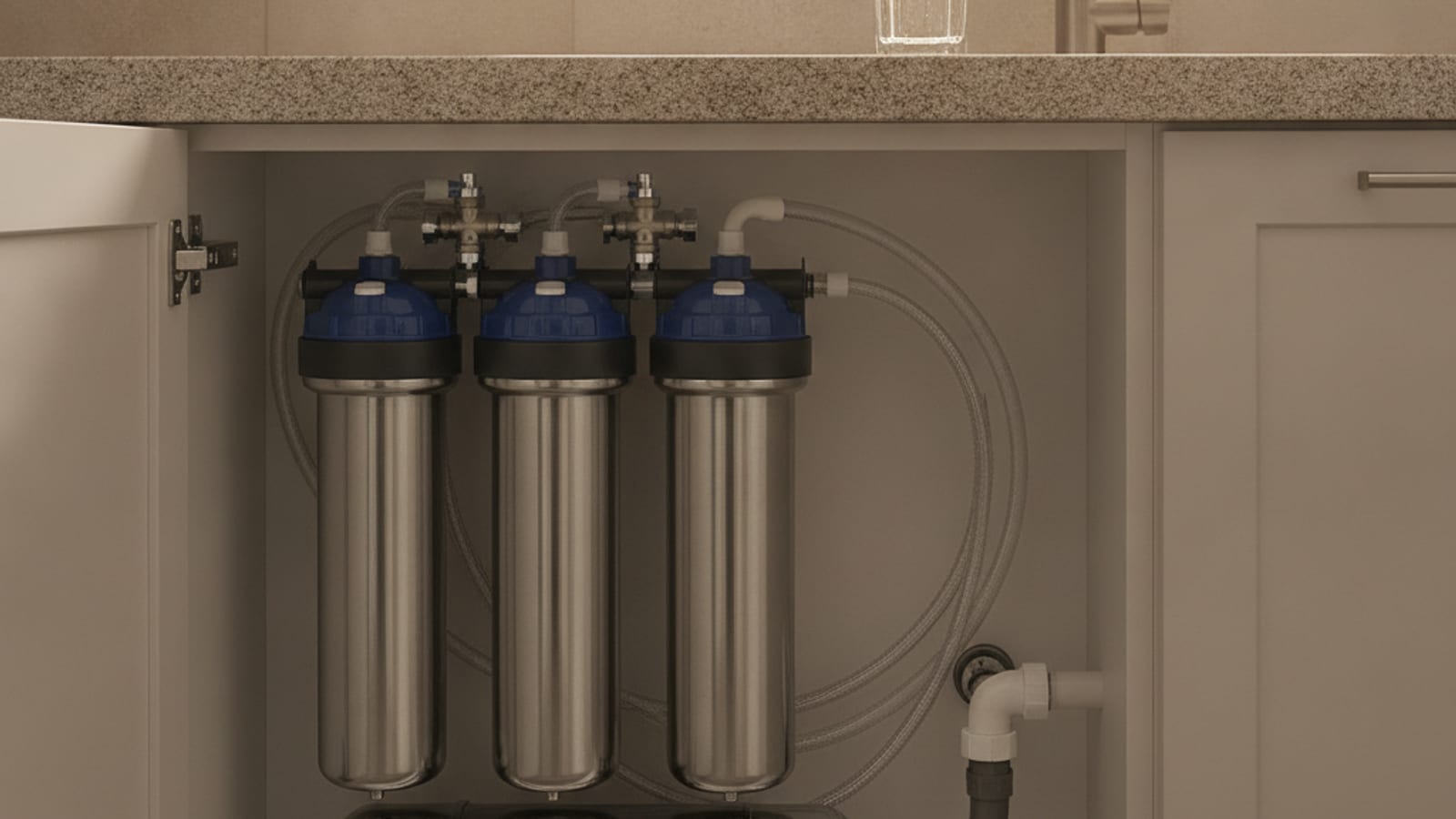
A quality under-sink reverse osmosis system in San Diego typically runs $300 to $900 installed in 2026, depending on the number of stages, the membrane rating, and your plumbing setup. Whole-house RO is a different category entirely and can cost $3,000 to $8,000 or more. Ongoing maintenance runs about $60 to $150 per year for pre and post filters, with the membrane replaced every two to five years at $80 to $200.
How much does a reverse osmosis system cost in San Diego?
Most San Diego homeowners pay between $300 and $900 for a professionally installed under-sink RO system. That range covers the unit, filters, membrane, dedicated faucet, and standard installation. Budget systems at the low end use lower-grade membranes and fewer filtration stages. Mid-range systems in the $500 to $750 range use NSF/ANSI 58 certified membranes and tend to have better flow rates and longer membrane life.
Here’s what you can expect at each price tier:
| System tier | Installed cost (2026) | Stages | Membrane rating |
|---|---|---|---|
| Entry-level | $300 to $450 | 3-4 | Basic, shorter lifespan |
| Mid-range | $500 to $750 | 4-5 | NSF/ANSI 58 certified |
| Premium | $750 to $900+ | 5-6 | High-rejection, long-life membrane |
| Whole-house RO | $3,000 to $8,000+ | Varies | Commercial-grade |
Installation adds $100 to $250 on average if your under-sink space is straightforward. Older homes with unusual plumbing configurations, corroded shutoffs, or limited cabinet depth may run higher.
What’s included in the cost of an RO system?
The installed price for an under-sink system covers several components that work together:
The filtration stages are the core of the system. A standard 4-5 stage setup includes a sediment pre-filter, one or two carbon pre-filters, the RO membrane itself, and a carbon post-filter for final polishing. More stages mean more contaminant coverage and better taste.
The RO membrane is the most important component. It’s the semi-permeable barrier that rejects dissolved solids, nitrates, PFAS, fluoride, arsenic, and heavy metals. Membrane quality varies significantly across price tiers. Look for NSF/ANSI 58 certification on the membrane.
The storage tank holds filtered water between uses. Tank material matters. Some lower-cost systems use plastic-lined tanks. The reverse osmosis drinking water systems we spec use stainless steel pressure tanks, because the water sits in that tank between every pour.
The dedicated faucet mounts at the sink and gives you a separate, clearly marked drinking water tap. Some faucets are basic chrome; nicer setups offer brushed nickel or matte black to match your existing hardware.
Installation labor covers connecting the system to your cold water supply line, running the drain line, mounting the tank, and testing for leaks and flow rate. A proper install takes one to two hours.
How much does it cost to maintain an RO system?
Ongoing costs are lower than most people expect. The main expenses are filter replacements and eventual membrane replacement.
| Maintenance item | Frequency | Typical cost |
|---|---|---|
| Sediment pre-filter | Every 6-12 months | $10 to $25 |
| Carbon pre-filter(s) | Every 6-12 months | $15 to $35 each |
| Carbon post-filter | Every 12 months | $15 to $30 |
| RO membrane | Every 2-5 years | $80 to $200 |
| Annual total (filters only) | — | $60 to $120 |
San Diego’s water tends to run harder and higher in total dissolved solids than many US cities, which can shorten filter life slightly. If you notice reduced flow from your RO faucet, that’s usually the first sign a pre-filter needs swapping.
Annual maintenance cost for a San Diego home with normal household consumption typically runs $70 to $150 per year. Compare that to bottled water: a family drinking two liters per day spends roughly $600 to $900 per year on bottled water. An RO system produces filtered water for a few cents per gallon.
Is reverse osmosis worth it in San Diego?
For most San Diego homeowners, yes. Here’s why it makes particular sense for this market.
San Diego’s tap water is imported from the Colorado River and the State Water Project, both of which travel long distances through hard rock and agricultural land. The result is water with relatively high total dissolved solids (TDS), elevated hardness, and measurable levels of nitrates and other dissolved compounds. The water utility also uses chloramine as its disinfectant rather than free chlorine, which is harder to remove with a standard carbon filter and is detectable in taste.
An RO system removes or dramatically reduces all of these: TDS, hardness in the water you drink, chloramine, nitrates, PFAS, fluoride, arsenic, and lead if your home has older plumbing. A quality system can reduce TDS by 85 to 98%. The result is water that tastes cleaner and tests cleaner than what comes out of a typical San Diego tap.
Worth it if: You’re concerned about PFAS or nitrates. You have children or elderly household members. You drink or cook with tap water daily. You currently spend money on bottled water. You want certainty about what’s in your drinking water.
Less urgent if: You’re renting and can’t install under-sink equipment. Your primary concern is taste only, and a pitcher filter currently satisfies that. (For a direct comparison, see reverse osmosis vs a filter pitcher.)
One honest note: RO treats your drinking and cooking water. It doesn’t soften your whole-house water supply. If you’re also dealing with scale buildup on showerheads, water heaters, and appliances, you’d want a whole-home water softener or conditioner alongside the RO system. They solve different problems.
Under-sink vs whole-house RO: what’s the cost difference?
Under-sink and whole-house RO are fundamentally different products at very different price points.
Under-sink RO ($300 to $900 installed) treats only the water at one dedicated faucet. It’s sized for drinking and cooking use, produces three to five gallons per hour, and stores a few gallons in a small pressure tank. This is the right choice for most households that want clean drinking water.
Whole-house RO ($3,000 to $8,000+) treats every drop of water entering the home. It requires a much larger membrane array, a high-capacity storage tank (often 100 to 300 gallons), a re-pressurization pump, and more complex installation. It’s genuinely effective for homes with severe water quality issues on all points of use, but most San Diego homeowners don’t need it for drinking water alone.
The math for most households: an under-sink system costs a fraction of whole-house RO, handles your actual drinking and cooking needs, and pays for itself against bottled water in two to three years. If scale on fixtures is the concern, a water softener or salt-free conditioner is typically a more cost-effective path than whole-house RO.
Under sink drinking water filtration covers the full range of under-sink options if you’re still deciding between RO and a standard carbon filter system.
Does RO remove what’s in San Diego water?
Yes, and it’s particularly well-matched to San Diego’s specific water chemistry.
San Diego’s imported water has high TDS (total dissolved solids) from the Colorado River source. Standard carbon filters improve taste but don’t reduce TDS. RO membranes reject dissolved solids at the molecular level.
San Diego water uses chloramine rather than free chlorine as its disinfectant. Carbon filters that work against free chlorine are less effective against chloramine. A properly configured RO system with a catalytic carbon pre-filter handles chloramine before the water reaches the membrane.
PFAS compounds have been detected in various California water supplies. RO membranes certified to NSF/ANSI 58 Protocol P473 are verified to reduce PFOA and PFOS. Not all RO systems carry that specific certification, so confirm before buying.
Nitrates, fluoride, arsenic, and lead in solution are all effectively reduced by a quality RO membrane. If your home has older pipes, that lead reduction matters for what comes out of your specific faucet, not just what the utility delivers.
At Filter Pros San Diego, we size an RO system after a free in-home water test so we know your actual TDS, hardness, and contaminant levels at your tap, not a county average. That test takes about an hour and gives you real numbers before you commit to anything.
For reverse osmosis installation in San Diego, we cover the full county with the same process: test first, size based on your water, and the pros we send install systems with NSF/ANSI 58 certified membranes and a remineralization option for households that prefer slightly mineral-balanced water after treatment.
Frequently asked questions
How long does an RO system last?
A quality under-sink RO system lasts 10 to 15 years with proper maintenance. The membrane is typically replaced every two to five years. Pre and post filters are replaced annually. The housing, tubing, and faucet often outlast two or three membrane cycles.
Does RO waste water?
Yes. Traditional RO systems produce a concentrate stream that flushes rejected contaminants down the drain. Older systems have a roughly 3-to-1 waste ratio (three gallons of drain water per one gallon of filtered water). Modern high-efficiency membranes have improved this to 1.5-to-1 or better. For most San Diego households, the water volume involved is small relative to total household use.
Can I install an RO system myself?
Under-sink RO systems are sold as DIY kits, and some handy homeowners do install them. The risks are supply line connections made without proper fittings and drain saddle clamps that leak slowly and cause cabinet damage. Professional installation typically costs $100 to $250 and includes a leak test and flow rate check. For most people, it’s worth it.
Does RO remove minerals from water?
Yes, RO removes virtually all dissolved minerals, including calcium and magnesium that contribute to water hardness. Some people prefer to add a remineralization cartridge as a final stage to add trace minerals back for taste and to raise the pH slightly. This is optional and based on personal preference.
Will an RO system fix my water pressure?
No. RO systems actually reduce flow rate at the dedicated faucet compared to your main tap, because the water is filtered at a measured pace and stored in a small tank. If low pressure throughout your home is the concern, that’s a separate plumbing issue.
What’s the difference between NSF 58 certified and NSF 58 Protocol P473?
NSF/ANSI 58 is the base certification for RO systems, covering general performance and safety claims including reduction of TDS, nitrates, and other common contaminants. NSF/ANSI 58 Protocol P473 is a specific testing addendum that verifies PFOA and PFOS reduction. If PFAS reduction is important to you, confirm that the specific system carries P473 certification, not just general NSF 58.
How do I know when to replace my RO filters?
The clearest signal is reduced flow from your RO faucet. The storage tank takes longer to fill, or the flow rate at the dedicated tap feels noticeably slower. Some systems include a filter change indicator. If your system has neither, set a calendar reminder for annual filter changes and test the flow rate every six months.
Call (858) 400-6508 to schedule your free in-home water test or ask about reverse osmosis drinking water systems for your San Diego home.