People in Carlsbad often fill a glass and assume the coastal desal plant is what they are tasting. The water at that faucet is whatever the serving utility delivered that day, usually as a blend, and it is not the same thing as a small reverse osmosis unit under the sink. The current consumer confidence report named on the bill is the document that lists sources for that address.
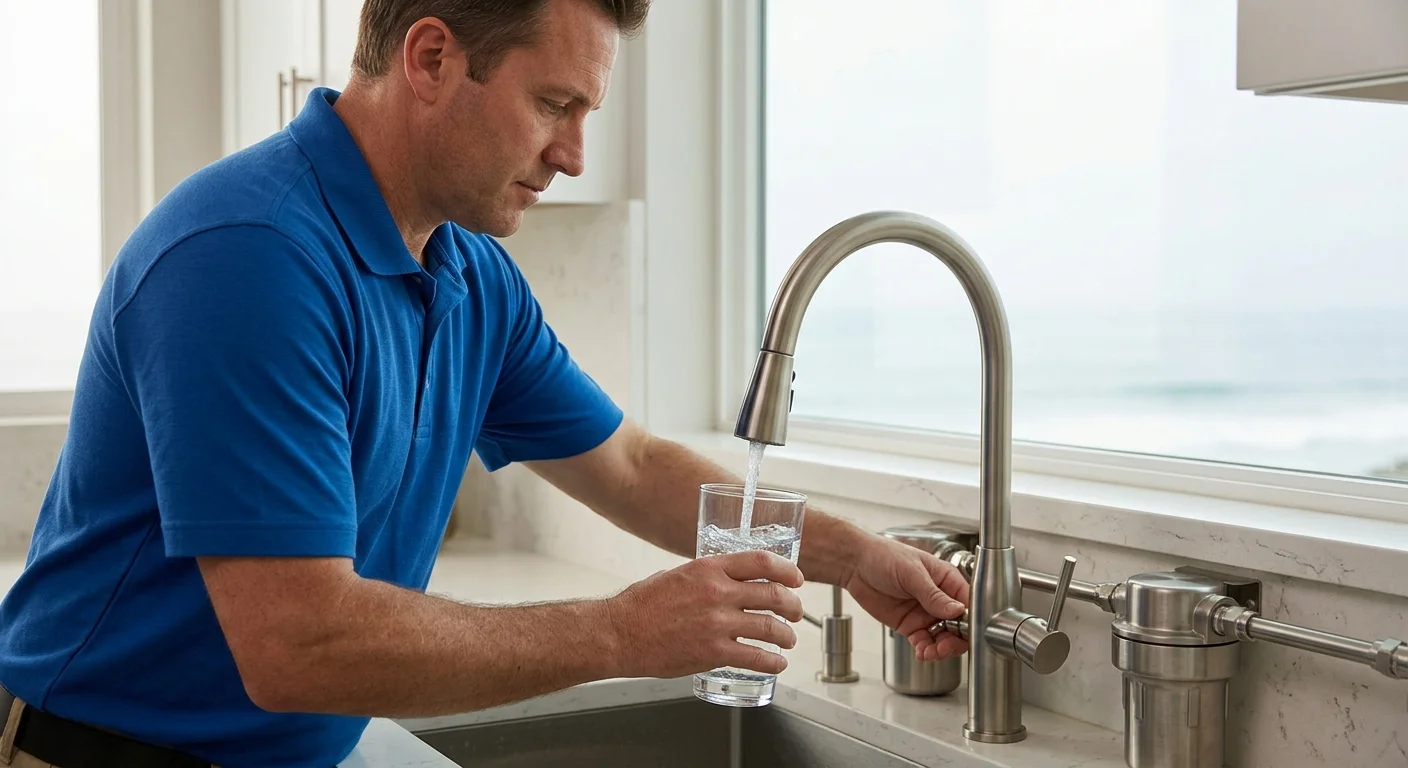
Plant reverse osmosis is not a home under-sink system
A seawater plant and a kitchen reverse osmosis unit both push water through membranes. That is where the resemblance stops. Plant equipment is built for a regional supply. A home unit is a point-of-use device on one cold line. NSF/ANSI 58 is the standard that covers reverse osmosis systems in the home. A standard is not a ranking, and it does not mean every unit reduces every contaminant. Check the exact model’s certified reduction claim.
Plant water also does not arrive at a Carlsbad faucet as a private, unblended stream you can map by street. This site has not confirmed a blend percentage, a dissolved-solids figure, or a hardness number for Carlsbad desalination plant tap water, and it has not confirmed which blocks receive desalinated water on a given day. If a page quotes those numbers without your utility’s current report, treat them as unverified.
Public drinking water is regulated federally by the EPA under the Safe Drinking Water Act. California adds its own limits through the Division of Drinking Water. Those rules apply to water served by a public system. They are not a blanket certificate for every building, private well, or emergency notice. For the county-level safety question, read is San Diego tap water safe and then open the report for the retailer on your bill.
Desalinated water from a public system is produced to be served as drinking water after that utility’s treatment and monitoring. That is not the same as a health claim for a home filter, and it is not a reason to skip the report. Cost per gallon at the plant is another figure this ledger could not confirm. Retail rates are set by the utility that bills you. Look there instead of a viral per-gallon number.
California supply planning is also bigger than one kitchen. This page is about what reaches a coastal North County tap. It is not a roster of every project in the state. For regional water-quality and supply context, start with the San Diego County Water Authority. Treated Water Authority supply, local blends, and other sources differ. Verify the serving retail provider.
A home reverse osmosis drinking water system does not replace the plant. It treats water after it is already in the house. EPA notes that an RO system produces treated water and reject water. Performance and efficiency are model-specific. WaterSense-labeled units demonstrate at most 2.3 gallons of reject water per gallon treated under that program’s criteria. That is a label criterion, not field performance for every install. EPA also gives a national example of five or more reject gallons per treated gallon, and up to ten for some inefficient units. Those are national examples, not a measurement of your unit.
How to see which utility serves a Carlsbad address
Carlsbad is coastal North County. Encinitas is a different city on the same stretch of coast. El Cajon is inland East County. Those taps do not share one source story, and they do not share one hardness number.
The serving utility is printed on the water bill. That name, not the neighborhood, is what you need. The consumer confidence report, sometimes called the annual water-quality report, is issued by that retailer. It is the place to read source mix, disinfectant, and monitored results for the reporting year. Do not borrow a City of San Diego table and treat it as a Carlsbad result. EPA’s home-treatment guidance is plain on this point: do not transplant utility data to other service areas.
The City of San Diego’s own plumbing page describes typical hardness in that city system as about 16 grains per gallon (276 ppm), with a range of 16 to 18 gr/gal (272 to 284 ppm) that varies by area and by water demand. The City’s 2025 Consumer Confidence Report then lists plant and purchased-treated hardness as different measurements for Public Water System 3710020. Those figures are for the City of San Diego’s system. They are not countywide, not private-well figures, and not a tap result for every Carlsbad address.
Helix Water District, which publishes for an East County service area that includes El Cajon, La Mesa, and Lemon Grove, states that water at 10 or more grains per gallon is considered hard, and that imported Colorado River and State Water Project supply averages about 14 grains. That is a statement about imported supply, not about a Carlsbad kitchen.
No verified hardness number for Carlsbad, and no verified countywide average, is on this site. USGS classifies hardness as calcium carbonate: 0–60 mg/L soft, 61–120 moderately hard, 121–180 hard, and over 180 very hard. That is classification guidance. It is not a prediction of your tap, your appliances, or a treatment you must buy.
If the property is on a private well, the utility report does not apply. This site has not confirmed how many Carlsbad properties use wells. CDC well guidance is to use a state-certified laboratory and to ask local health or environmental authorities which extra tests fit the location. CDC recommends annual testing for total coliform, nitrate, TDS, and pH when that well guidance applies.
For a municipal Carlsbad address, stay with the bill and the current report. The City of San Diego water-quality portal is the right door for City customers. It is not automatic proof for a North County retailer. If the bill names a different agency, use that agency’s report.
Taste, minerals, and what a tap test can show
Taste is often about disinfectant, minerals, or the plumbing, not a rumor about the plant. CDC notes that chlorine-water taste and smell can differ from untreated water or from chloramine water. The report is how you identify the disinfectant, the levels, and related byproducts. A pool-like smell at the tap is a reason to read that section and to consider chlorine and chloramine removal after you know what is actually in the water. It is not proof the plant failed, and it is not a safety clearance by itself.
What TDS in water means in San Diego is the next reading if a handheld meter is what started this search. EPA’s secondary guideline for total dissolved solids is 500 mg/L. It addresses aesthetic and technical concerns. It is not a universal drinking-safety cutoff. You cannot infer that contaminants are absent, or that state rules are met, from a TDS number alone. USGS notes that specific conductance depends on the type and concentration of ions and can only approximate dissolved solids. A conductivity estimate is not a laboratory analysis of each constituent.
Fluoride is another value people mix up across cities. The City of San Diego’s FAQ describes adjustment to 0.7 ppm. That is a City target. It is not a countywide tap concentration and not a legal-limit statement for Carlsbad. CDC home-treatment guidance says RO may reduce fluoride. NSF/ANSI 58 treats fluoride reduction as an optional exact-model claim. Do not assume a percentage.
A tap test is how you stop guessing. Filter Pros San Diego arranges a free in-home water test and then connects you with a separately licensed water filtration pro. The homeowner contracts with that pro directly. The in-home test is a starting measurement at the faucet. Confirm the scope with the provider. Do not treat it as a full certified-lab panel or as medical clearance.
If you need a laboratory result for a specific contaminant, use a state-certified lab and the analyte list that matches the concern. CDC’s well-testing list is not a menu to copy onto every Carlsbad city tap. Match the test to the problem. If someone in the home is on a restricted sodium diet, that is a physician conversation, not a blog diagnosis. University of Nebraska–Lincoln Extension notes that ion-exchange softening adds about 8 mg/L of sodium for each grain per gallon of hardness removed. That is an estimate of added sodium from hardness removed, not a measured Carlsbad tap result.
Treatment choices after you have a result
Identify the water concern first. EPA’s home-treatment guidance is that no single technology removes every contaminant. Compare point-of-use and whole-house scope, the exact certified reduction claims, maintenance, and water use.
NSF/ANSI 42 covers certified aesthetic reduction claims, including many taste and odor claims. NSF/ANSI 53 covers specified health-effect contaminant claims. NSF/ANSI 44 covers ion-exchange softeners that reduce calcium and magnesium hardness. NSF/ANSI 58 covers reverse osmosis. Certification is not a promise that a category of filter handles every contaminant. Read the model.
If the issue is chlorine or chloramine taste through the whole house, a point-of-entry carbon approach is the usual conversation after the test. If the issue is drinking water at one sink, a point-of-use RO or under-sink filter may be the better match. Salt-free conditioning does not remove hardness ions. Evaluate the exact scale-reduction claim. Do not buy it as softened water.
EPA’s November 2024 guide describes basic pitchers and tap filters as typically under $100, RO and distillation systems as tending to cost a few hundred dollars and possibly requiring professional installation, and point-of-entry systems as costing thousands and generally requiring professional installation. Those are attributed broad categories from that guide. They are not a San Diego installed quote and not a Filter Pros price. Maintenance, replacement filters, and install scope belong in a written quote from the licensed pro.
An RO unit can also lower treated-water pH in treatment applications. EPA describes that process effect. There is no universal household output pH, mineral benefit, or taste outcome to promise. Feedwater, the exact system, and upkeep control what comes out.
Compare independently certified efficiency when RO is on the table. Waste-to-treated ratio and efficiency percentage use different denominators. Efficiency is treated water divided by incoming water. Do not promise bill savings from a label.
When a separately licensed pro should weigh in
Call in a licensed water filtration pro when the test points to equipment you cannot size from a brochure: a whole-house filter, a softener, a salt-free conditioner, or an under-sink RO with a drain line and tank. Oversizing a softener can waste water. EPA advises sizing from measured hardness and household use, and excluding irrigation demand when that is appropriate. Demand-initiated regeneration responds to use and hardness rather than a fixed timer.
Filter Pros San Diego does not install, repair, or pull permits. It tests, answers the phone, and connects you with licensed pros who do that work. The pro should be able to show a California license you can confirm on the CSLB license check. City of San Diego plumbing pages list water-softener installation among Simple No-Plan Plumbing/Gas Permit work for eligible properties in that city. That is City jurisdiction guidance, not a countywide Carlsbad permit rule, and it is not evidence of a softener ban.
A separately licensed pro should also weigh in when a unit is already in place and something is off: no drinking water from an RO faucet, a softener that will not regenerate, or a leak at a tank or bypass. Isolation and model-manual steps come first. Do not open pressurized assemblies, and do not handle wet electrical parts.
If the only goal is to settle the desal question, you may not need new equipment. You may need the current report and a tap test. If the report and the test still leave a taste, staining, or drinking-water concern, that is the moment to match a certified system to the result.
When to call us
When a Carlsbad tap tastes off, or when you want a reading before you choose filtration, start with a test rather than a plant rumor. Filter Pros San Diego will arrange the free in-home water test and connect you with a licensed water filtration pro for any install that follows. Call us at (858) 400-6508 to set up a free in-home water test.