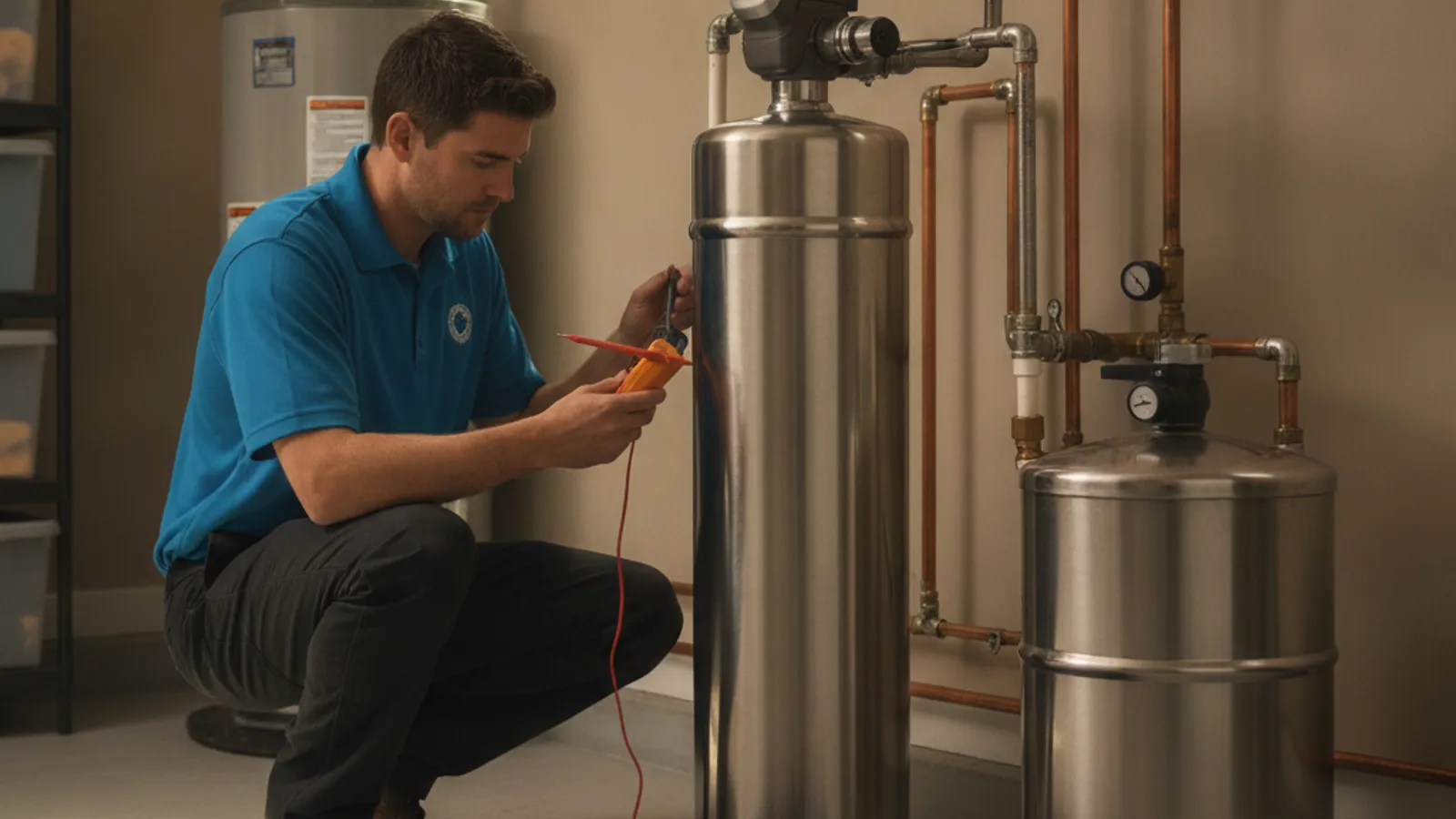
A softener that’s quietly failed doesn’t announce itself. There’s no warning light, no alarm, just water that slowly goes back to feeling the way it did before you ever installed the thing. San Diego’s water runs hard enough, firmly in the hard-water range or higher depending on your neighborhood, that most homeowners notice a failing softener within a few weeks. The trick is knowing what to actually look for instead of just wondering.
Signs your softener is doing its job
A working softener leaves a specific, recognizable feeling behind. Skin should feel slightly slippery in the shower, not squeaky, because soap isn’t fighting dissolved minerals to lather. You’ll notice you’re using less soap and shampoo to get the same result. Dishes and glasses come out of the dishwasher clear, without the cloudy white film hard water leaves behind. Faucets, showerheads, and coffee makers stay free of the chalky white buildup that shows up fast on untreated hard water. If all of that still describes your house, your softener is likely doing exactly what it’s supposed to.
Signs it’s stopped working, or never really was
The reverse of every sign above is a red flag. White, chalky spots reappearing on faucets and shower glass is usually the first thing people notice. Skin and hair start feeling dry and tight again, especially right after a shower. Soap stops lathering the way it used to, and you find yourself using more of it. Scale starts building up inside the water heater and around fixture aerators. And a quiet one that’s easy to miss: if you haven’t refilled the salt tank in weeks and the level genuinely hasn’t dropped, that’s often a sign the unit has stopped regenerating altogether, not a sign you’re saving money.
Three checks you can run this week
Check the salt level and how fast it’s dropping. Open the brine tank and look at the salt level compared to last time you checked. A working softener uses salt steadily during each regeneration cycle. Salt that hasn’t moved in a month, even though you’re using water normally, usually means the unit isn’t regenerating or isn’t drawing brine correctly.
Test your water hardness before and after. A simple hardness test strip, or a request for a free test, tells you the real number instead of a guess based on feel. Test water straight from an outdoor spigot before treatment, then test a treated tap inside the house. If both readings come back close to the same high number, the softener isn’t doing its job regardless of how the water feels. For the full method, see our guide on how to test water hardness at home.
Confirm the unit is actually regenerating. Most softeners run on a timer or a metered head that tracks water usage and triggers regeneration automatically. Check the control head’s display or settings to confirm the last regeneration date matches what you’d expect for your household’s water use. If it’s been weeks longer than it should be, or the display shows an error, that’s your answer.
Check for a salt bridge before you assume the worst
One of the most common reasons a softener seems to stop working overnight is a salt bridge, a hardened crust that forms above the water level in the brine tank and blocks salt from dissolving into the water below it. From the outside, the tank looks full. In reality, the softener has been running without brine for who knows how long. If your salt level looks fine but your water has gone hard anyway, this is the first thing to rule out. Our full walkthrough on identifying and breaking up a salt bridge covers exactly what to look for and how to fix it safely.
Make sure it’s not stuck in bypass
Every softener has a bypass valve, usually used during maintenance, a vacation, or a plumbing repair, that routes water around the unit entirely instead of through it. It’s easy to forget a bypass valve was switched, especially after a repair visit or a DIY project elsewhere in the house. Check the valve position on the softener’s inlet and outlet. If it’s set to bypass, your water has been running untreated the entire time, and the softener itself may be working perfectly fine.
What “working” should actually look like in San Diego
Given how hard San Diego’s raw water runs, well into the hard-water range depending on your part of the county, a properly working softener should bring treated water down to near zero, typically under 1 gpg. That’s the benchmark worth testing against, not a vague sense that things “feel better.” If your treated water is still testing in the double digits, something in the system isn’t doing its job, whether that’s a salt bridge, a bypass issue, a worn-out resin bed, or a control head that’s stopped regenerating on schedule. Routine upkeep matters here too. Our guide to water softener maintenance in San Diego covers what to check on a regular basis so problems get caught before they turn into a full failure.
Frequently asked questions
How often should I test my softener’s performance? A quick hardness test every few months is enough for most households, plus a check any time you notice spotting, dry skin, or scale returning.
Why is my salt level dropping but my water is still hard? This usually points to a mechanical issue, like a worn resin bed, a stuck valve, or a control head programmed incorrectly, rather than a salt problem. It’s a sign the system needs a professional look.
Can a softener work fine for years and then just stop? Yes. Resin beds wear down over time, control heads can fail, and valves develop leaks or jams. A softener that’s worked well for years isn’t guaranteed to keep working without any maintenance.
Is it normal for salt usage to vary month to month? Some variation is normal based on water usage, but a sudden drop to near-zero salt use over several weeks with a household running water normally is usually not.
When it’s a repair call, not a guessing game
If you’ve checked the salt, ruled out a bridge, confirmed the bypass valve, and your water is still testing hard, the issue is mechanical, and that’s worth a professional look before it gets worse. The pros Filter Pros San Diego sends repair and service softeners across the county and can pinpoint the actual failure instead of leaving you to guess. Call (858) 400-6508 to schedule a repair visit and get your water back to where it should be.