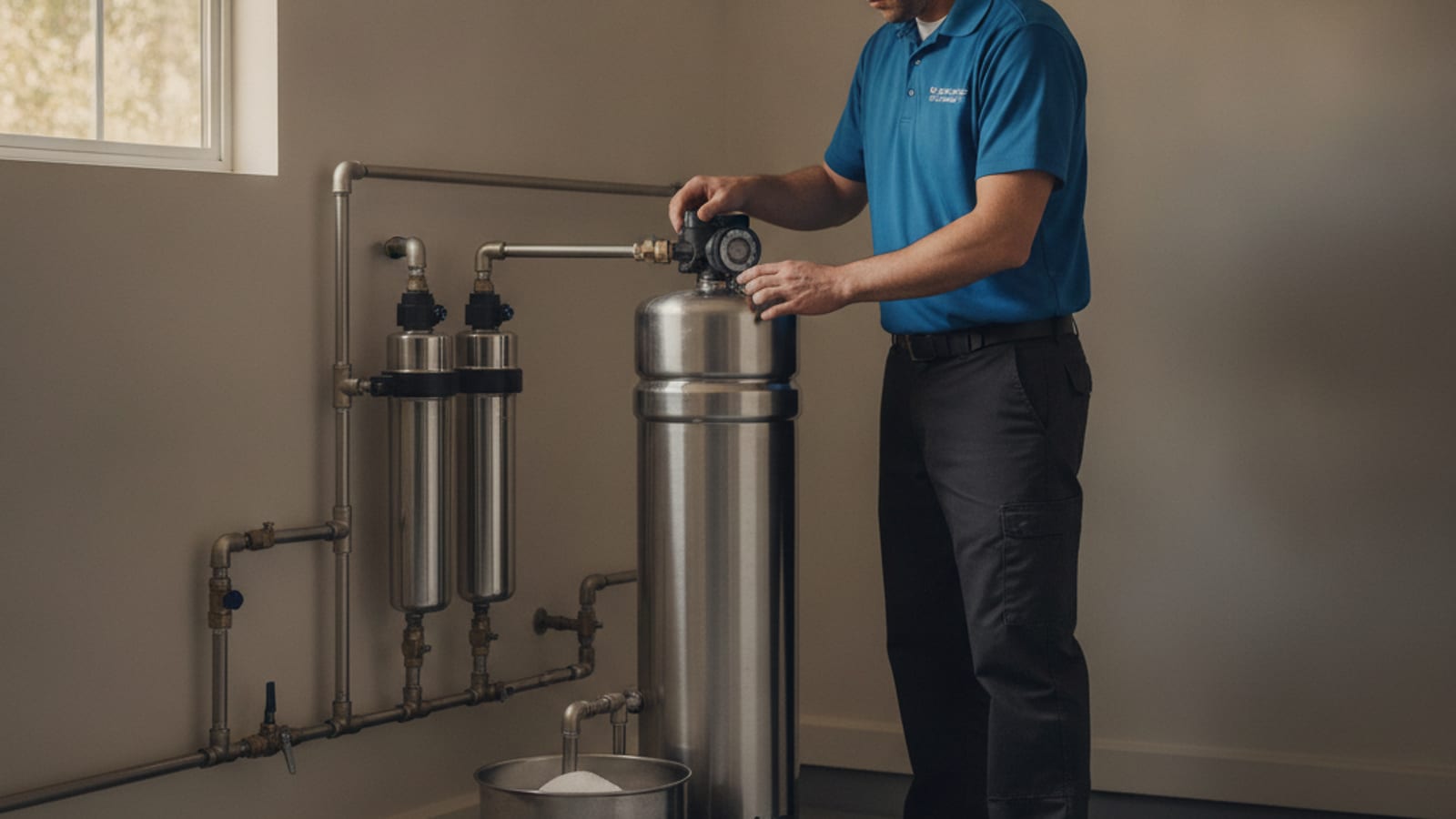
Water softeners in San Diego need professional service once a year, minimum. That’s not a general guideline, it’s specific to this city. San Diego tap water runs hard. That hardness level pushes resin beads harder, accelerates salt consumption, and shortens the window before things start going wrong. Skipping annual water softener maintenance here isn’t a money-saving move. It’s a slow way to wreck a $1,500 to $3,000 system.
How often should you service a water softener?
Once a year is the standard for most homes. If your household uses more than 100 gallons per day or you have a smaller, older system, twice a year is smarter.
San Diego’s water hardness is the key variable. The resin in your softener is working constantly. That constant ion exchange depletes resin capacity faster than it would in a city with softer source water. Imported from the Colorado River and the State Water Project, San Diego’s supply is also disinfected with chloramine rather than chlorine. Chloramine degrades resin over time in a way that chlorine doesn’t. Annual service catches resin wear before it crosses the line from “working okay” to “not working.”
At Filter Pros San Diego, an annual service schedule gets set at install so you don’t have to track it yourself.
What does annual water softener maintenance include?
A proper service call covers the full system, not just a salt top-off.
Brine tank inspection and cleaning. The brine tank is where salt dissolves to recharge the resin. Over time, sediment and salt impurities collect at the bottom. A technician drains and cleans the tank, then checks for mushing (compacted salt that won’t dissolve properly) and inspects the float and brine valve.
Salt bridge check. A salt bridge is a hard crust that forms mid-tank, leaving an air gap below it. Salt looks full from the top, but the water can’t reach it. The softener stops regenerating. Breaking a salt bridge sounds simple, but finding one during routine maintenance prevents weeks of hard water passing unnoticed through your home.
Control valve inspection. The control valve manages the regeneration cycle, timing, water flow, brine draw, and backwash. A technician checks each stage, verifies the timer or demand settings, and looks for worn seals or O-rings. A valve that cycles incorrectly wastes salt, wastes water, and eventually fails outright.
Resin testing. Resin beads have a finite lifespan, typically 10 to 15 years with proper care, but shorter when chloramine exposure is constant. A technician tests the resin’s exchange capacity to see if it’s holding hardness reduction as designed. Fouled or exhausted resin can’t be cleaned back to factory performance, it needs replacement.
Hardness setting verification. Your softener should be programmed to your actual water hardness. San Diego’s hardness varies slightly by neighborhood and season depending on the blend of Colorado River water and State Water Project water. If the setting is off, you’re either over-salting (wasting money) or under-treating (leaving hard water in your pipes).
Leak inspection. Fittings, bypass valves, and connection points are checked for drips. Small leaks found during maintenance cost nothing to fix. The same leak found after it’s soaked a cabinet or damaged drywall is a different story.
For full water softener service and repair, a technician should be in and out in about an hour.
What are the signs your water softener needs service?
The most obvious sign is water that starts feeling hard again. Soap that doesn’t lather well, spotty dishes out of the dishwasher, and mineral film on shower glass all point to a softener that isn’t keeping up.
Beyond that, watch for:
Salt that isn’t going down. If you’re not using salt at the normal rate, the system isn’t regenerating. Salt bridge, blocked brine valve, or a failed control valve are the usual causes.
Salt that drops unusually fast. Over-regenerating wastes salt and water. It usually means the hardness setting is too high or the regeneration timer is misconfigured.
Wet or damp area around the unit. Any moisture around the tank, connections, or valve head means a leak. Don’t wait on this one.
Water with a sulfur or rotten egg smell. Bacteria can colonize a brine tank that hasn’t been cleaned. It’s fixable, but the longer it goes, the more thoroughly the tank needs to be treated.
System running at unusual hours. A softener should regenerate during low-use periods, typically early morning. If you’re hearing it cycle during the day or hearing it cycle too frequently, the control valve needs attention.
If you’re in the north county area and noticing any of these signs, water softener service in Oceanside is something we cover regularly.
How much does water softener maintenance cost in San Diego?
For an annual tune-up, inspection, cleaning, setting verification, salt bridge check, expect to pay somewhere in the $100 to $250 range from most San Diego service providers. The spread depends on the age and complexity of the system and how long the technician is on-site.
Resin replacement costs more, typically several hundred dollars including parts and labor, because it requires draining and refilling the mineral tank. It’s not a frequent expense, but when resin fails, performance drops sharply.
Control valve repair or replacement varies by brand and model. Simple seal and O-ring replacements are relatively affordable. A full valve head swap runs higher.
A new water softener installation is a separate conversation that depends on your household size, water usage, and hardness. Installations don’t get quoted over the phone, a free in-home water test gives the actual data to size the system correctly and put an honest number in front of you. If you’re shopping around, see how to choose a water softener company in San Diego before you sign anything.
Can you maintain a water softener yourself?
Some tasks, yes. Adding salt, checking for salt bridges, and watching your water feel and taste are things any homeowner can do.
The deeper work is harder to DIY. Testing resin capacity requires test equipment most homeowners don’t have. Inspecting the control valve means understanding how each regeneration stage should flow and recognizing what’s off. Cleaning the brine tank properly means draining it without disturbing the safety float or brine valve, then reassembling it correctly.
The risk of DIY maintenance isn’t usually that something breaks immediately. It’s that a problem gets missed, goes unaddressed, and costs more to fix a year later. A salt bridge that goes undetected for six months means six months of hard water scale building inside your pipes and water heater.
Annual professional water softener service is affordable specifically because it’s routine. Reactive repair after a failure is always more expensive.
If you’re considering skipping the traditional softener entirely, a salt-free conditioning system is worth understanding. It has no resin to test, no brine tank to clean, and no control valve to service.
What happens if you skip maintenance?
The short version: a softener that isn’t maintained stops softening water, and by the time most homeowners notice, scale has already built up somewhere it shouldn’t have.
Hard water scale inside a water heater acts as insulation between the heating element and the water. The heater works harder, uses more energy, and fails earlier. Scale inside pipes narrows the interior diameter over years, reducing flow and pressure. Fixtures and appliances connected to the hard water supply show the same damage, dishwashers, ice makers, washing machines.
The control valve is especially vulnerable. When regeneration cycles run incorrectly for months, the valve seals wear unevenly and the internal components degrade faster than designed. A valve that could have been serviced for $50 in O-rings becomes a valve that needs full replacement.
Resin fouling from chloramine is cumulative and invisible. You won’t notice water getting harder day by day. You’ll notice it when the softener stops working and the resin test shows it’s past the point of recovery.
Annual water softener maintenance is the simplest way to avoid all of this.
Frequently asked questions
How often does a water softener need maintenance in San Diego?
Once a year for most households, twice a year for high-usage homes or smaller systems. San Diego’s water runs hard. That hardness level, combined with chloramine disinfection, puts more stress on softener resin than softer water markets. Annual service keeps the system performing as designed.
What does a water softener tune-up include?
A standard tune-up covers the brine tank (cleaning, salt bridge check, float inspection), the control valve (cycle verification, seal inspection, timer settings), resin testing, hardness setting confirmation, and a full leak check. A thorough service call typically takes about an hour.
How do I know if my water softener is failing?
Watch for water that feels hard again (soap won’t lather, spots on dishes and glass), salt that isn’t going down at the normal rate, unusual moisture around the unit, or the system regenerating at odd times. Any of these signals point to a problem worth investigating. Water softener service and repair can diagnose and fix most issues in a single visit.
How much does water softener maintenance cost?
An annual tune-up from a San Diego service provider typically runs $100 to $250. Resin replacement, when needed, costs more, generally several hundred dollars including parts and labor. For anything involving a new system or significant repair, a free in-home water test gives you the data to get an accurate quote.
Can I do water softener maintenance myself?
You can handle routine tasks like adding salt, checking for salt bridges, and monitoring water quality. Professional maintenance is worth it for resin testing, control valve inspection, and brine tank cleaning, tasks that require specific tools and knowledge to do correctly. Missing a problem during a DIY check is the real risk, not the cleaning itself.
What happens if I never service my water softener?
The system eventually stops softening water effectively, and by the time it’s noticeable, scale has accumulated in your pipes, water heater, and appliances. Untreated hard water shortens the life of water-using appliances and raises energy costs. Internally, neglected resin and an uninspected control valve degrade faster and cost more to repair or replace than they would with routine service.
Is a salt-free system easier to maintain?
Yes. A salt-free conditioning system uses template-assisted crystallization technology and has no resin, no brine tank, and no control valve to service. It’s essentially maintenance-free once installed. The tradeoff is that it conditions water rather than softening it, hardness minerals stay in the water but are changed in form so they don’t deposit as scale. For many San Diego households, it’s a practical alternative worth considering.
How do I schedule water softener service in San Diego?
Call (858) 400-6508 or schedule a free in-home water test. We cover all of San Diego County. The water test gives us your actual hardness reading and a clear picture of what your system needs, whether that’s a tune-up, resin replacement, or a conversation about a different treatment approach.