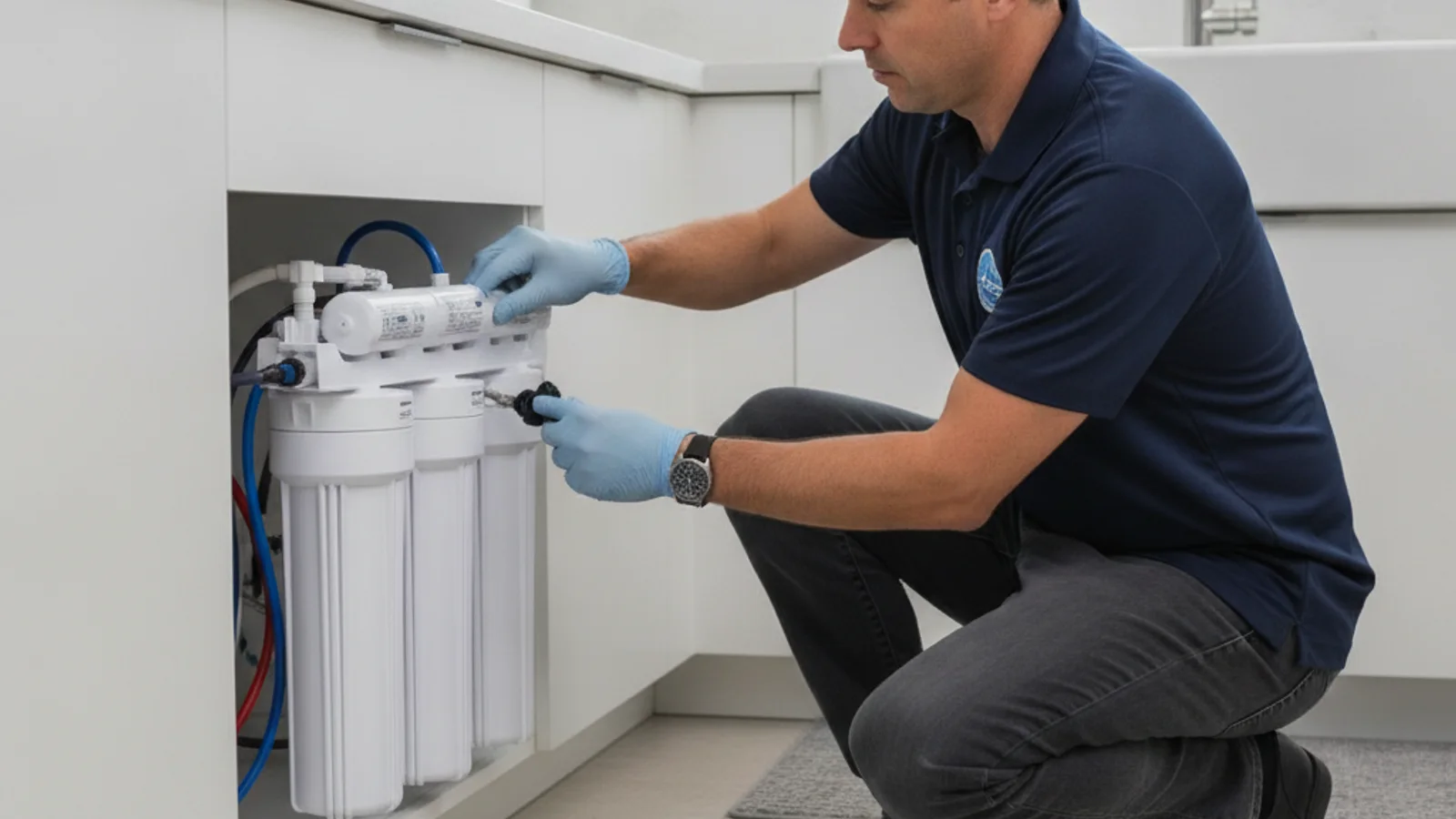
Most reverse osmosis filters need changing on a set schedule: sediment and carbon pre-filters every 6 to 12 months, the carbon post-filter once a year, and the RO membrane every 2 to 5 years. In San Diego, hard water and high dissolved solids push you toward the shorter end of every interval. Budget about $60 to $150 a year for replacement filters, with the membrane an occasional larger cost. Skip the schedule and you lose the water quality you paid for, and a clogged pre-filter can shorten the expensive membrane’s life.
Reverse osmosis filter replacement schedule by stage
A reverse osmosis system isn’t one filter. It’s a stack of stages, and each one has its own replacement interval. A typical under-sink system in San Diego has four or five stages, and here’s when each is due.
| Stage | What it does | Replace it |
|---|---|---|
| Sediment pre-filter | Catches dirt, rust, and grit | Every 6 to 12 months |
| Carbon pre-filter(s) | Removes chlorine and chloramine before the membrane | Every 6 to 12 months |
| RO membrane | Rejects dissolved solids, PFAS, nitrates, lead | Every 2 to 5 years |
| Carbon post-filter | Polishes taste after the tank | Every 12 months |
| Remineralization (optional) | Adds trace minerals back | Every 12 months |
The pre-filters matter most for protecting the rest of the system. They take the beating so the membrane doesn’t. A carbon pre-filter that’s spent lets chlorine or chloramine reach the membrane, and that chemical exposure damages the membrane faster than anything else. That’s why replacing cheap pre-filters on time protects the pricey part.
How often should you change reverse osmosis filters in San Diego?
Plan on the shorter end of each interval, because San Diego water is harder on filters than the national average. The county’s imported supply runs high in total dissolved solids and 15 to 28 or more grains per gallon of hardness, and both load up cartridges faster. See is San Diego water hard? for the full county picture.
Two local factors move the schedule up. First, sediment. Older neighborhoods and any recent main work send more grit through the line, so the sediment pre-filter clogs sooner. Second, chloramine. San Diego disinfects with chloramine instead of plain chlorine, and carbon works through chloramine faster than through chlorine, so the carbon pre-filters wear down quicker. More on that in chlorine vs chloramine in San Diego water.
A practical rule for most San Diego homes: change the sediment and carbon pre-filters every 6 to 9 months rather than stretching to a full year, and test the membrane’s output with a TDS meter once a year to decide when it’s actually done.
What are the signs your RO filters need changing?
The clearest sign is slower flow from the dedicated faucet. The storage tank takes longer to refill, and the pour feels weak. That usually means a clogged sediment or carbon pre-filter, and it’s the first thing to check.
Watch for these other signals:
- Taste changes. A return of chlorine, chloramine, or a flat, off taste means the carbon stages are spent. If your water started tasting like chlorine again after filtering, the carbon is the suspect.
- A rising TDS reading. Test the filtered water with a cheap TDS meter. If the number climbs well above your baseline, the membrane is losing its rejection rate and is near the end.
- A calendar you can’t remember. If you don’t know the last time filters were changed, they’re due. Set a reminder so it isn’t guesswork.
Don’t wait for the water to taste bad before acting. By the time taste breaks through, contaminants have already been slipping past the spent stage for a while.
How much does reverse osmosis filter replacement cost?
Replacement filters are the main ongoing cost of owning an RO system, and they’re cheaper than most people expect. Here’s what each stage runs in San Diego.
| Item | Frequency | Typical cost |
|---|---|---|
| Sediment pre-filter | Every 6 to 12 months | $10 to $25 |
| Carbon pre-filter(s) | Every 6 to 12 months | $15 to $35 each |
| Carbon post-filter | Every 12 months | $15 to $30 |
| RO membrane | Every 2 to 5 years | $80 to $200 |
| Annual filter total | Yearly | $60 to $150 |
Over a year, filters for a San Diego home run about $60 to $150. Averaged across a membrane’s life, the all-in cost is closer to $100 to $180 a year. That still beats bottled water badly, and it’s a small price to keep the system doing its job. For the full picture on what the system itself costs, see reverse osmosis cost in San Diego.
One money-saving note: match the replacement cartridge to your system’s stage sizes and certifications. Off-brand filters that don’t fit correctly leak or channel water past the media, which wastes the filter and the water. Verify NSF/ANSI certification on any cartridge you buy.
Can you change RO filters yourself, or should a pro do it?
Pre-filter and post-filter swaps are doable for a handy homeowner. You shut off the supply, depressurize the system, twist out the old cartridges, and twist in the new ones in the correct order. The common mistakes are cross-threading a housing, forgetting to sanitize, and skipping the flush before you drink the first batch.
The membrane and any system that’s acting up are better left to a pro. A membrane change is a good time to sanitize the whole unit, check the tank pressure, and confirm the system is rejecting properly with a TDS test. At Filter Pros San Diego, the pros we send service and replace filters on RO systems across the full county, from San Diego to Oceanside, and we test your water first so the swap is sized to what’s actually at your tap. If you’re weighing a reverse osmosis drinking water system or comparing it against a whole-house filter, we start every job with a free in-home water test so the numbers are yours, not a county average. The same testing applies to an under sink filtration setup.
Frequently asked questions
How often should you replace reverse osmosis filters?
Sediment and carbon pre-filters every 6 to 12 months, the carbon post-filter every 12 months, and the RO membrane every 2 to 5 years. In San Diego, aim for the shorter end because hard water and chloramine wear filters faster.
How long does an RO membrane last in San Diego?
Two to five years for most homes. High dissolved solids and hardness shorten that, so test your filtered water with a TDS meter yearly and replace the membrane when its rejection rate drops.
What happens if you don’t change RO filters?
Flow drops, taste returns, and contaminant reduction falls off. A clogged or spent pre-filter also exposes the membrane to chloramine, which can ruin the expensive stage years early.
Do all RO filters get replaced at the same time?
No. Pre-filters and the post-filter change on a 6-to-12-month cycle, while the membrane lasts several years. Replacing pre-filters on time is what extends the membrane’s life.
How do I know when my RO filters are spent?
Watch for weaker flow from the faucet, a return of chlorine or off taste, and a rising TDS reading. Any one of the three means a stage is due.
Can hard water damage a reverse osmosis system?
Hard water doesn’t destroy the membrane, but it loads cartridges and can scale the membrane faster. Many San Diego homes pair an RO unit with a softener so the RO stages last longer.
Call (858) 400-6508 to schedule a filter change or a free in-home water test, and we’ll size your reverse osmosis drinking water system to San Diego water.