Replace a whole-house filter when its documented trigger is reached, not on a generic calendar. Start with the exact product, its service records, and current water conditions.
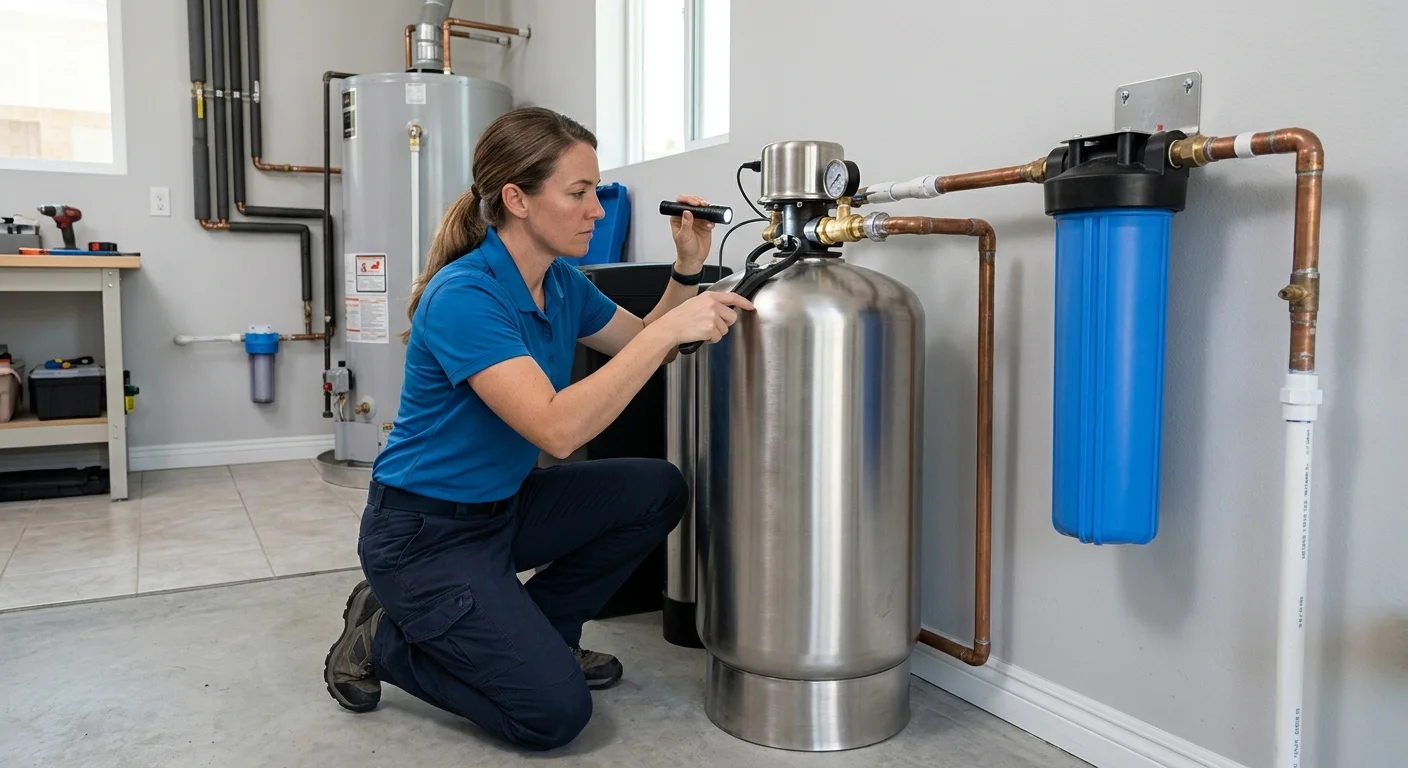
Identify the filter and media before setting a schedule
“Whole-house filter” can describe different equipment in the same plumbing line. Your system might have a replaceable cartridge, a media tank, or several treatment stages. Each component may follow different service instructions.
Begin at the equipment label. Record the manufacturer, model, and any cartridge or media identifiers. Photograph each label before opening a housing or moving insulation. If a label is faded, check the purchase documents, installation invoice, or product manual.
Next, trace the visible equipment without changing any valves. Note how many housings and tanks are present. A small cartridge housing shouldn’t be treated like a larger media tank. A tank’s outside material, including stainless steel or fiberglass, also doesn’t reveal its internal media or replacement trigger.
Look for a service card near the system. Previous invoices may identify what was changed and when. Don’t assume every component was serviced during the last visit. The invoice should name the specific cartridge, media, or part.
San Diego County addresses can receive water from different providers and sources. The San Diego County Water Authority is a useful starting point for identifying regional agencies, but your actual provider’s current report is the better household reference. Private-well owners need records tied to their own well.
A whole-house water filtration system should match the water entering that property. Its schedule should match the documented product, not another homeowner’s system.
Follow the product’s documented replacement trigger
The product manual should control the replacement decision. Find the exact manual for the model on your equipment label. A manual for a similar-looking housing isn’t enough.
Some documentation may describe a calendar interval. Other products may use treated capacity, pressure readings, a meter, or another stated trigger. Follow the trigger actually printed for your model. Don’t borrow a number from a retailer, neighbor, or unrelated video.
Read the conditions attached to that trigger. Product literature may distinguish between replacement, inspection, cleaning, and media service. Those terms aren’t interchangeable. It may also direct owners to use a particular replacement element or service procedure.
Keep the documentation with the system. A simple record can include:
- The full equipment model
- The replacement component or media identifier
- The date of each inspection or service
- Meter or gauge readings, when the product documents use them
- Observed changes in pressure, color, odor, or taste
- The name of the separately licensed contractor who performed the work
Never invent a missing service date. Mark it “unknown” and begin a new record after the equipment is identified. If the prior owner left no documents, a licensed pro can inspect the setup and help locate the correct manufacturer information.
Warranty terms weren’t confirmed for this page. They vary by product and must be checked in the current manufacturer documents. Confirm whether a proposed part or service method affects your specific coverage before authorizing work.
This product-first approach also helps with budgeting. Our guide to whole-house water filtration costs in San Diego explains why system configuration matters when comparing proposals.
Check pressure and water changes without guessing the cause
A noticeable water change is a reason to inspect the system. It isn’t proof that a particular filter has expired.
Write down what changed, where it appears, and when it started. Compare several fixtures rather than relying on one faucet. Note whether the concern affects hot water, cold water, or both. Also record any recent plumbing work, utility notice, well service, or filter adjustment.
Low pressure deserves the same careful approach. Check any installed gauges and record their readings without inventing an acceptable range. The correct limits must come from the equipment documentation or a licensed pro’s evaluation. Our guide to low pressure after a whole-house filter explains how to organize the symptoms before requesting service.
Water hardness doesn’t provide a universal filter-change schedule. For the City of San Diego system, the city reports an average of about 16 grains per gallon, or 276 parts per million. It reports a range of 16 to 18 grains per gallon, or 272 to 284 parts per million, depending on area and water demand. Those figures apply only to the city’s system, not the entire county or private wells. The City of San Diego water information should be checked for its current wording.
Testing can separate an observed change from a guess. Filter Pros arranges a free in-home water test and connects homeowners with separately licensed water filtration pros. Test findings and product records give the pro a better starting point.
Separate cartridge service from tank media replacement
A cartridge and tank media shouldn’t share one handwritten replacement date unless their documentation says they should. They’re separate components, even when they’re part of one treatment setup.
Cartridge service usually concerns a removable element inside a housing. Tank service concerns the material or treatment component associated with the tank. A system may contain more than one cartridge, more than one tank, or equipment serving different purposes. Identify every stage before scheduling anything.
Create one line in the service record for each component. Use the product name and model rather than labels such as “big filter” or “front tank.” That small step prevents one replaced part from being mistaken for a full-system service.
Don’t assume a tank needs new media because a nearby cartridge reached its trigger. Don’t assume a cartridge is current because someone inspected the tank. Check each documented trigger separately.
This distinction matters when comparing proposals. Ask the licensed pro to identify the exact component being inspected or replaced. The written scope should distinguish a cartridge, tank media, control part, housing, or other item. It should also identify which existing components will remain.
No universal cartridge interval, media lifespan, pressure limit, or warranty term could be confirmed from the approved sources for this page. The manufacturer’s current documentation sets those product details. If the model can’t be identified, ask the pro to explain how the proposed replacement was selected.
Homeowners planning a larger change can review our guide to water filter installation in San Diego. It covers the questions that help define a whole-house project before contracting with an installer.
When a separately licensed pro should inspect the system
Arrange an inspection when the equipment can’t be identified, the service history is missing, or the documented trigger has been reached. A pro should also evaluate unexplained pressure changes, leaks, damaged housings, uncertain valve positions, or water changes that persist.
Don’t open unfamiliar equipment just to discover what’s inside. Stop if the manufacturer’s procedure is unavailable or the required isolation steps aren’t clear. A separately licensed pro can inspect the plumbing arrangement, identify accessible equipment, and explain the proposed service scope.
Ask the contractor to show you the equipment label and applicable documentation. The proposal should name the component being serviced. It should also separate routine replacement from repairs or a larger system change.
Confirm the individual contractor’s current license status through the California Contractors State License Board. The homeowner contracts with and pays the pro directly. Filter Pros handles the water-test appointment and referral, not the installation or service work.
Bring your records to the inspection. Include product photos, previous invoices, gauge readings, and notes about water changes. Share your water provider’s current report or private-well test records when available. These details help the pro assess your actual system instead of applying a generic schedule.
If replacement is recommended, request the manufacturer document supporting that trigger. Keep the completed invoice beside the equipment record. The next decision will be easier because the model, component, and service date are no longer unknown.
When to call us
Call when the filter model is unclear, its records are missing, or a licensed Water Filtration pro needs to inspect the system. Call us at (858) 400-6508 to set up a free in-home water test.