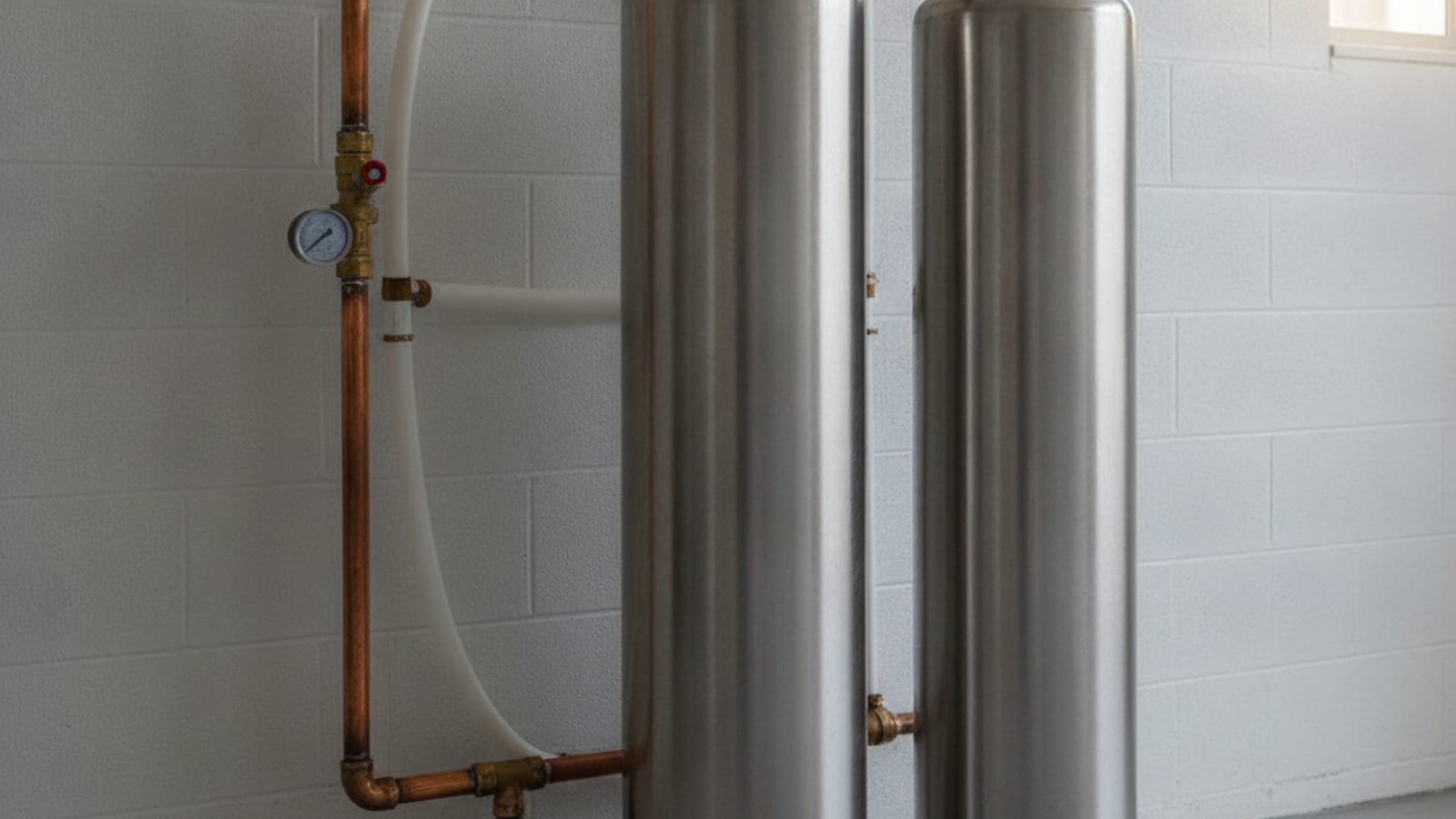
Installed cost depends on the treatment goal, exact equipment, flow requirements, plumbing and labor. EPA’s November 2024 national guide places point-of-entry systems broadly in the thousands of dollars and says they generally require professional installation. That is planning context, not a San Diego market estimate; the licensed provider’s written proposal determines the actual price.
How much does a whole-house water filtration system cost in San Diego?
The installed price depends on three things: what problems your water has, which combination of treatment stages you need, and how complex the installation is.
Use these items to compare proposals:
| Configuration | Scope to confirm | Ongoing cost to confirm |
|---|---|---|
| Carbon filtration | Exact certified claim, capacity, plumbing and commissioning | Model-specific media, cartridges and service |
| Carbon plus salt-free conditioning | Both exact-model claims, capacity and labor | Model-specific media and service |
| Carbon plus ion exchange | Capacity, bypass, drain, labor and commissioning | Salt, regeneration water, parts and service |
| Well-water treatment | Laboratory-supported stages and exact claims | Model-specific lamps, media, parts and testing |
| Whole-house plus point-of-use RO | Both systems and plumbing | Replacement elements, service and RO water use |
The provider’s written proposal determines the actual price. Compare the appropriate test results, pipe configuration, location and exact equipment for whole house water filtration in San Diego.
What’s included in a whole-house water filtration system?
A point-of-entry system treats water on the supply line serving the home. The plumbing layout determines which fixtures receive that water; confirm any bypassed branches and the proposed treatment stages.
Start with the serving utility’s current report, appropriate testing and the concern you want to address. Depending on those findings, a provider may propose stages such as:
Sediment pre-filter. May address particles before the main media. Confirm the exact rating, flow, pressure loss and replacement instructions.
Carbon media. Match the exact model’s certified aesthetic or contaminant-reduction claim to the serving utility’s current disinfectant and the treatment goal. A carbon category alone does not prove reduction of every chemical.
Conditioning or softening stage. Ion exchange reduces calcium and magnesium hardness. Salt-free conditioning does not remove hardness ions; compare the exact model’s documented scale-reduction claim. The right choice depends on measured hardness, household use and the treatment goal.
Included controls, bypasses, gauges and plumbing vary by model and proposal. Confirm each item in writing.
Does the price include a softener or conditioner?
Check the written proposal. It should state whether softening or conditioning is included, identify each model and show how any additional equipment, connections and labor affect the quoted scope.
The City of San Diego reports that its own system averages about 16 grains per gallon and ranges from 16 to 18 depending on area and demand. That figure is not countywide. Verify the serving utility and measure at the address before deciding whether a conditioning stage fits the goal.
The choice between ion exchange and salt-free water conditioning affects installation and operation. Ion exchange uses salt and regeneration water; salt-free conditioning does not remove hardness ions. Compare exact-model maintenance and confirm current requirements for the property.
Filter Pros connects homeowners with independent licensed providers. A free field screen can support an initial assessment but is not a laboratory analysis or an all-contaminant safety clearance.
What makes San Diego water need whole-house filtration?
Treatment decisions should start with the serving utility’s current report or appropriate private-well testing and the household’s goal.
Hardness. Verify the serving utility and measure at the address. Hardness classification does not certify safety, predict equipment life or prove treatment is necessary.
Disinfectant. Check the serving utility’s current report and notices rather than assuming one disinfectant countywide. If reduction is a goal, compare the exact model’s applicable certified claim. See chlorine and chloramine removal.
Plumbing and equipment. Ask equipment manufacturers about water-quality limits and warranty terms. Do not infer protection or longer component life from a general treatment category.
Local differences. Utility boundaries and private wells matter more than a coastal or inland label. Do not transplant one area’s water results to another.
What ongoing costs should you expect?
The upfront installation price is one number. The cost to run the system over its lifespan is a different calculation.
Include every model-specific cartridge, media, salt, regeneration-water, lamp, membrane, service and disposal requirement. Use the manufacturer’s schedule and the provider’s written prices rather than generic intervals or local averages.
Is whole-house filtration worth it in San Diego?
It depends on the measured concern, household goal and full written cost.
Consider treatment when measured water characteristics and an exact certified claim match the goal. Taste or odor alone does not establish safety or identify the disinfectant.
Compare the complete ownership cost with current household spending. No single system addresses every contaminant, and treatment does not carry a guaranteed payback period.
Renters should obtain property-owner approval, and every household should compare the treatment goal and written ownership cost before buying.
The El Cajon water-filtration planning guide explains questions to ask about water source, treatment goals and installation scope. Choose any point-of-entry treatment by its exact claims and the fixtures it will serve.
How to get an accurate price for your home
Market ranges are starting points. An accurate number requires knowing your water’s actual hardness and chemistry, your home’s square footage and daily water use, the location of your main shutoff and available installation space, pipe material and condition, and whether you want a softener, conditioner, RO, or all three.
Schedule a free in-home water test for a field screen and site assessment with an independent provider. The provider explains its limits and supplies the written quote; use a suitable laboratory for concerns outside the screen.
Call us at (858) 400-6508 or book a free test online. We serve all of San Diego County.
Frequently asked questions
How much does it cost to install a whole-house water filter in San Diego?
EPA’s national guide places point-of-entry treatment broadly in the thousands and says it generally requires professional installation. That is planning context; the provider’s written estimate determines the actual price.
What’s the difference between a water softener and a salt-free conditioner?
Ion exchange reduces calcium and magnesium hardness. Salt-free conditioning does not remove hardness ions; compare the exact scale-reduction claim, maintenance and property-specific requirements.
Does a whole-house filter remove chloramine from San Diego water?
Verify the serving utility’s disinfectant. If chloramine reduction is a goal, compare the exact model’s certified claim and operating conditions; a generic carbon label does not establish performance.
How long do whole-house water filtration systems last?
Service life and media replacement intervals are model- and water-specific. Compare the exact manufacturer’s instructions, warranty, material specification and replacement costs; a material label alone does not establish superior lifespan or treatment.
Do I need a whole-house system or just an under-sink RO?
An under-sink reverse-osmosis system treats a selected tap; a point-of-entry system treats water entering the residence. Compare the exact certified reduction claims, water use and maintenance for each proposed model. One scope does not prove the other is necessary.
Will a whole-house water filter reduce my water pressure?
Pressure performance is model- and site-specific. Compare rated flow and pressure-drop data with measured demand, and follow the manufacturer’s maintenance instructions.
Is financing available for whole-house water filtration in San Diego?
Ask the independent licensed provider whether payment options are currently available and request all terms in writing. Filter Pros does not promise financing availability.