A whole house water filter low pressure complaint needs a clear starting point. Confirm when the change began, which fixtures are affected, and whether the documented bypass changes anything. Don’t open a housing or loosen connections while parts may be pressurized.
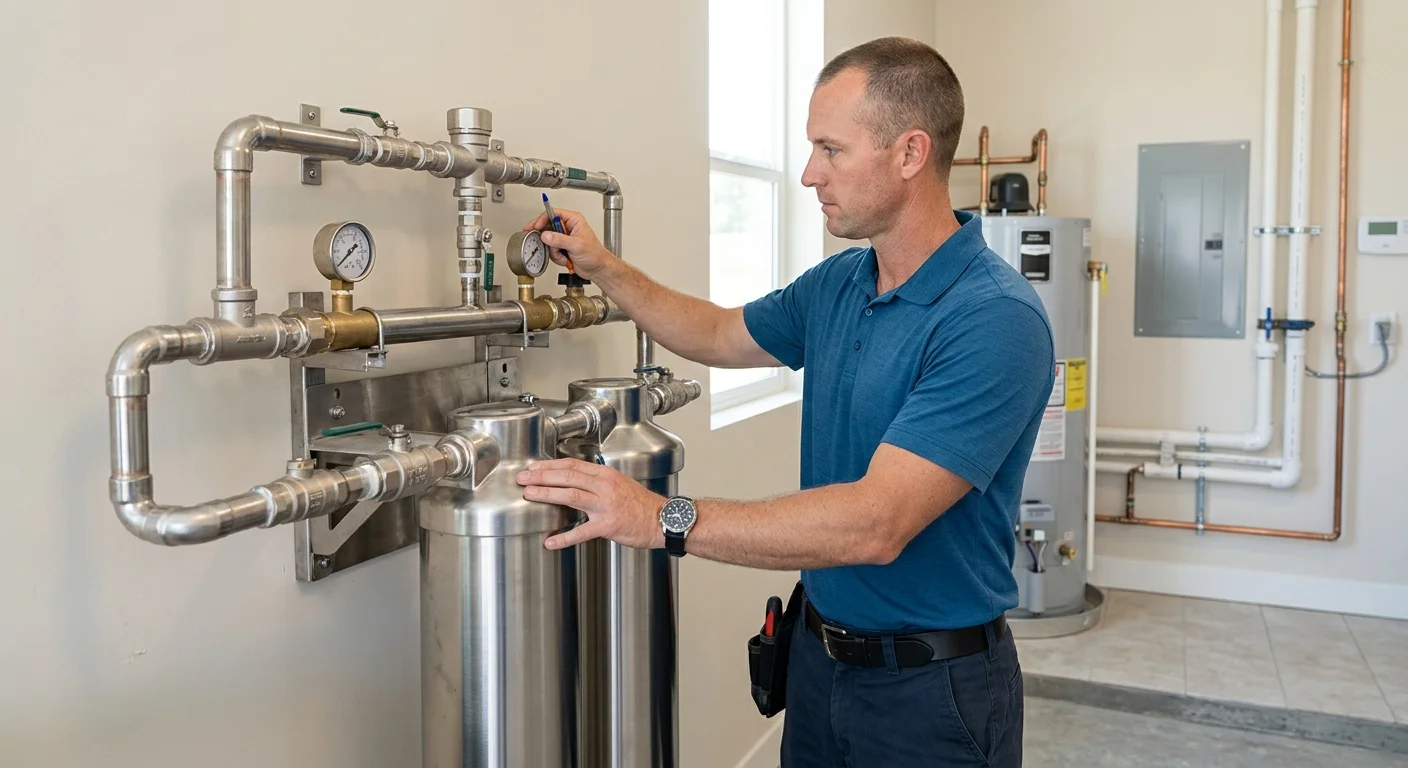
Confirm when the pressure change began
Start with the first moment the pressure felt different. Timing won’t prove the cause, but it narrows the inspection.
Write down whether the change followed installation, filter service, plumbing work, or utility activity. Note whether it appeared suddenly or became noticeable over several days. If another person first noticed it, record which fixture they used.
A change immediately after service keeps the filter assembly and its valves in focus. A gradual change keeps possible filter restriction on the list. Neither pattern confirms the cause. Supply pressure, a shared valve, plumbing scale, and other equipment can produce a similar complaint.
Record what was happening when you noticed the problem. A shower running alone gives different context than several fixtures running together. Compare the same fixture under similar conditions. That makes the observation more useful to a pro.
San Diego’s water conditions also need careful wording. The City of San Diego Public Utilities Department reports that its drinking water typically averages about 16 grains per gallon, or 276 parts per million. It reports a range of 16 to 18 grains per gallon, depending on water demand and the area served. Those figures apply only to the City’s system. They don’t establish conditions across San Diego County or at private wells.
That hardness information may justify checking for scale. It doesn’t prove scale caused the pressure change. Keep scale and filter restriction separate until testing identifies the affected part.
Separate one-fixture trouble from house-wide pressure loss
A whole-house filter sits on a shared water path, but every plumbing layout differs. First determine whether the complaint affects one outlet, several rooms, or the entire home.
Use the same faucet position during each comparison. Check more than one sink and shower. Note what happens on both hot and cold settings without taking anything apart. Also record whether the change appears upstairs, downstairs, or in only one part of the home.
Trouble at one fixture doesn’t establish a whole-house filter pressure drop. That fixture, its branch, or another local component may need attention. When several unrelated fixtures change together, the filter, shared valves, supply side, and common plumbing remain possible causes.
Don’t rely on a generic internet pressure number. This site’s verified sources don’t establish one universal pressure or flow figure for every San Diego County home. A licensed pro can compare measured conditions with the equipment documents and the home’s prior baseline.
Local service context matters too. Coastal North County, inland communities, central San Diego, East County, and the South Bay don’t share one retail water provider. If the problem remains when the filter is bypassed, identify the agency serving the address through the San Diego County Water Authority. Ask that agency whether work or a known supply issue affects the property.
If deposits or narrowed plumbing remain a concern, read the separate guide to low water pressure and hard-water scale in San Diego. That possibility still needs its own inspection. Don’t treat it as a confirmed filter failure.
Check visible valves and the documented filter trigger
Keep this check outside the equipment. Don’t remove a housing, gauge, clamp, drain, union, or plumbing connection.
Look for visible labels identifying the inlet, outlet, service position, and bypass. Compare the current arrangement with the installer’s documentation or the manufacturer’s instructions for that exact model. Don’t rely on a generic drawing from another system.
A handle’s direction alone may not explain its setting. Valve designs and bypass assemblies differ. Don’t force a handle that resists movement. Photograph the valve positions instead, including any labels and the equipment model information.
Next, find the product’s documented filter trigger. That may appear in the owner’s manual, service record, or instructions supplied with the system. Follow only the condition named for that product. Don’t substitute an invented service interval, pressure limit, or flow target.
No universal cartridge life or replacement schedule could be confirmed from this site’s approved sources. Actual product instructions control. If the manual can’t be found, record the manufacturer and model so a separately licensed pro can locate the correct document.
Visible details can still help. Note whether the housing looks displaced, whether a valve was recently touched, and whether the symptom began after service. Don’t use cartridge color or appearance as proof of restriction. A visual clue isn’t a pressure diagnosis.
Installation layout also affects what can be checked without opening equipment. The guide to water filter installation in San Diego explains the planning questions that belong in an installation conversation. For an existing system, a licensed pro should compare the actual layout with its product instructions before changing parts.
Compare bypass results without opening pressurized parts
Use the bypass only when the system has one and its current instructions clearly explain operation. If the labels are missing or the sequence is unclear, skip this step and leave the valves alone.
No product-specific bypass sequence can apply to every whole-house filter. Assemblies differ. Use the exact model manual or installer instructions, not a diagram from an unrelated product.
Before changing anything, photograph the original valve positions. Follow the documented sequence without forcing a handle. Then compare water at the same fixture and faucet position. Keep other water use as consistent as practical.
Record one of three simple results: the pressure felt better, it stayed the same, or the comparison was unclear. Avoid assigning a cause beyond that observation.
A clear improvement in bypass tells the pro to inspect the treatment path. It doesn’t identify the exact restriction. The cartridge, media, valve arrangement, filter head, and connecting plumbing remain separate possibilities until inspected.
No improvement means the filter may not be the only source. Supply-side pressure, a shared shutoff, plumbing scale, pressure-control equipment, or another restriction could still be involved. Those are possibilities, not findings.
A mixed result needs measured comparison. Don’t repeat valve changes until the outcome matches the answer you expect. Give the photos and notes to the licensed pro.
Return the system only as its instructions direct. Don’t leave unfamiliar valves in a guessed position. Follow the product documentation concerning water use during bypass.
Most importantly, don’t loosen a housing to test whether it’s restricted. Opening pressurized equipment falls outside this symptom-triage guide. The goal is to collect useful observations without turning a pressure complaint into a plumbing problem.
When a separately licensed pro should inspect the system
Bring in a separately licensed Water Filtration pro when the loss is house-wide, the valve positions are uncertain, or the bypass changes the symptom. An inspection also makes sense when the housing or connecting plumbing appears damaged or wet.
Give the pro a short record. Include when the change began, which fixtures were affected, recent service, valve photos, the model information, and the bypass result. This helps keep filter restriction, scale, and supply-side pressure from being treated as one issue.
Ask the pro to compare conditions before and after the treatment equipment. The inspection should identify the affected part before replacement work is proposed. Don’t accept an unsupported cartridge interval, pressure target, or equipment diagnosis.
A free in-home water test can help define the water-treatment question. Ask separately what pressure checks are included in the referred pro’s visit. The scope couldn’t be confirmed as identical across every independently operated pro.
Filter Pros San Diego arranges testing and connects homeowners with local pros. The homeowner contracts with, and pays, that separately licensed pro directly. You can check the pro’s license through the California Contractors State License Board.
If replacement or redesign becomes appropriate, review the options for whole-house water filtration only after the source of the pressure loss is identified. Changing equipment before testing can leave the original problem unresolved.
When to call us
House-wide pressure that remains low after visible checks needs a separately licensed Water Filtration pro, especially when the bypass result is unclear or the housing may need to be opened. Filter Pros San Diego can arrange testing and connect you with a local pro, while you contract with and pay that pro directly. Call us at (858) 400-6508 to set up a free in-home water test.