A whole-house water filtration system in Escondido only earns its keep if it matches the water that actually enters the house. City of Escondido service and a private well are different jobs. Confirm the source on the bill, then size a point-of-entry system to a real test, not to a countywide guess.
Identify City of Escondido water versus a private well
Start with the water bill. The serving retailer is printed there. An Escondido mailing address is not proof of City of Escondido water. Downtown and mid-valley streets on the I-15 and Centre City Parkway grid are often city service. Unincorporated pockets near Harmony Grove, Del Dios, Hidden Meadows, and the Valley Center edge can sit on a different retailer, or on a well. Read the bill before anyone orders a tank.
Municipal water is regulated under the federal Safe Drinking Water Act by EPA, with extra California limits through the Division of Drinking Water. The serving utility’s current Consumer Confidence Report is the document for that tap. The San Diego County Water Authority publishes regional water-quality information. It does not replace the retailer’s report for your street.
A private well has no retailer report. The owner is the one who tests. CDC guidance is to use a state-certified laboratory and to ask local health or environmental staff which extra tests fit the location. CDC recommends annual testing for total coliform, nitrate, TDS, and pH. Harmful or suspected contamination means another safe source and health-department guidance until a lab says otherwise. Boiling does not remove chemical contamination. For well chemistry and treatment trains, see our well water treatment guide. Do not treat a Bear Valley Parkway or Lake Hodges well as if it were a Grand Avenue municipal tap.
Hardness is the number people ask for first. We do not have a verified City of Escondido hardness figure to print. Helix Water District says water at 10 or more grains per gallon is considered hard, and that imported Colorado River and State Water Project supply averages about 14 grains. That is a statement about imported supply, not about an Escondido kitchen tap. The City of San Diego publishes its own system numbers. Those numbers are for that city only. They do not describe Escondido, and they do not describe private wells. Pull the current report for the address, or test the well.
Iron is another well-edge question. EPA’s secondary drinking water standard for iron is 0.3 mg/L, tied to rusty color, sediment, metallic taste, and reddish or orange staining. That is an aesthetic guideline, not a diagnosis of your well. Test first. Then match treatment to the result.
What a whole-house system is built to treat at this tap
A whole-house water filtration system is a point-of-entry unit. It treats water as it enters the residence, so showers, laundry, and hose bibs see the same first stage. A point-of-use device treats one tap. EPA’s home-treatment guidance is to identify the goal from the serving utility’s report and from appropriate testing. No single technology removes every contaminant.
NSF/ANSI labels are how you compare claims. NSF/ANSI 42 covers certified aesthetic reduction, such as chlorine taste and odor when the exact model lists that claim. NSF/ANSI 53 covers specified health-effect contaminant claims. NSF/ANSI 44 covers ion-exchange softeners that reduce calcium and magnesium hardness. NSF/ANSI 58 covers reverse osmosis. A standard is not a ranking, and it does not mean the unit reduces every contaminant. Verify the exact model’s certified reduction claim before you buy.
City service in Escondido often leads people to carbon at the main for disinfectant taste and odor, plus a sediment stage if the house throws rust or grit. CDC notes that chlorine-water taste and smell can differ from untreated water or from chloramine, and that the utility report is how you identify the disinfectant. Do not assume every North County tap uses the same disinfectant. Read the current report.
Hardness is a separate job from filtration. An ion-exchange softener removes calcium and magnesium. Salt-free conditioning does not remove hardness ions. EPA says to evaluate a salt-free unit against its exact scale-reduction claim, not against a promise of softened water. Filter Pros refers salt-free PF1025 conditioning when scale control without salt, sodium, brine discharge, or salt bags is the goal. That is conditioning, not softening.
Kitchen drinking water is often still a second system. Whole-house carbon does not replace a certified reverse osmosis unit at the sink. If drinking-water reduction is the search, use the Escondido reverse osmosis page. That is point-of-use work. This page is the main-line decision.
Well-fed houses can need a train: sediment, then iron or odor treatment if the lab shows it, then hardness equipment if hardness is the problem, then a drinking-water stage. CDC says match treatment to the identified problem and test again to confirm it worked before you resume use. A positive total-coliform result is an indicator. It is not a full pathogen ID, and it is not a reason to guess at chemical dosing.
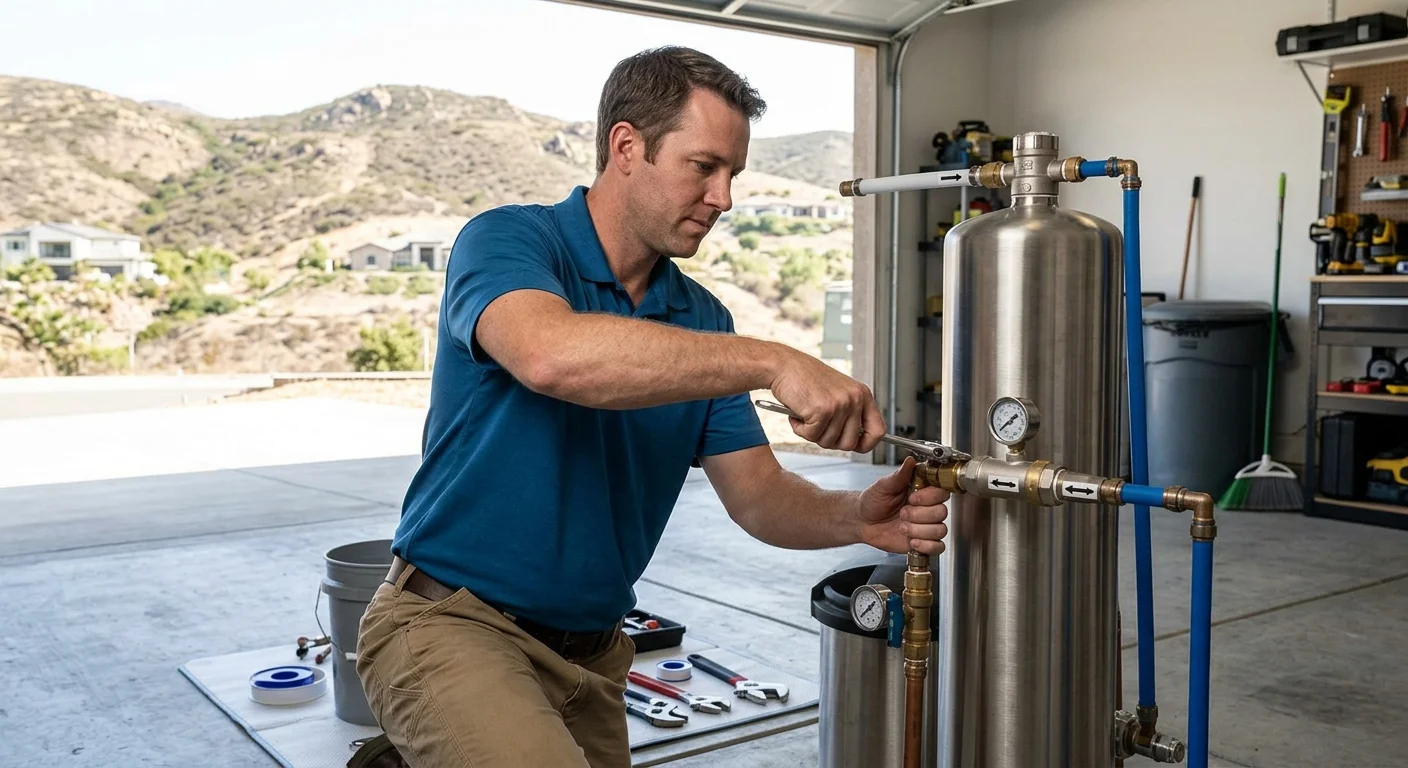
Tank material matters in a hot inland garage. The pros we send install medical-grade stainless steel tanks. Many competing units are fiberglass with a plastic liner. Ask to see the vessel, not a brochure photo.
EPA describes point-of-entry systems as costing thousands and generally requiring professional installation. That is an attributed national category from EPA’s November 2024 home-treatment guide. It is not a Filter Pros price, not an Escondido installed quote, and not a promise. Pitchers and tap filters sit in a much lower EPA cost band. They also only treat the tap you fill.
Inland heat, scale, and well-edge housing
Escondido sits inland in North County, in a valley with dry hills around it. Summer heat on a west-facing stucco wall, a tankless heater in a tight garage, and irrigation on decomposed-granite yards are the local pattern. Water that spots glass and leaves white film on a shower door is showing dissolved minerals as it dries. That is a reason to test hardness. It is not a license to invent a grains-per-gallon number for the city.
Scale is hardest on heat. Navien’s tankless maintenance guidance says annual flushing and descaling of heat exchangers is part of upkeep, that hard water may require more frequent maintenance, and that anti-scale or water-softener systems can reduce mineral buildup. Those are Navien terms. Other heater brands write their own manuals and warranties. Failure to maintain as the manual requires can void a warranty on that brand. Ask the heater maker, then size treatment from a test.
Housing stock splits the install. Older ranch and tract houses near downtown and along East Valley Parkway often have a tight garage wall and a main that was never planned for a tall tank. Newer infill and hillside homes can have more slab and more copper in view, but still need a bypass and a drain path. Well-edge properties toward Bear Valley, Lake Wohlford, and the granite ridges do not share one chemistry. Geology talk without a lab result is just a story. Test the well. Then pick stages.
A warehouse whole-house kit does not change that. Costco and similar aisles sell equipment. They do not test your Escondido main, pull a local permit, or certify that the model matches your contaminant list. The disadvantage of buying first and testing later is simple: you can install the wrong stage. A sediment-only tank will not fix disinfectant taste. A softener will not fix coliform. Salt-free media will not strip hardness ions. Reverse osmosis at one sink will not protect the water heater.
Worth is also a test question. If the report and the lab show a problem the certified model is built to reduce, point-of-entry treatment is a home-protection decision. If the only goal is drinking taste at the kitchen, a whole-house tank can be more hardware than the job needs. EPA’s rule of thumb still holds: identify the concern first, then compare point-of-entry and point-of-use scope, certified claims, maintenance, and water use.
Space, bypass, and drain planning
The tank lives at the main, usually in the garage or a side utility bay. The licensed installer needs room for the vessel, a bypass, and any drain the model requires. Escondido slabs and older garages run tight. Measure before anyone orders a tall stainless tank.
A bypass routes water around the unit so the house still has water while the system is isolated for service. Valve types differ: lever, knobs, a three-valve assembly, or an app-controlled valve. Do not force a stuck handle. Confirm bypass by running a cold tap. Follow the exact model manual. Persistent drain flow on a regenerating unit can mean a malfunction. EPA says to follow model-specific installation, bypass, and maintenance instructions.
Drain planning depends on the technology. Ion-exchange softeners regenerate and send brine to a drain. EPA also advises that a property with onsite septic should check with the septic manufacturer or local service provider about overload, warranty, and performance before a softener goes in. Salt-free PF1025 conditioning has no salt and no brine discharge, which changes the drain conversation. Carbon and sediment housings still need a service path and dry, accessible space.
Permits are local. The City of San Diego lists water-softener installation among qualifying Simple No-Plan Plumbing/Gas Permit work for eligible properties in that city. That is City of San Diego guidance. It is not an Escondido rule, and it is not a countywide permit path. We could not confirm a current City of Escondido or County of San Diego whole-house filtration permit number from the claims we are allowed to use. Ask Building at the City of Escondido for addresses inside city limits. Ask the County for unincorporated parcels. Historic-property rules can change the route. The separately licensed pro should tell you who pulls the permit.
Do not DIY a pressurized main install because a box diagram looked simple. EPA says point-of-entry systems generally require professional installation. Check the installer’s license on the CSLB license lookup before work starts.
Questions for the separately licensed pro
Filter Pros San Diego answers the phone, arranges the free in-home water test, and connects you with a separately licensed water-filtration pro. You contract with that pro. You pay that pro. Ask the person who will put the tank on your main these questions, in this order.
What did the test actually show, and which certified reduction claim on this exact model matches it. Bring the utility CCR for city water, or the state-certified lab report for a well. Ask to see NSF/ANSI 42, 53, 44, or 58 on the data plate, not on a generic category page.
Is this point-of-entry only, or is a kitchen reverse osmosis stage still on the list. Whole-house and under-sink jobs solve different taps. Ask how the two will sit together if you want both.
What vessel is going in the garage. Stainless steel is the tank we refer. Ask why a fiberglass-and-liner unit is being quoted if it is.
Where the bypass and drain will land, and whether the property is on sewer or septic. Ask for the model manual’s maintenance list and replacement-filter cost in writing. EPA says to include manufacturer maintenance and replacement-filter costs when you compare ownership cost. That quote comes from the pro, not from this page.
Who pulls the permit, and which building counter has jurisdiction: City of Escondido or the County. Confirm the license number and look it up on CSLB.
What the system will not do. No honest whole-house water filtration system Escondido quote should claim it removes every contaminant. Salt-free conditioning will not give you ion-exchange soft water. A carbon tank will not replace well disinfection when the lab calls for it. Pressure, flow, and media life are model-specific. If a number is not on the certified spec sheet, treat it as marketing.
Water treatment Escondido CA work is local because the source is local. A Grand Avenue city tap and a well off the eastern ridges are not interchangeable. Get the source right, then let the licensed pro size the train.
When to call us
Call when you want a whole-house filter matched to City of Escondido service or to a private well, and you need a licensed water-filtration pro to test, size, and install at the main. Filter Pros San Diego sets up the free in-home water test and the referral. The homeowner contracts with the installer directly. Call us at (858) 400-6508 to set up a free in-home water test.