Weak water pressure has a handful of usual suspects: a municipal supply issue, a failing pressure regulator, a hidden leak. In a lot of San Diego homes, though, the real cause is quieter and slower-moving: mineral scale building up inside pipes and fixtures over years, gradually narrowing the path water has to travel.
Start with the easy checks first
Before assuming scale is the culprit, rule out the simpler causes. Check whether the pressure drop affects the whole house or just one fixture. A single low-pressure showerhead or faucet usually points to a clogged aerator or showerhead, not a house-wide problem. If it’s isolated to hot water only, the culprit is often scale buildup specifically inside the water heater rather than the plumbing.
If the whole house is affected, check your pressure regulator, if your home has one, since a failing regulator is a mechanical part that wears out over time independent of water quality. And rule out an active leak, since a leak anywhere in the system can drop pressure everywhere else.
Why hard water scale narrows pipes over time
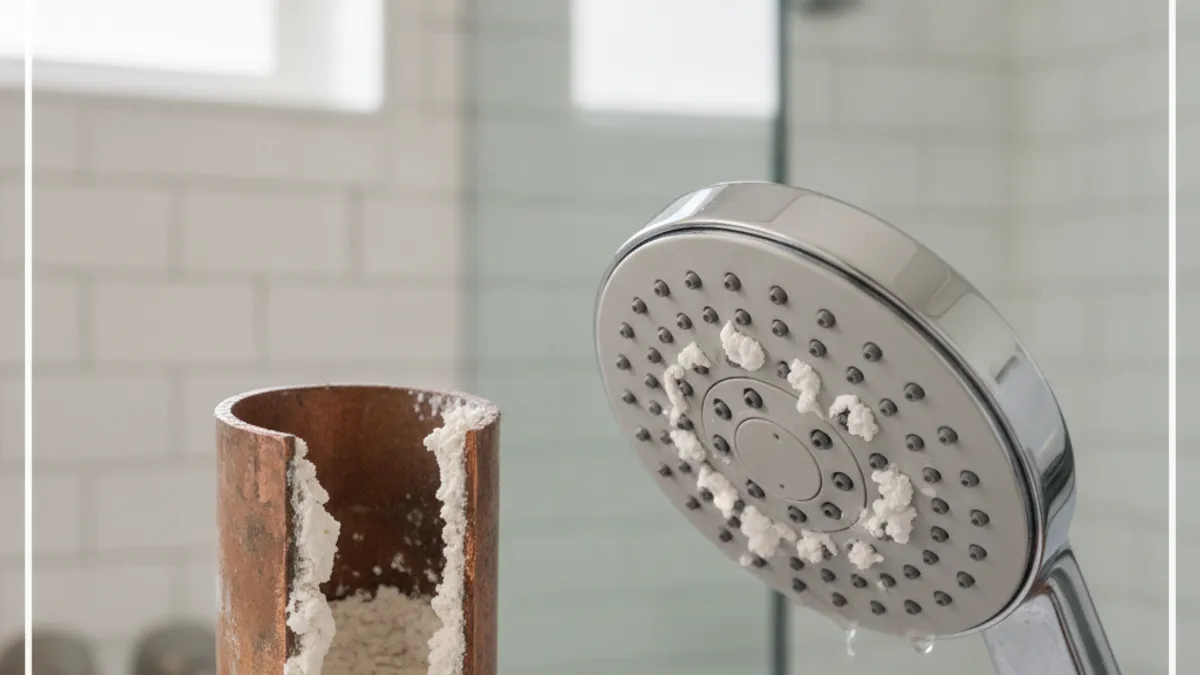
San Diego’s water is imported from the Colorado River and the State Water Project, both sources that run naturally high in dissolved calcium and magnesium. That’s what makes water “hard.” Those minerals don’t stay dissolved forever. As water heats, sits, or moves through pipes and fixtures, calcium and magnesium precipitate out and cling to interior surfaces, forming a chalky white deposit called scale.
Scale builds gradually, which is exactly why it’s easy to miss as a cause. A pipe that started with a clear half-inch interior diameter can lose a meaningful percentage of that opening over ten or fifteen years of scale accumulation, especially in older copper or galvanized steel plumbing common in San Diego homes built before the 1970s. The same buildup clogs showerhead nozzles, faucet aerators, and the internal components of a water heater, each one narrowing the path water has to squeeze through.
Why this shows up worse on hot water lines
Scale forms faster in hot water than cold, since heat accelerates the rate at which dissolved minerals come out of solution. That’s why a lot of homeowners notice the pressure problem specifically on hot water taps and showers before they notice it anywhere else. A water heater with years of internal scale buildup is also working harder to do the same job, which shows up as reduced hot water pressure alongside higher energy bills.
Older San Diego homes carry more risk
Homes with original galvanized steel plumbing, still common in older neighborhoods across the county, are especially prone to this. Galvanized pipe has a rougher interior surface than copper or modern PEX, which gives scale more surface area to grab onto and accelerates the narrowing. If your home still has its original galvanized supply lines and pressure has been declining gradually over years rather than suddenly, scale buildup inside that old pipe is a strong candidate.
What actually fixes it
Clearing an already-scaled showerhead or aerator is simple: soak the fixture in a descaling solution or vinegar, and it often restores flow at that one point. That’s a temporary, fixture-level fix. It doesn’t touch the pipe itself, and it does nothing for a water heater with internal buildup.
The systemic fix is addressing hardness before it enters your plumbing, typically with a water softener or a salt-free conditioning system installed at the point where water enters the house. That doesn’t reverse scale that’s already built up inside old pipe, but it stops new scale from forming going forward, which is the difference between a problem that keeps getting worse and one that stabilizes. If you’re specifically dealing with a pressure drop that started right after installing a new softener, that’s a different and more immediate issue, covered in our post on low pressure after a water softener install.
For pipe that’s already significantly scaled or corroded, a plumber may need to address the pipe itself, which is outside what a water treatment system alone can fix.
Frequently asked questions
How do I know if scale is really the cause of my low pressure?
A gradual decline over years, worse on hot water, combined with visible mineral buildup on faucet aerators and showerheads, points toward scale. A sudden drop is more likely a leak, a regulator failure, or a supply issue.
Will a water softener fix low pressure immediately?
A softener stops new scale from forming but doesn’t remove scale already built up inside old pipes. Pressure may improve gradually as fixtures are cleaned or replaced, but existing pipe buildup usually needs to be addressed separately.
Can I test my water’s hardness myself?
Yes, home hardness test strips are inexpensive and give a rough reading. For a precise number, a professional water test gives a more reliable baseline before deciding on a treatment system.
Is scale buildup covered by homeowners insurance?
Gradual mineral buildup is generally considered normal wear rather than sudden damage, and coverage varies by policy. Check directly with your insurer for how they classify it.
If your pressure has been fading for a while and you’re not sure whether it’s scale, a leak, or something else, call Filter Pros San Diego at (858) 400-6508 and we’ll help you figure out which one it is.