A garage tank that rumbles, or a tankless unit in Mira Mesa that keeps calling for a descale, is often fighting hardness, not a random failure. The City of San Diego reports typical drinking water around 16 grains per gallon, ranging from 16 to 18 grains by area and demand. Helix Water District treats 10 grains or more as hard. Confirm hardness at your tap before you replace the heater.
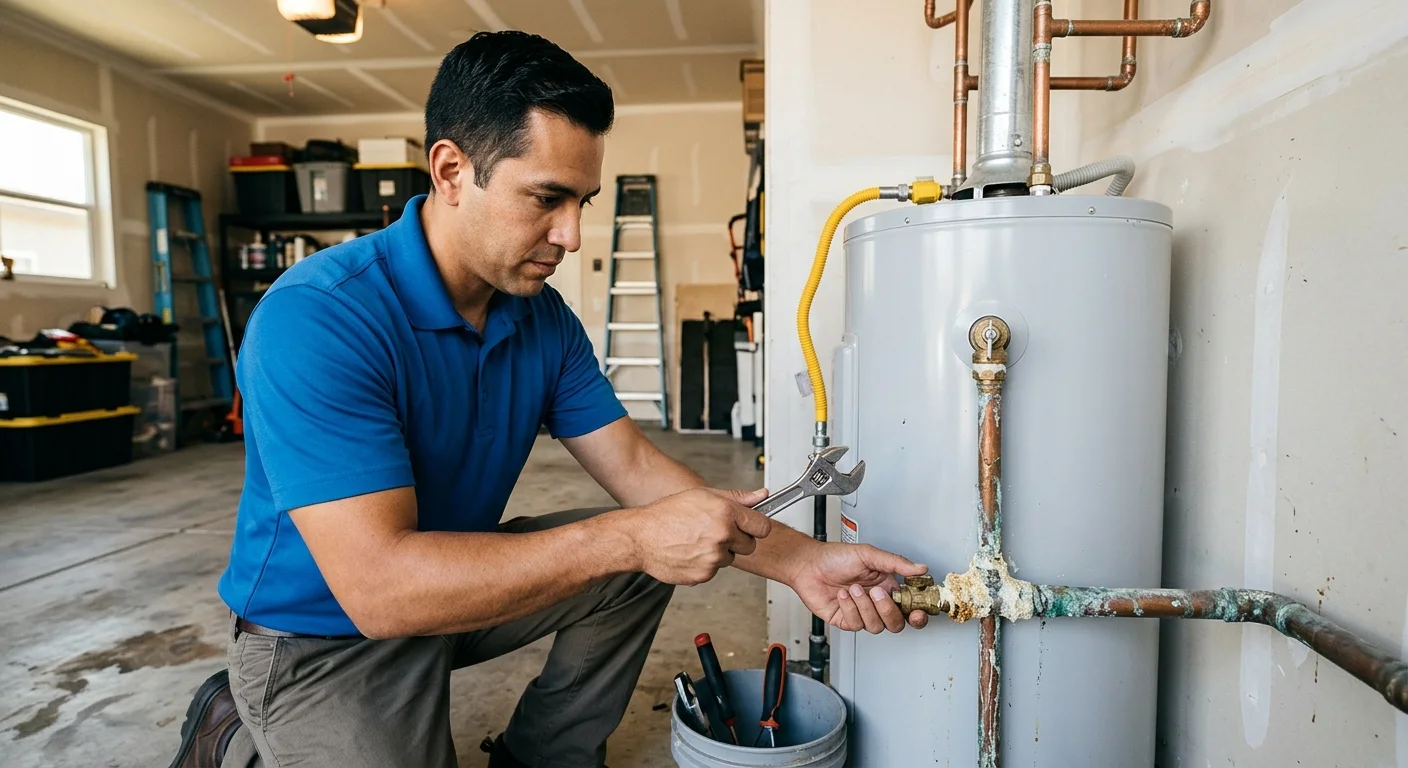
How hardness scale shows up on tanks and tankless units
Hardness is calcium and magnesium in the water. When that water is heated, those minerals drop out as scale. USGS classifies water over 180 mg/L as calcium carbonate as very hard. That sits a bit above 10 grains using USGS’s figure of about 17.1 mg/L per grain. Helix Water District draws the same hard line at 10 grains or more. City of San Diego taps in the published 16 to 18 grain range sit well above it.
On a storage tank, scale in a San Diego water heater often collects as sediment on the bottom. You’ll see a white crust around the drain valve. You may hear popping or rumbling as the burner or element heats through that layer. Hot taps can spit flakes. Electric elements can coat and heat poorly. Those are appliance symptoms. They still start with the water feeding the tank.
A hard water tankless water heater fails in a tighter space. There is no big reservoir of sludge. Water runs through a heat exchanger. Scale forms on those passages. Flow can drop. The unit can throw a maintenance or scale warning. Navien’s tankless guidance includes an annual flush and descale of the heat exchangers. It also says hard water may need more frequent maintenance, and that an anti-scale device or a water softener can reduce mineral buildup. Navien’s NHW-SE warranty is void for improper maintenance, including scale buildup, and for damage from hard water deposits, lime, or mineral build-up. Those are Navien terms. Other brands write their own manuals and warranties. Follow the model you own.
There is no verified ranking of which water heater is best for hard water. A tank stores sediment. A tankless unit scales a smaller heat path. Both see the same incoming grains. Incoming treatment does more for the next heater than swapping tank for tankless and leaving the supply alone.
Flushing a tank can move some sediment already sitting inside. It does not change the hardness still coming in. How often you flush is a manufacturer call, not a county rule. Navien’s annual service is a brand instruction, not a universal interval for every tank from Encinitas to Otay. Filter Pros San Diego does not service water heaters. A licensed plumber handles the unit. A hardness test tells you whether the replacement will see the same water.
Separate supply issues from heater damage
Not every cold shower is scale. An electric tank with a tripped breaker sits cold. A gas tank with a dead pilot does too. A broken dip tube or a leaking tank are heater faults. Those belong to a licensed plumber. Do not open a pressurized tank. Do not work on wet electrical parts.
Supply problems can mimic heater damage. Scale in pipes and fixtures can cut flow at showers and laundry, which looks like a weak heater. Low pressure from hard water scale is a house-wide pattern. If only the hot side is weak, the heater or its hot lines are the first look. If cold and hot are both weak, the incoming line and the pipes need a look too.
House-wide clues help you separate the two. Chalk on shower glass, crust on faucet aerators, and stiff laundry show up when hardness is in the whole plumbing, not only the tank. Our guide to hard water effects on your home covers those room-by-room signs. An isolated rumble with clean glass can still be sediment in the tank. It can also be a failing anode or a tank that a plumber will want to replace. We do not publish a lifespan figure for heaters. The manufacturer and a plumber set that call.
If you smell gas, leave the house and use the utility’s gas emergency line. That is not a filtration visit. If the tank is leaking onto a garage floor in City Heights or a closet in Chula Vista, shut the supply if you can do it safely and call a plumber. Treatment can wait until the leak is isolated. Treatment cannot wait forever if the incoming water is hard. A new heater on untreated City or Helix water will see the same minerals.
What a hardness test can confirm
A hardness test answers a narrow question: how many grains of calcium and magnesium feed the heater. It does not prove the tank is dead. It does not certify the water as safe to drink. EPA’s home-treatment guidance says to start with the serving utility’s report and with testing that matches the concern.
The City of San Diego’s plumbing page reports typical drinking water around 16 grains per gallon, or about 276 ppm, and a range of 16 to 18 grains, or 272 to 284 ppm, that varies by area and by water demand. That figure is for the City system. It is not a countywide average. It does not describe private wells.
The City’s 2025 Consumer Confidence Report, Public Water System 3710020, reports total hardness in grains per gallon by plant. Alvarado averaged 13.8 (11.9 to 15.8). Miramar averaged 14.1 (11.7 to 16.6). Otay averaged 14.2 (11.7 to 15.8). Purchased treated water averaged 8.5 (3.18 to 13.6). Those are plant and purchased-water rows for the 2025 reporting year. They are a different City publication covering different measurements from the plumbing-page typical figure. Neither row is your tap until you confirm the serving plant and test the house.
Helix Water District states that imported Colorado River and State Water Project water averages 14 grains, and that 10 grains or more is hard. That is a statement about the imported supply, not a given East County tap in La Mesa, El Cajon, or Lemon Grove. Confirm the retail agency for the address. The San Diego County Water Authority publishes water-quality information for the regional wholesale supply. Other districts publish their own reports. Do not copy a City number onto a well in Ramona or a Helix number onto a City meter in Pacific Beach.
USGS classifies hardness as calcium carbonate: 0 to 60 mg/L soft, 61 to 120 moderately hard, 121 to 180 hard, and over 180 very hard. That is classification guidance, not a safety rating and not a prediction of heater failure.
Filter Pros San Diego arranges a free in-home water test and connects you with a separately licensed water-treatment pro. The test is for hardness and related treatment questions. Ask the pro what the visit covers. It is not a state-certified lab panel unless that is arranged separately.
Treatment that protects plumbing after the heater
Flushing the heater removes some of what already dropped out. It does not soften the water still entering the house. Hard water solutions sit at the point of entry, ahead of the heater, so treated water reaches the tank or the tankless exchanger and the rest of the plumbing.
NSF/ANSI 44 covers ion-exchange softeners that reduce calcium and magnesium hardness. A listing is not a ranking. Compare the exact model’s certified reduction claim, rated capacity, and salt and water use. EPA’s May 2026 water-softener guide says to size from measured hardness and household water use, and to leave irrigation out of that demand when it is appropriate. Oversizing can waste water. Demand-initiated regeneration follows use and hardness instead of a fixed timer.
Salt-based softening adds sodium. University of Nebraska–Lincoln Extension estimates about 8 mg/L of sodium for each grain per gallon of hardness removed. People on restricted sodium diets should talk with a physician. Drinking and cooking water is often taken from a kitchen cold line that bypasses the softener. Potassium chloride is an option on some units, with professional guidance.
Salt-free conditioning does not remove hardness ions. EPA says to evaluate the exact scale-reduction claim, not a promise of softened water, and to weigh salt-free models against IAPMO/ANSI Z601 scale-reduction requirements. Filter Pros refers salt-free PF1025 conditioning when that path fits: no salt, no added sodium, no bags to haul, no brine discharge. That is a product path, not a certified performance ranking. The licensed pro should match the claim to the test.
Tanks in this network are medical-grade stainless steel, not fiberglass with a plastic liner. Ask the pro to show you the vessel you would actually get.
Point-of-use reverse osmosis, under NSF/ANSI 58 when the model is certified for a given claim, treats a drinking tap. It does not protect the water heater. Whole-house scope is the heater conversation. Water softener installation is contracted with the licensed pro you are connected with. Filter Pros does not install the system. In the City of San Diego, water-softener installation is listed among Simple No-Plan Plumbing/Gas Permit work for eligible properties. Scope and historic-property rules change the permit route. That is City guidance, not a countywide rule.
When to involve a licensed plumber and a water-treatment pro
Call a licensed plumber for the heater itself: leaks, gas, electrical, T&P discharge, no hot water, a failed element, or a tankless unit that needs a manufacturer-specified descale. Check the plumber’s license on the CSLB license lookup. Filter Pros San Diego does not pull heater permits and does not repair heaters.
Call a licensed water-treatment pro when a hardness test shows the supply is hard enough to keep scaling the next unit. The homeowner contracts with that pro and pays that pro. The brand answers the phone, arranges the test, and makes the referral. The pros we connect you with are licensed and insured.
Many San Diego jobs need both visits. The plumber saves or replaces the appliance. The treatment pro changes the water the appliance will see. Doing only the heater leaves the same grains on the new tank or the new exchanger. Doing only treatment will not stop a tank that is already leaking.
If the property uses a septic tank, EPA advises checking with the septic manufacturer or local service provider before installing a softener, because of overload, warranty, and performance questions. That is not a San Diego ban. Softener restrictions in local cities have not been verified here. Confirm the current rule with the building department that has jurisdiction.
When to call us
If a heater is scaling and you need a hardness number before you replace it, start with the water, not the appliance aisle. Filter Pros San Diego will set up a free in-home water test and connect you with a licensed water-treatment pro for the treatment side. Call us at (858) 400-6508 to set up a free in-home water test.