The brine tank only works if the salt in it can dissolve. A bag that cakes, a fill that sits too high, or a form the valve never meant to use will starve regeneration. City of San Diego Public Utilities reports typical drinking water around 16 grains per gallon, with a 16 to 18 grain range that varies by area and demand, so a stalled unit shows up as scale on glass and fixtures.
Why salt form matters for a working softener
A salt-based softener is an ion-exchange unit. Resin in the mineral tank holds calcium and magnesium, then a brine rinse knocks those hardness minerals off so the bed can work again. NSF/ANSI 44 is the standard that covers those ion-exchange softeners for hardness reduction. It is a certification role for a named model. It is not a ranking of salt bags, and it does not prove a bag will perform in every tank.
The brine comes from salt sitting in water in a separate brine tank. If the salt cannot reach that water, the valve can still cycle and the house still gets water. The resin does not get a real recharge. That is why form, fill height, and dryness matter as much as the name on the bag.
Helix Water District treats 10 or more grains per gallon as hard water. The imported Colorado River and State Water Project supply the county buys averages about 14 grains, per Helix. That is a statement about the imported supply, not every tap. The City of San Diego figure above is for the City system only. It is not a countywide average, and it does not describe private wells. Confirm the serving utility for the address, and read the current report from the San Diego County Water Authority or your retail district.
EPA guidance says to size a softener from measured hardness and household water use, and to follow the model’s own maintenance instructions. Demand-initiated regeneration responds to use and hardness rather than a fixed timer. None of that replaces the salt the brine tank is built to dissolve. If you are still choosing a whole-house path, start with hard water solutions and a measured hardness reading, not a guess from a neighbor’s leftover bag.
The homeowner buys the salt. Filter Pros San Diego does not stock a warehouse or run a salt route. The brand answers the phone, arranges a free in-home water test, and connects you with a separately licensed Water Filtration pro when the unit itself needs work.
Pellets, solar salt, and potassium chloride
Hardware stores around San Diego County sell a few forms. The model’s manual, not the aisle sign, decides which one belongs in your tank. Kinetico’s owner guidance is plain on this point: tablet versus block depends on the model, and other brands follow their own manuals. Water softener salt pellets vs solar salt is a form choice. It is not a purity contest, because we could not confirm a universal percentage that belongs on every bag.
Pellets
Pellets, often sold as tablets, are compressed so they sit in a pile and dissolve as brine is drawn. Many valve manuals name pellets or tablets as the default because they tend to feed the grid in an even layer. That is still a form choice, not a lab result. If a number is not printed on your bag and in your manual, do not treat a round figure from memory as a spec.
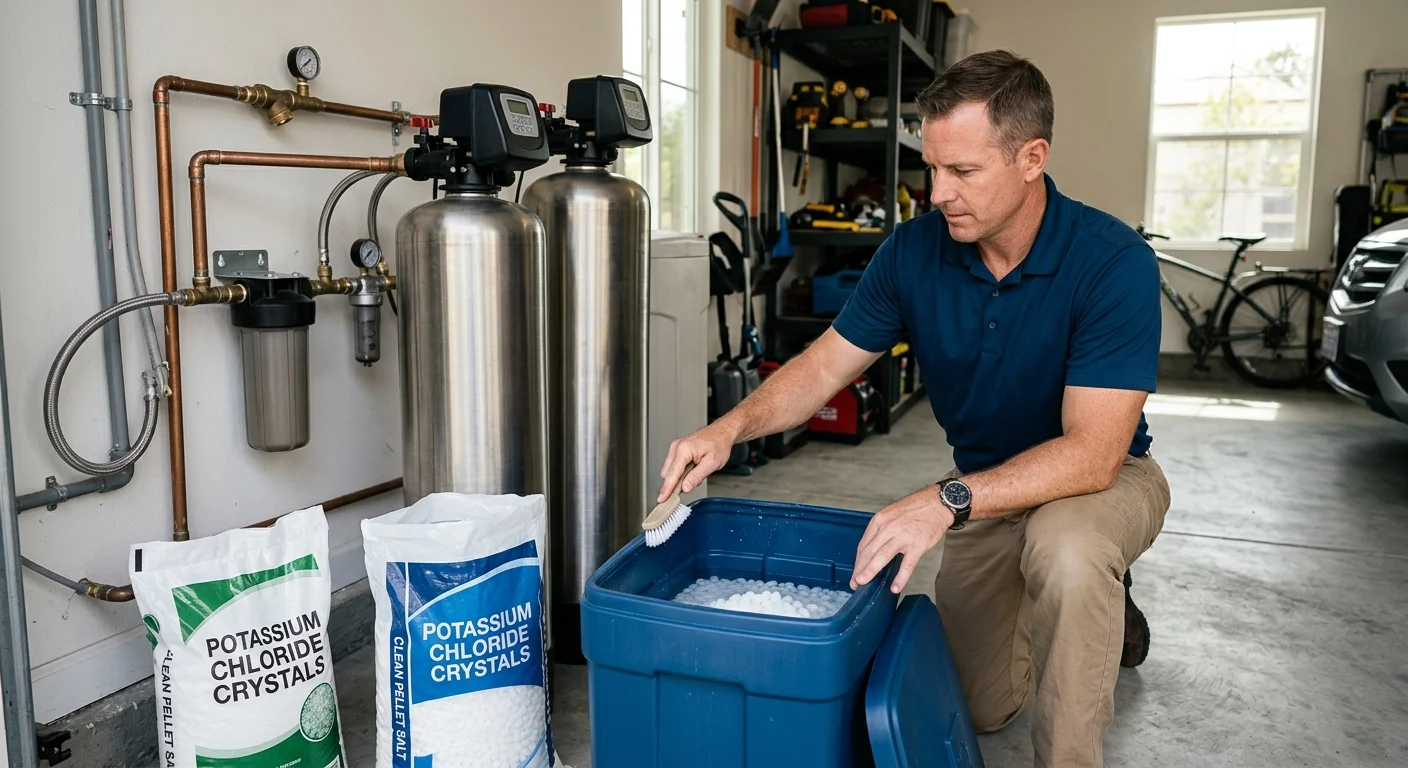
If water is visible above the salt, Kinetico tells owners to add salt or potassium chloride. Identify the brine tank, not the resin tank, before you pour. Our walkthrough on how to add salt to a water softener covers that step without turning the lid into a repair job.
Solar salt
Solar salt is a crystal form made by evaporating brine in the sun. Bags labeled solar salt sit next to pellets in San Diego big-box aisles. Some owners prefer the looser crystals because they pour easily. Some manuals still want a tablet or a block. If the manual names a form, match it. Do not mix leftover rock salt into a pellet tank to use it up.
Kinetico tells owners not to use rock salt. That is that manufacturer’s rule. Treat it as a reason to skip rock salt unless your own manual clearly allows it.
Potassium chloride
Potassium chloride water softener salt is the usual sodium-free bag option. University of Nebraska–Lincoln Extension describes potassium chloride as an option in some units instead of sodium chloride, with professional guidance. Through ion-exchange softening, sodium is added at about 8 mg/L for each grain per gallon of hardness removed. Their example: 10 gpg of hardness yields about 80 mg/L of sodium after treatment. That is an estimate of added sodium from hardness removed, not a measured San Diego tap result, and it is not medical advice.
People on restricted sodium diets should consult a physician. Drinking and cooking water is often taken from a kitchen cold line that bypasses the softener. Read our note on whether a water softener adds sodium before you switch bags for a diet reason. A licensed pro can confirm whether your valve and resin are set up for potassium chloride. Do not treat potassium as a proven health upgrade. That claim is not in the sources we hold.
EPA also notes that salt-free conditioning does not remove hardness ions. If you want a no-bag path, that is a different system with its own scale-reduction claim to verify, not a different salt.
What a salt bridge is versus the wrong salt
A salt bridge is not the same problem as the wrong product in the tank. Rheem’s manufacturer manual describes a hardened salt crust that can create a gap between the salt and the water. The salt sits on a crust. The water sits below it. Nothing dissolves, so the unit cannot make brine, and regeneration fails.
That crust is a salt bridge. The service steps live on that page. Do not chip at it with a sharp bar, and do not pour water on a guess. Read that post, then follow the model manual.
Wrong salt is a different failure. Rock salt and dirty crystals can leave insolubles in the grid. A packed fill can cake. Kinetico warns that overfilling can cause bridging, and that you should not fill the tank completely. Their own fill guidance: medium to high usage about one-half to three-quarters full; low usage about half full. Other brands use their own marks. If the salt has turned to mush against a humid garage wall, that is storage, not a mystery chemical.
If the tank looks fine, the salt is dropping, and the house still feels hard, the problem may be the valve, the resin, or a bypass left open. That is water softener repair territory, not a new bag.
Storage and humidity in a San Diego garage
Most San Diego brine tanks live in a garage. That space is not the same in La Jolla as it is in El Cajon. Coastal north county and the South Bay pick up marine-layer moisture. Inland north county and East County run hotter and drier. Bags stacked on a damp slab in Imperial Beach cake faster than bags on a pallet in Ramona. The chemistry of the salt is the same. The garage is not.
Keep unopened bags off the concrete, sealed, and out of sprinkler overspray. A cracked bag next to a water heater drip will pull moisture and fuse. Once a bag is open, use it rather than parking a half-empty sack against the tank. Do not invent a calendar for how often every house should refill. If water sits visible above the salt, add the form your manual allows. If the pile is still high and dry, wait.
Inside the brine tank, leave headroom. Kinetico’s overfill warning is about bridging, and it matches what owners see after a fill-it-to-the-lid session. Humidity plus a packed tank is how a crust forms across the top while a hollow sits under it.
Do not store pool chlorine, paint, or fertilizer against the brine tank. Those are garage habits, not salt specs. If you already have a crust, treat it as a bridge and go to the salt-bridge page. Routine water softener maintenance in San Diego is checking salt level, looking for standing water above the salt, and listening for a regen that actually finishes.
EPA flags persistent drain flow as a possible malfunction. A hose that never stops is not a salt-type issue. Isolate the unit with the bypass if you need to, then have a licensed pro look at the valve. Culligan notes that bypass exists so household water can keep running while the softener is isolated. Confirm bypass at a cold tap. Do not force a stuck handle. Follow the exact model manual.
When a separately licensed pro should inspect the unit
Call a separately licensed Water Filtration pro when the bag change did not restore soft water. Hard water back on glass after a fresh fill, a tank that will not drop salt, a bridge that returns, or a leak at the valve, bypass, overflow, or tank are inspection items.
EPA’s May 2026 water-softener guide says to follow model-specific installation, bypass, and maintenance instructions. Persistent drain flow can indicate a malfunction. Manufacturer leak notes from Rheem and GE point to locating the wet spot, isolating with bypass or supply shutoff, and contacting the installer or plumber. Do not open pressurized assemblies. Do not handle wet electrical parts.
Filter Pros San Diego is a referral brand. It does not hold the contractor license for the work, and it does not own the truck that shows up. The homeowner contracts with, and pays, the licensed pro directly. You can confirm a California contractor license on the CSLB license check.
A free in-home water test is the right first step when you are not sure whether the supply, the softener, or both are the issue. The City of San Diego 2025 Consumer Confidence Report lists plant hardness, not a countywide tap result. Alvarado averaged 13.8 gr/Gal, Miramar 14.1, Otay 14.2, and purchased treated water 8.5. Those are 2025 plant figures, not your faucet and not a well. The older City plumbing-page typical of about 16 gpg is a different City publication covering a different measurement. A test at the house beats both.
If the unit is undersized, the resin is exhausted, or the valve is stuck in brine, more pellets will not fix it. That is repair or replacement, scoped in writing by the pro.
When to call us
When the brine tank, valve, or resin needs hands-on work, a licensed Water Filtration pro should inspect the unit. Filter Pros San Diego can arrange a free in-home water test and connect you with that pro. Call us at (858) 400-6508 to set up a free in-home water test.