For a Del Mar home, start with the water provider, current report, and a tap-specific test. Then choose a documented system that addresses your confirmed drinking-water goal and fits beneath the sink. Filter Pros arranges the free in-home water test and connects you with a separately licensed pro.
Identify the provider serving the Del Mar address
Start with the provider and service address named on the current water bill. Confirm the installation authority for the property before applying a permit rule.
That gap matters because the provider’s report must match the property. Don’t substitute a nearby agency’s numbers because its service area looks close on a map. The San Diego County Water Authority is a useful regional starting point, but the current bill remains the clearest address-specific record.
If the property is a condominium or rental, ask the manager or owner for the bill. Keep three labels separate during the project: the mailing city, water provider, and local installation authority. Ask the provider for its current water report. Ask the appropriate city, county, or building authority about any approval requirements.
The City of San Diego reports an average of about 16 grains per gallon for its own system, varying by area and water demand. That does not establish the hardness at a Del Mar tap. Check the actual supplier’s report and measure the property’s water when selecting equipment.
Helix Water District says imported Colorado River and State Water Project water averages about 14 grains per gallon. That describes imported supply, not an individual Del Mar address.
Inspect the actual cabinet, plumbing, countertop, and property documents. Record space, connection and access requirements for the proposed model rather than estimating them from the ZIP code.
Compare the current water report with a tap-specific test
Once you’ve identified the provider, obtain its current water report. Record the report year, provider name, and service area. Any contaminant figure used in the buying decision should retain its year and source.
The report and tap test answer different parts of the decision. The report describes the provider’s published water information. A tap-specific test records a sample from the home where the system will be used. Keep both documents together when comparing equipment.
Filter Pros arranges a free in-home water test before making the referral. Ask for the sample date, sample location, test method, and units to be written down. If your concern involves a specific regulated contaminant or a health question, ask the provider or a qualified laboratory which test applies. A screening result shouldn’t be stretched beyond what its method can support.
Your comparison notes should include:
- The provider serving the exact address
- The publication year of its current report
- The faucet or location where the home sample was collected
- The substance, taste, or other drinking-water goal being evaluated
- Any result that still needs confirmation through the provider or a laboratory
Check your provider’s current report for published contaminant results and any active notices. For a specific concern at the property, ask an appropriate laboratory about sampling and analysis. A city name, taste or basic field screening does not establish whether PFAS, lead, iron or another constituent is present.
This comparison keeps the purchase focused. It also gives a licensed pro something concrete to review before recommending a model.
Match treatment to the confirmed drinking-water goal
Turn the goal into one plain sentence. It might concern a documented test result, an identified taste issue, or the water used at one kitchen faucet. Keep separate concerns on separate lines. That prevents a broad product label from replacing the evidence.
Reverse osmosis is one possible treatment path. Match the exact model’s certified reduction claims to the concern identified in your report or test. A general claim that a system removes everything does not tell you which substances it reduces or under what conditions.
Ask for performance documentation for the exact model and exact target. The document should identify the substance, test conditions, rated performance, and replacement requirements. Check that the model number on the proposal matches the model number in the supporting document.
NSF/ANSI 42 covers specified aesthetic claims, NSF/ANSI 53 covers specified health-effect contaminant claims, and NSF/ANSI 58 covers reverse-osmosis systems. A standard number alone does not establish every reduction. Look up the exact model and replacement element and compare the listed claim with the proposed treatment goal.
For a system intended at one sink, compare reverse osmosis drinking-water options with other under-sink drinking-water filtration. These categories aren’t automatically interchangeable. The test result, stated goal, and exact product documentation should drive the choice.
Keep hardness observations separate from contaminant claims. The City of San Diego figures don’t prove the hardness at a Del Mar home, and an imported-supply average isn’t a tap measurement. If residue or scale is part of the concern, include it in the testing notes rather than treating it as a confirmed local number.
Taste preferences also belong in the written goal. If a proposal includes an additional stage or remineralization option, ask what it changes and request documentation. The goal is a system selected from confirmed information, not a longer list of features.
Plan the cabinet, faucet, and drain connection
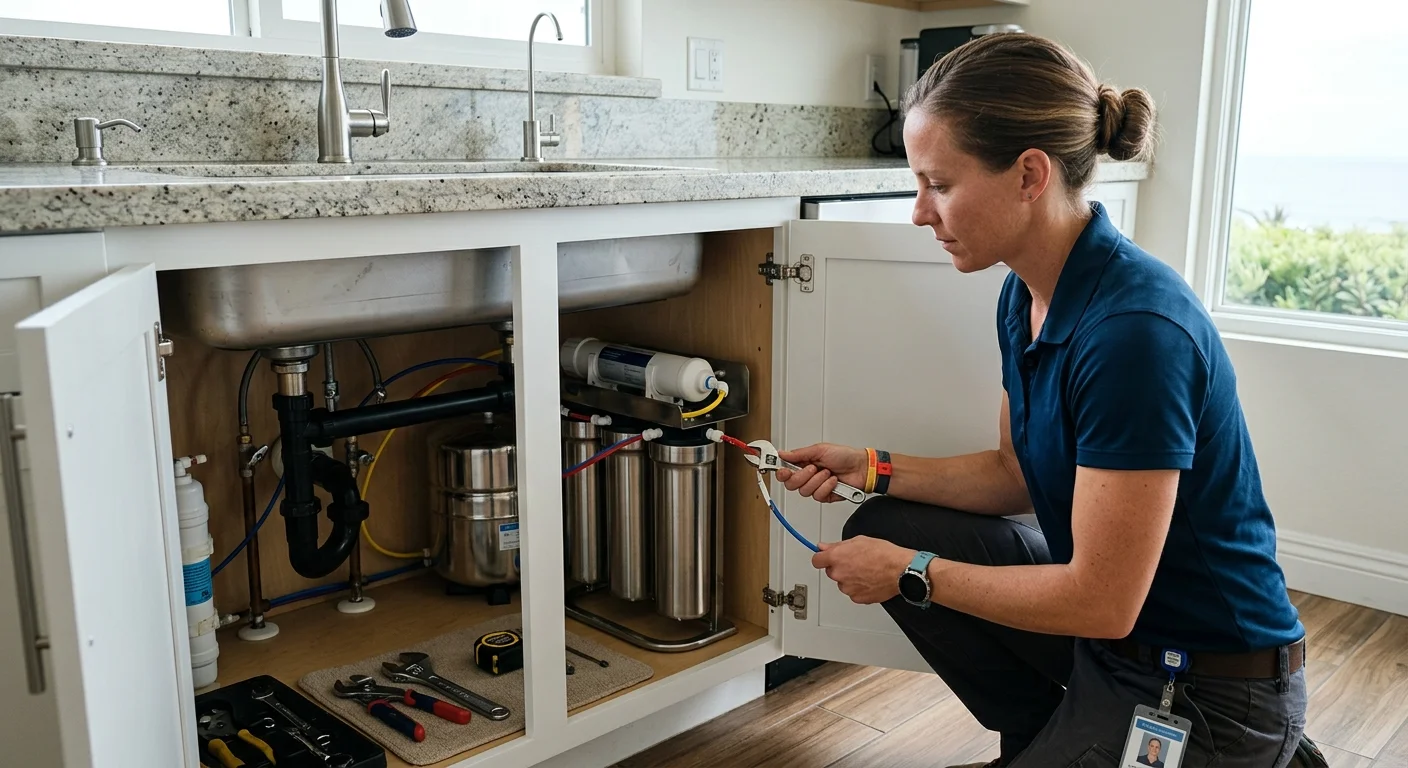
An under-sink plan starts with measurements. Record the cabinet’s usable width, depth, and height. Note shelves, drawers, shutoff valves, pipes, the garbage disposal, and anything stored inside. Photograph the cabinet with the doors fully open.
Ask the pro to mark each planned component. A proposed layout may include the treatment assembly, storage tank, faucet line, and drain connection. Confirm that filters and other replaceable parts remain reachable after installation. A unit that technically fits can still be awkward if a door, pipe, or disposal blocks access.
The faucet plan needs the same detail. Identify any unused sink opening. If a new opening is proposed, the pro should first identify the sink or countertop material and obtain any required property approval. Renters and condominium owners should check their lease, owner instructions, or association documents before permanent changes are made.
For the drain connection, ask the pro to show the proposed location. Have that location included in the written scope. The proposal should also state whether cabinet changes, plumbing changes, or an electrical connection are part of the design.
Don’t assume the home’s water pressure meets a product requirement. Ask the pro to measure it and compare the result with the manufacturer’s current instructions. Avoid inserting an unverified pressure number into the proposal.
Ask the separately licensed pro to identify the authority for the property and confirm the current permit requirements for the proposed installation scope.
Tank materials also need documentation. Request the exact tank model, drinking-water suitability, construction specifications and manufacturer instructions. Compare operating limits and warranty terms; a material label alone does not establish treatment performance or service life.
Our San Diego water-filter installation guide offers more planning context. The final layout still needs to reflect this cabinet and this property.
Questions for the separately licensed pro
Bring the report, tap-test notes, cabinet measurements, and photos to the appointment. The proposal should connect every recommendation to those records. If an answer relies on a product claim, ask for the supporting document.
Use these questions during the review:
- Which water provider and report year did you use?
- Which confirmed result or drinking-water goal does this model address?
- What’s the exact manufacturer and model number?
- Where’s the performance documentation for the stated target?
- Where will the assembly, tank, faucet line, and drain connection go?
- Will any cabinet, countertop, plumbing, drain, or electrical work be needed?
- Which authority decides whether the proposed scope needs approval?
- Who handles any required application or inspection?
- What parts require replacement, and what manufacturer schedule applies?
- Who provides the written product and workmanship warranty?
- What’s included in the written price, and what could change it?
Get a written, address-specific proposal covering the equipment, installation, maintenance and replacement parts. General national price guidance is a planning aid; it is not a Del Mar installation quote. Review the questions in our San Diego reverse osmosis cost guide before comparing proposals.
Confirm the business name and license information presented for the contracted work. California’s CSLB license check lets you review the license record directly. Make sure the business named in the contract matches the information you checked.
Filter Pros San Diego is the referral service. We answer the phone, arrange the free in-home water test, and connect homeowners with separately licensed pros. We don’t perform the installation. You contract with and pay the selected pro directly.
When to call us
Call when you’re comparing a permanently connected RO system, planning plumbing changes, or matching a model to a tested drinking-water goal. We’ll arrange the free in-home water test and connect you with a separately licensed Water Filtration pro. Call us at (858) 400-6508 to set up a free in-home water test.