The right water softener starts with hardness measured at your Coronado tap. Don’t choose equipment using a neighboring city’s average or a salesperson’s guess. Filter Pros arranges a free in-home water test, then connects you with a separately licensed pro.
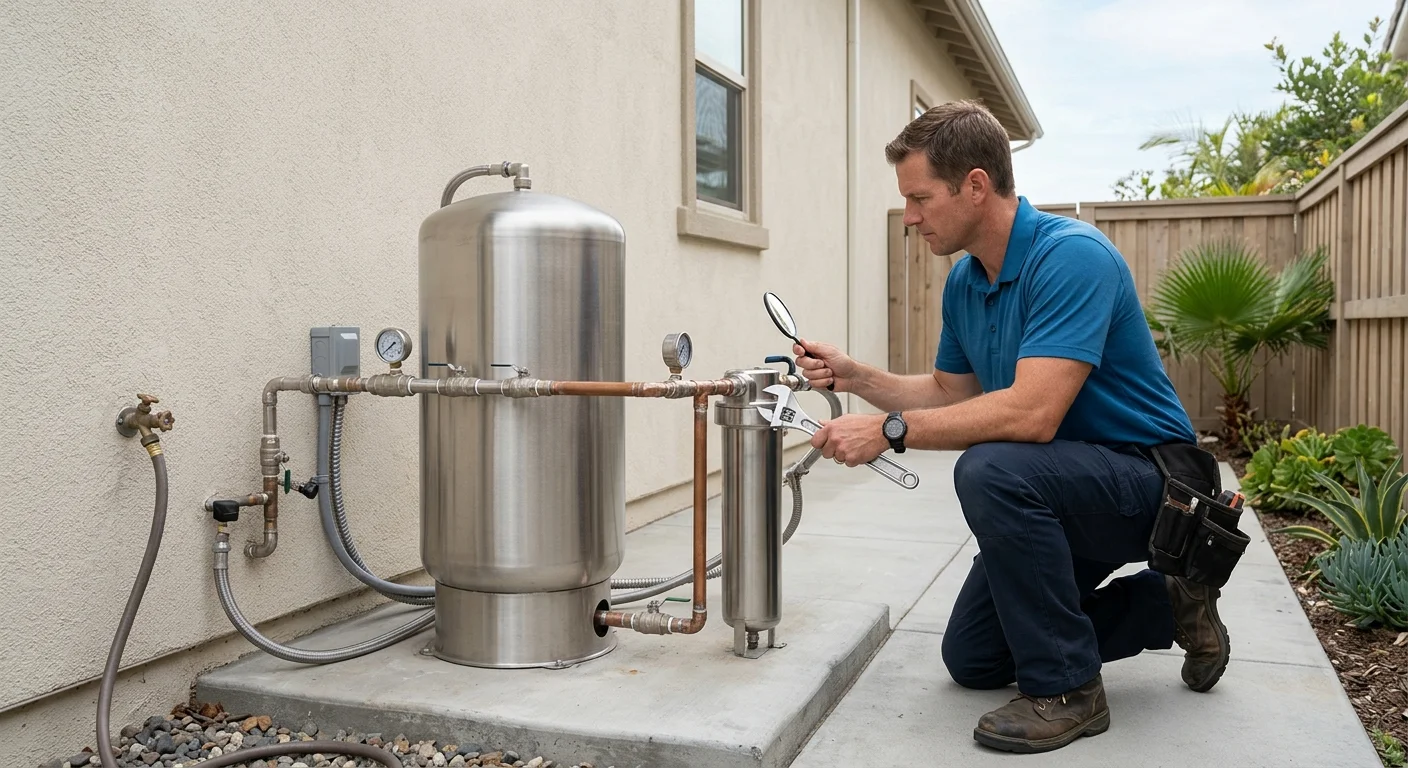
Start with hardness measured at the Coronado tap
Coronado water softeners should be selected using results from the home itself. Start by identifying the water provider shown on your current bill. Then find that provider’s latest Consumer Confidence Report and compare it with a tap test.
Use the home’s water provider for published supply information and measure hardness at the property before sizing equipment. A number reported for another water system is not a reading from a Coronado tap.
The nearby City of San Diego publishes an average of about 16 grains per gallon, or 276 parts per million. It also publishes a range of 16 to 18 grains per gallon, or 272 to 284 parts per million. The city says those figures vary by area and water demand. They apply only to the City of San Diego system, so they don’t establish the hardness at a Coronado address. The figures can be reviewed on the City of San Diego Public Utilities water page.
A test at the Coronado tap closes that information gap. Ask for the result in grains per gallon or parts per million. Keep the written result beside any equipment proposal. It gives the licensed pro a measured starting point and gives you something concrete to compare later.
Don’t rely only on spots, residue, or how soap feels. Those observations can help describe the problem, but they don’t replace a hardness measurement. Testing first keeps the equipment discussion tied to the water entering that specific home.
Separate water supply facts from home plumbing
A water report and an in-home test answer different questions. The report describes the public supply for a stated reporting year. The tap test records what was measured at the selected fixture during that visit.
Start with the provider listed on the bill. The San Diego County Water Authority can provide regional context, but a countywide statement can’t replace information from the provider serving the address. Hardness can vary by service area and season within San Diego County.
The home also has its own plumbing layout. Before recommending equipment, the licensed pro should inspect the point where water enters, the available pipe route, and the proposed installation area. Tell the pro about residue, recurring scale, or changes you’ve noticed. Those details help frame the inspection without turning a visual symptom into an unsupported diagnosis.
This distinction matters across Coronado. A home in Coronado Village may present a different installation layout than a residence in the Coronado Cays. A condo, detached house, and shared utility area also require different planning. Those building conditions don’t establish water hardness, but they can affect where equipment may fit.
Our guide to whether San Diego water is hard explains why one regional number can mislead homeowners. For a Coronado buying decision, keep three items together: the current provider report, the tap result, and the plumbing inspection. That gives the licensed pro a useful foundation for the recommendation.
Choose between softening and salt-free conditioning
Don’t treat “softener” and “conditioner” as interchangeable product labels. Ask the licensed pro to explain what the proposed equipment changes, what it doesn’t change, and how those claims will be checked at your tap.
If your goal is measurable hardness reduction, ask how the recommended water softener installation addresses that goal. The proposal should identify the exact model and the water-test result used for its selection. It should also explain the operating supplies, discharge needs, maintenance steps, and testing method.
If avoiding stored salt or a brine discharge connection is a priority, discuss salt-free water conditioning. Ask whether the proposed system reduces measured hardness or addresses scale behavior another way. Get that answer in plain language. Product documentation should support any performance statement.
Don’t assume a hard-water system addresses every water concern. EPA sets federal drinking water contaminant limits under the Safe Drinking Water Act. California’s Division of Drinking Water adds state limits. A hardness result alone doesn’t establish whether another treatment method is needed. Any additional recommendation should connect to a relevant test or the provider’s current report.
Tank construction also deserves attention. Compare documented stainless steel construction with fiberglass tanks that use plastic liners. Ask for the exact material specification, model sheet, and warranty terms. If a tank is described as “medical-grade stainless steel,” request documentation supporting that description. Our stainless versus fiberglass water tank guide shows which details to compare without relying on marketing shorthand.
The best fit is the system whose documented purpose matches the measured problem. A licensed pro should explain that match before installation. You’ll contract with and pay that pro directly, so the recommendation and final scope should be clear in writing.
Plan the bypass, drain, and installation space
Equipment selection isn’t finished until the plumbing route is inspected. A licensed pro needs to confirm the proposed tank location, bypass arrangement, pipe access, and any drain connection required by the selected model.
Start with practical access. The equipment shouldn’t block a door, water heater, storage path, or another utility. The pro should also have enough working room for installation and future service. If the location is outdoors or exposed, ask how the manufacturer’s placement requirements affect the plan.
A bypass matters because it provides a way to route water around the equipment when needed. Ask the pro to identify the bypass in the proposal and show you how it operates after installation. Don’t assume every model uses the same valve arrangement.
Drain planning depends on the actual equipment. Ask whether the recommended system creates a discharge stream, where that stream would go, and what local approval is required. The approved source material doesn’t confirm a Coronado-specific softener restriction or installation rule. Before authorizing work, verify current requirements with the local building authority. Don’t substitute a City of San Diego rule for Coronado guidance.
Shared buildings need another check. If the proposed location is in a condo or common utility area, ask whether property management or an association must approve the work. A licensed pro can inspect the plumbing, but the homeowner should confirm any property-specific rules that apply.
Take photos of the proposed area before the appointment. Include the water entry point, nearby drain options, wall clearances, and access path. Photos don’t replace an inspection, but they help the pro prepare focused questions about the Coronado home.
Questions to ask the licensed pro
A good proposal for a water softener in Coronado should connect every recommendation to the home. Use the test result and plumbing inspection to keep the conversation specific.
Ask these questions before signing:
- What hardness was measured at this tap?
- Which fixture was tested, and what method was used?
- Which water provider and Consumer Confidence Report apply here?
- What does the proposed equipment change?
- Does the model reduce measured hardness?
- How was the equipment selected for this household?
- What tank material and internal lining does it use?
- What operating supplies does the model require?
- Does it require a drain or discharge connection?
- Where will the bypass valve be installed?
- What routine maintenance does the manufacturer specify?
- What parts and labor are included in the written proposal?
- Which warranty applies, and who provides it?
- Does the local building authority require a permit or inspection?
- Who will perform the installation?
Request the contractor’s license information before work begins. You can check it using the California Contractors State License Board lookup. Confirm that the information matches the person or company named in the contract.
Avoid choosing equipment from an undocumented hardness number. The same caution applies to broad purity claims, material labels, and promises about maintenance. Ask for model-specific documentation and written terms.
Filter Pros San Diego arranges the test and referral. The homeowner contracts with the separately licensed pro who recommends and installs the equipment. Keeping those roles clear helps you know who is responsible for the proposal, installation, payment, and warranty.
When to call us
Call when you need measured hardness and a licensed pro to inspect the plumbing before recommending equipment. Filter Pros arranges the free test and connects Coronado homeowners with separately licensed Water Filtration pros. Call us at (858) 400-6508 to set up a free in-home water test.