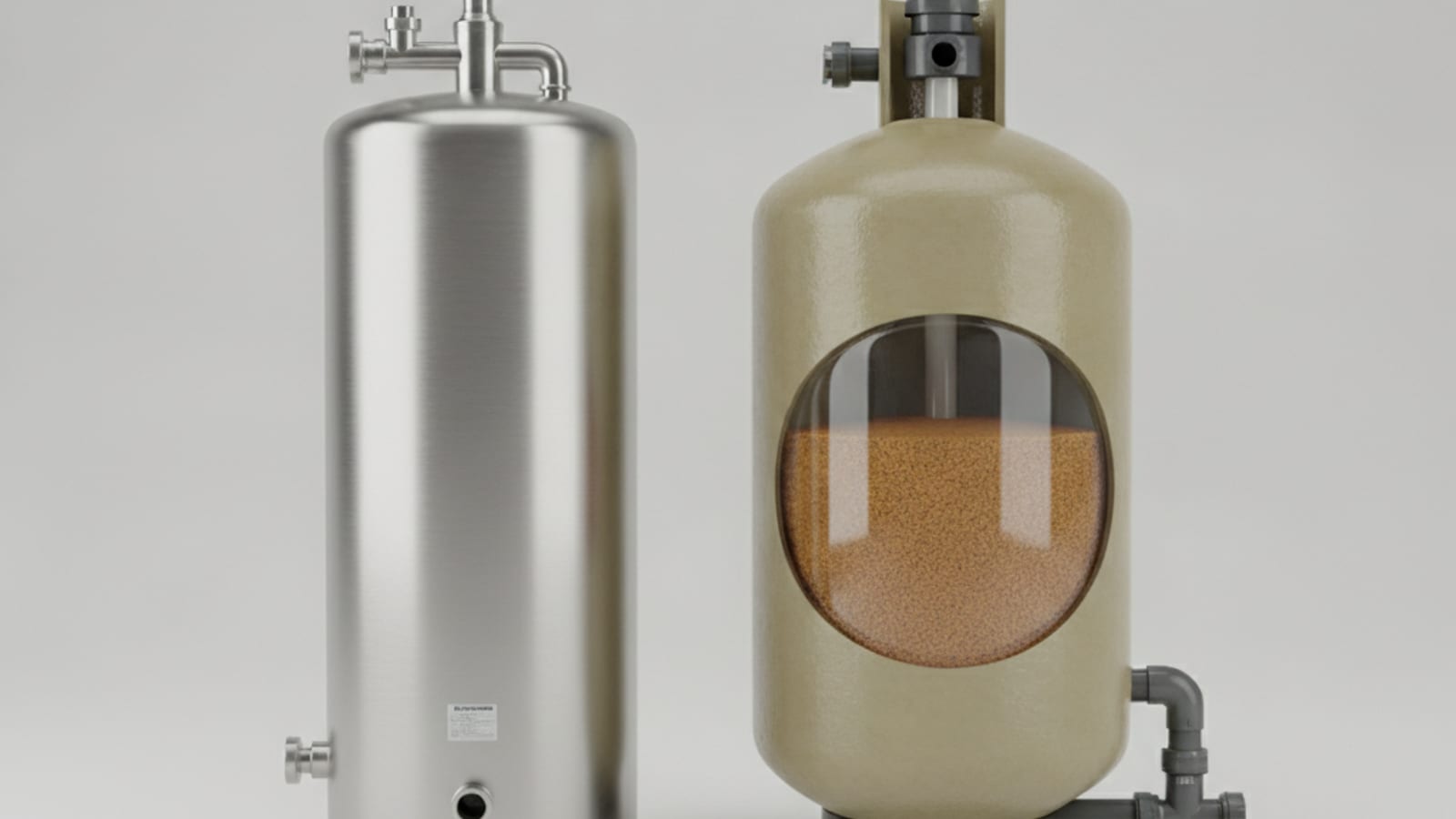
Most people shopping for a whole-house water filter focus on brand names, flow rates, and filter media. Very few ask what the pressure vessel itself is made of. That’s the tank that holds your filtration media, operates under continuous water pressure, and sits in contact with your water supply for years. It’s also where a lot of systems quietly fail over time.

The two main options are medical-grade stainless steel and fiberglass with a plastic liner. They look similar from the outside. They perform very differently over a decade of real use.

How pressure vessel tanks are actually built

A whole-house water filter tank is a pressure vessel. It holds the filtration media (carbon, birm, greensand, resin, or other materials) and water flows through it under pressure from your home’s supply line. The tank has to handle that pressure continuously, resist the chemistry of your water, and not contribute anything to the water passing through it.

There are two common construction approaches in the residential market.

Fiberglass tanks with plastic liners are the most common type sold through big-box stores, online retailers, and many lower-cost water treatment companies. The structural body is wound fiberglass, which is strong and lightweight. Inside, a plastic liner (typically polyethylene or a similar food-safe polymer) provides a barrier between the fiberglass and the water. The water never directly contacts the fiberglass itself, at least in theory.

Medical-grade stainless steel tanks use 304 or 316 grade steel throughout. There’s no liner. The steel itself is the contact surface. Grade 304 is the standard food-grade stainless used in commercial kitchens, food processing, and water systems. Grade 316 adds molybdenum, which increases corrosion resistance further and is used in marine applications and medical equipment where contact with aggressive chemicals or chlorides is a concern.

What happens to fiberglass liners over time

The liner in a fiberglass tank is doing important work. It’s the barrier that prevents any potential off-gassing from the fiberglass structure from reaching the water, and it’s the surface that resists degradation from whatever chemistry your water throws at it.

San Diego County water presents specific challenges. Coastal and inland municipal water is treated with chloramines rather than free chlorine. The Metropolitan Water District of Southern California has used chloramine as its primary disinfectant for decades. Chloramines are chemically different from free chlorine and are known to be more aggressive toward certain plastics and elastomers. The EPA’s guidance on chloramines in drinking water notes that it can attack rubber and plastic components in plumbing and water treatment equipment.

Beyond chloramines, San Diego water is hard, consistently in the 17 to 20+ grains per gallon range in most areas. Hard water with high mineral content creates scale. When scale builds up on the interior surface of a liner and then breaks loose over years of thermal cycling, backwashing, and pressure changes, it can carry liner material with it.

The degradation isn’t dramatic or sudden. It’s gradual. Liners can develop micro-fissures, lose flexibility, and shed microscopic particles into the water supply long before the tank shows any obvious external sign of failure.

There’s no publicly established timeline for when plastic liners in water treatment tanks degrade, because it depends on water chemistry, temperature, and the specific liner material. What is documented is that plastic components in contact with chloraminated water have shorter service lives than the same components in free-chlorine systems. The American Water Works Association has published research on chloramine’s effects on elastomers and polymers in distribution infrastructure for this reason.

What stainless steel does differently

304 and 316 stainless steel don’t have a liner to degrade. The steel itself is the contact surface, and its corrosion resistance comes from the passive oxide layer that forms on chromium-containing stainless alloys. That layer self-repairs when scratched or abraded. It doesn’t react with chloramines. It doesn’t shed particles.

The practical result is a tank with a significantly longer service life and no interior-surface degradation concern. Well-maintained stainless steel water contact components routinely last 20 to 30 years or more in commercial and industrial water treatment applications. In residential settings with lower flow demands, the lifespan is proportionally longer.

Stainless steel also handles temperature variation better than plastic liners. Garage installations in San Diego see hot summers. Utility rooms can get warm. Thermal cycling over years is one of the mechanical stressors that causes plastic materials to fatigue. Stainless isn’t affected by the temperature ranges a residential water filter will ever see.

What warranties actually tell you

Warranty terms are worth reading carefully when comparing water filtration systems. Fiberglass tank warranties from most manufacturers run 5 to 10 years, sometimes with coverage that excludes liner failure or requires proof of correct installation and water chemistry conditions. The limitations matter as much as the headline number.

Stainless steel tanks in professional water treatment systems typically carry longer warranties because there’s less that can go wrong with the vessel itself. When we install systems with medical-grade stainless steel tanks, the vessel warranty reflects the actual expected lifespan rather than a shorter term designed to exclude the most likely failure mode.

Why this often gets overlooked in the buying process

The tank doesn’t show up prominently in most filter marketing. Companies lead with the media, the grain capacity of softeners, the micron rating of sediment filters, or the certifications on their carbon. The vessel is treated as a commodity.

It isn’t. For a whole-house water filtration system that’s going to run continuously for 15 or 20 years, the vessel is the long-term investment. Replacing media is routine and expected. Replacing a tank that’s degrading from the inside out means draining the system, removing the media, and installing new equipment. The upfront cost difference between fiberglass and stainless steel is real, but it’s a fraction of what a mid-life replacement costs.

How San Diego water makes this more important

In other parts of the country with softer water and free chlorine treatment, fiberglass liner concerns are somewhat lower. San Diego’s combination of hard water and chloramine treatment makes the liner question more relevant here than in many other markets.

If you’re evaluating a whole-house system and the company can’t tell you what grade of stainless the tanks use, or defaults to describing them as “quality fiberglass,” that’s a meaningful data point about what they’re selling and why.

The honest picture

Fiberglass tanks work. They’re not defective. Many people run them for years without any noticeable problem. The concern isn’t that they fail immediately. It’s that over a decade-plus in San Diego’s chloraminated, high-mineral water, the liner’s condition is an unknown variable, and there’s no way to inspect it without opening the tank.

Medical-grade stainless steel removes that variable. The tank is visible, inspectable, and its corrosion resistance is a material property that doesn’t change based on what’s in your water. For equipment that sits at the heart of your home’s water supply, that’s a meaningful difference.

Our whole-house water filtration systems and salt-free conditioning units use medical-grade stainless tanks specifically because of how San Diego water performs over time. We’d rather explain the difference upfront than have a customer come back with a degraded system in year eight.

Call (858) 925-5546 or schedule a free in-home water test to see what your water looks like and what kind of equipment actually makes sense for it.

Related reading: