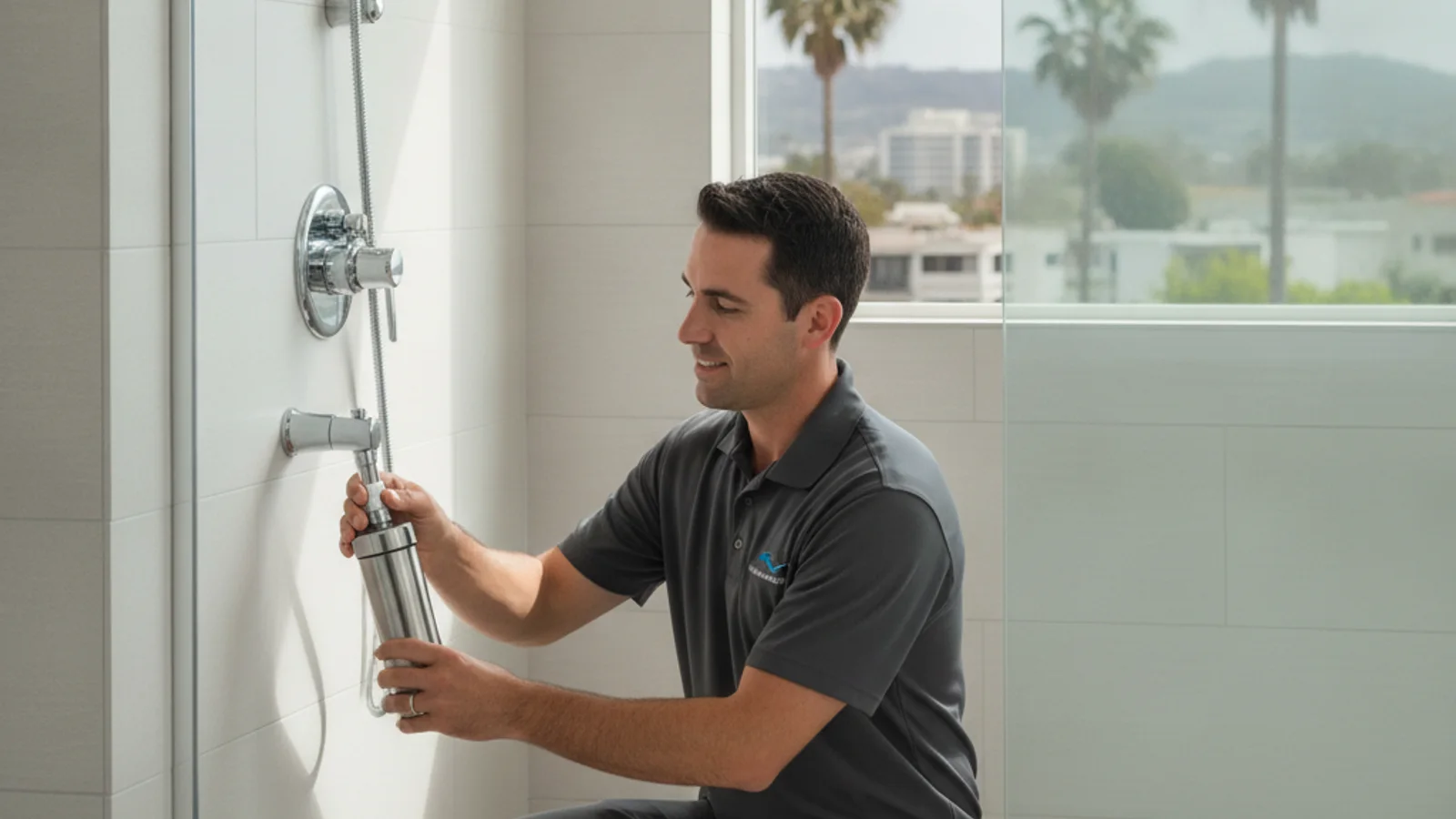
No shower filter can remove hardness minerals. Shower filters use KDF-55, activated carbon, or vitamin C media, and all three are built to pull out chlorine, not calcium and magnesium. Those minerals are what make water “hard,” and stripping them out takes ion exchange or reverse osmosis, neither of which fits inside a showerhead. A shower filter can help with chlorine-related dryness. It will not stop scale, spotting, or stiff hair from San Diego’s hard water.
What do shower filters actually remove?
Shower filters remove chlorine, and some remove a portion of chloramine, using KDF-55 (a copper-zinc alloy), granular activated carbon, or vitamin C cartridges. All three work through chemical reactions or adsorption that target chlorine compounds specifically. None of them touch dissolved minerals like calcium and magnesium, because those aren’t chemically reactive with the filter media the same way chlorine is.
Chloramine is the harder case. Utilities use it because it’s more stable than plain chlorine, and that same stability makes it resist KDF and carbon media, especially at shower flow rates. A shower filter typically gives water contact with the filter media for about one second. That’s enough time to strip chlorine. It’s not enough time to fully break down chloramine or touch a mineral ion.
Why can’t a shower filter soften water?
Softening means swapping calcium and magnesium ions for sodium or potassium ions, and that swap only happens through ion exchange resin, the same technology inside a full water softener. A shower filter cartridge holds carbon or KDF media in a housing the size of a coffee mug. There’s no room for the volume of resin a softening reaction needs, and there’s no regeneration cycle to keep it working.
Contact time is the other problem. Softening resin needs sustained contact with water to complete the ion swap. Water moving through a showerhead filter passes the media in about a second, which is fine for chlorine but nowhere near enough time for hardness minerals to bind to anything. Reverse osmosis is the other way to remove hardness, and it works by forcing water through a membrane at low flow under pressure, which is also incompatible with a showerhead’s flow rate and space.
Are shower filters worth it in San Diego?
They’re worth it if your main complaint is chlorine or chloramine smell and dry skin from chemical exposure, and not worth it if your complaint is scale, spotting, or stiff hair. San Diego tap water is hard: the City of San Diego publishes an average of about 16 grains per gallon, ranging 16 to 18 depending on your area and demand, well past the 10.5 gpg line the U.S. Geological Survey uses for “very hard” water. Most of it is imported from the Colorado River and Northern California, both of which pick up heavy mineral loads before reaching county taps.
That hardness level means a shower filter here is filtering out one irritant while leaving the bigger one untouched. Homeowners who install a shower filter expecting less scale on their glass door or softer-feeling hair are usually disappointed within a week, because the minerals causing both problems are still in every drop. For the hardness numbers by neighborhood, see is San Diego water hard. East County, including El Cajon, tends to run toward the higher end of that range, so a shower filter alone does even less there. Check your area on our water filtration service page for El Cajon.
What actually fixes hard water in the shower?
A whole-house water softener is the real fix, because it removes calcium and magnesium through ion exchange before water reaches any fixture in the house, not just the showerhead. That’s the difference that matters. A shower filter treats one tap. A softener treats the water supply, which means no more scale buildup on glass, no more soap that won’t lather, and skin and hair that stop reacting to mineral buildup instead of chlorine.
Some homeowners pair a softener with a separate carbon filter if chlorine taste and smell are also a concern, since a softener alone doesn’t remove chlorine. That combination covers both problems a shower filter tries and mostly fails to solve on the hardness side. Hard water shows up as more than just shower spotting too. See hard water and hair loss for how mineral buildup affects hair specifically, and does a water softener help eczema if dry or irritated skin is the bigger concern.
Which should you choose?
Choose a shower filter if chlorine smell or chlorine-related dryness is your only complaint and you’re not dealing with visible scale or spotting. Choose a water softener if you’re seeing white residue on glass or fixtures, stiff hair, or soap that won’t rinse clean, since those are hardness problems a filter can’t touch. Choose both if you want chlorine reduction and hardness removal in one shower, which usually means a softener for the whole house plus a small in-line carbon stage.
| Shower filter | Water softener | |
|---|---|---|
| Removes chlorine | Yes | No |
| Removes chloramine | Partially, poorly at shower flow | No |
| Removes calcium/magnesium (hardness) | No | Yes |
| Stops scale and spotting | No | Yes |
| Typical cost | $20-$80 | $1,500-$5,500 installed |
| Install | Screws onto showerhead, DIY | Professional whole-house install |
If you’re not sure which category your water problem falls into, a free in-home water test measures your actual grains per gallon instead of guessing from a county average. At Filter Pros San Diego, we connect homeowners across the county with vetted local water treatment pros who size the fix to your real numbers. For the full cost breakdown on softening, see water softener cost in San Diego, and if you’re weighing a softener against a salt-free conditioner, water softener vs salt-free conditioner covers that tradeoff too.
Frequently asked questions
Do shower filters remove hard water?
No. Shower filters remove chlorine and some chloramine through carbon or KDF-55 media, but they can’t remove dissolved calcium and magnesium, which are what make water hard. Removing hardness requires ion exchange or reverse osmosis, not a showerhead filter.
What’s the best hard water filter for a shower?
There isn’t one, because no shower filter is built to remove hardness minerals. The best shower filters (KDF-55 or vitamin C models) are good at reducing chlorine and chlorine odor. For actual hardness removal, a whole-house water softener is the product that does the job.
Will a shower filter stop scale buildup on my glass door?
No. Scale is mineral deposit from calcium and magnesium drying on the glass, and a shower filter doesn’t remove those minerals. Only a water softener, which swaps hardness minerals out through ion exchange, stops scale from forming.
Can a shower filter help with dry skin and hair in San Diego?
It can help if chlorine exposure is part of the cause, since chlorine strips natural oils from skin and hair. It won’t help with the dryness and stiffness caused by hard water mineral buildup, which is the larger factor given how hard San Diego water is.
Do I need a shower filter if I already have a water softener?
Only if chlorine or chloramine taste and smell still bother you. A softener removes hardness but not chlorine, so pairing a small carbon shower filter with a softener covers both, while a softener alone already solves the scale and spotting problem a shower filter can’t touch.
Call (858) 400-6508 to schedule your free in-home water test, or ask about water softener installation to actually fix hard water in your San Diego shower.