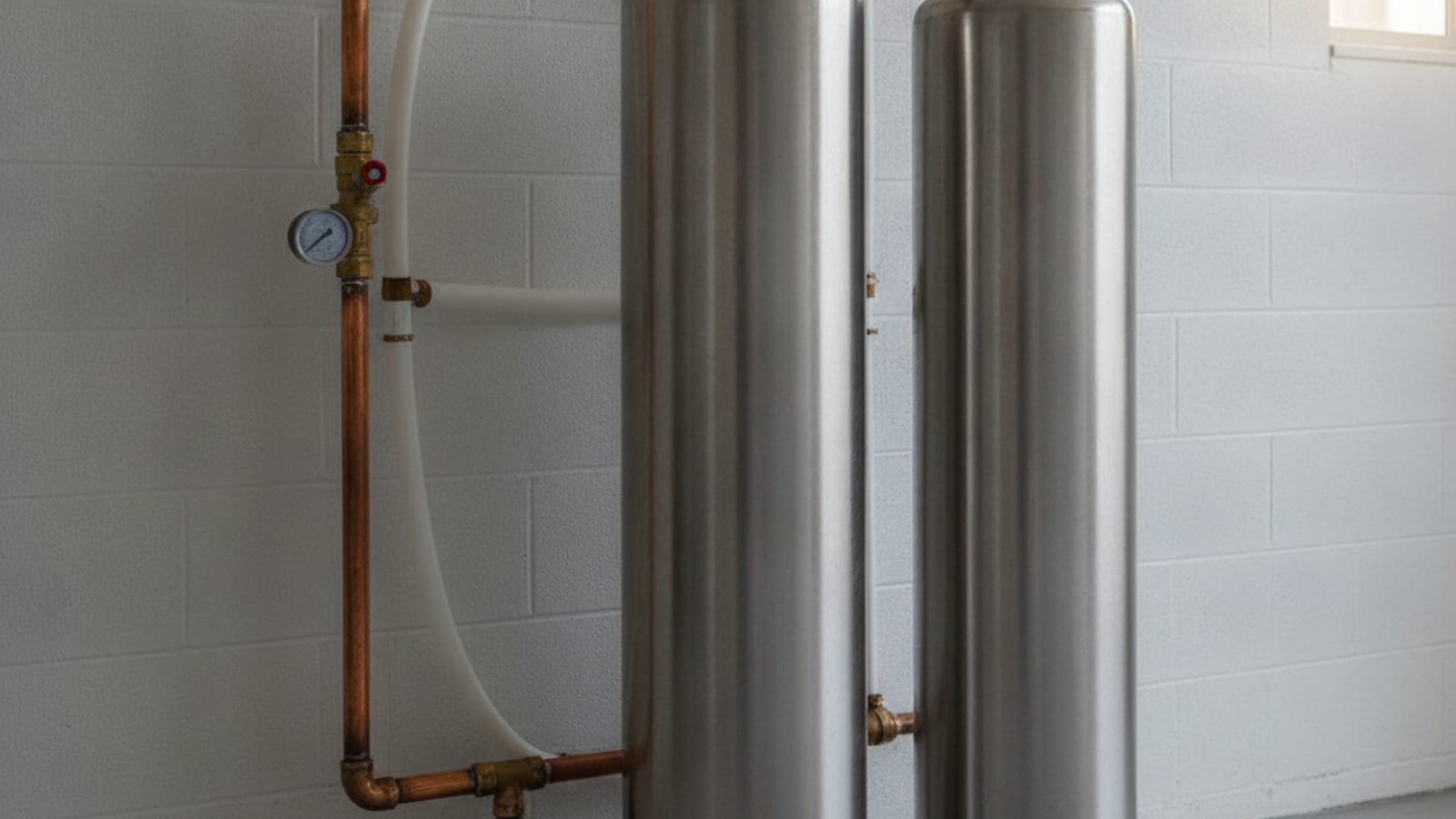
The best water filtration system for a San Diego home is the one that addresses a specific water concern at the right part of the plumbing. Some households want better taste at one drinking-water tap. Others want to reduce sediment or disinfectant taste and odor throughout the house. Hard-water scale is a separate problem that may call for a softener or conditioner.
You may need one system or a combination, but there is no universal package. Start with your water provider’s current report, the symptoms you notice, and testing when appropriate. Then compare systems by verified performance, household flow, maintenance, and total ownership cost.
What is the best water filtration system for a San Diego home?
Choose by problem and treatment scope:
- A whole-house filter is a point-of-entry system. It treats water before it is distributed to fixtures.
- A reverse osmosis system is usually a point-of-use system under one sink. It focuses on drinking and cooking water.
- A water softener uses ion exchange to reduce calcium and magnesium hardness.
- A salt-free conditioner is intended to manage scale behavior, but it does not remove hardness minerals or produce conventionally softened water.
Water conditions vary by provider, service area, season, and source. The City of San Diego water-quality page publishes monitoring information and links to drinking-water reports. If another agency supplies your home, use that provider’s report. Private wells may require a different testing approach.
Compare the four main options
| System | Treatment location | Practical fit | Main limitation | What to verify |
|---|---|---|---|---|
| Whole-house filter | Main water line | Taste, odor, or sediment concerns at multiple fixtures | Performance depends on the media, model, sizing, and target substance | Certified reduction claims, peak flow, pressure drop, media and prefilter schedule |
| Reverse osmosis | Usually one sink | Drinking and cooking water at a selected tap | Does not treat showers, laundry, or every fixture; produces reject water | Exact contaminants claimed, daily output, storage, filter and membrane schedule |
| Water softener | Main water line | Reducing hardness minerals and producing softened water | Requires regeneration supplies and routine maintenance | Capacity, regeneration settings, salt or potassium use, drain and installation needs |
| Salt-free conditioner | Main water line | Scale-management goals without ion-exchange softening | Minerals remain in the water; results and claims vary by model | Test standard or evidence for the exact model, flow limits, media life, expected outcome |
The NSF guide to home water treatment recommends identifying the concern before selecting treatment and distinguishing point-of-entry treatment from point-of-use treatment. It also advises buyers to include replacement filters and required maintenance in the budget.
Whole-house filter vs reverse osmosis
A whole-house water filtration system makes sense when the concern appears across the home, such as sediment or an unwanted taste or odor at several fixtures. The system must be sized for the home’s plumbing and peak demand. An undersized system or unsuitable filter can reduce flow or fail to deliver the expected result.
Reverse osmosis drinking-water treatment is a better fit when the goal is targeted treatment at the kitchen sink. RO can reduce dissolved substances covered by a particular model’s performance claims, but no RO system should be assumed to reduce every contaminant. Confirm the exact model, the substances listed on its certification or performance data sheet, its output rate, and its maintenance schedule.
Some homes use both approaches because they solve different problems. That should follow from the household’s goals, not from a rule that every San Diego home needs two systems.
Do you need a softener or a salt-free conditioner?
Scale on fixtures, spots on glassware, and poor soap performance can justify checking hardness. A water softener removes hardness ions through ion exchange. A salt-free water conditioner does not remove those minerals, so it should not be presented as equivalent to softened water.
Ask the installer to define the promised outcome. Is the goal softer water, less visible scale, easier cleaning, or protection for a specific appliance? Then ask what evidence supports that outcome for the exact model at your measured hardness and household flow. Also confirm installation requirements with the local authority and your plumbing professional instead of assuming one option is required or prohibited based on location or septic use.
How to check filtration claims
Do not rely on a broad phrase such as “NSF certified.” The NSF standards overview explains that different standards address different treatment categories and claims. NSF/ANSI 42 covers specified aesthetic claims, NSF/ANSI 53 covers specified health-effect contaminant claims, NSF/ANSI 44 covers ion-exchange softeners, and NSF/ANSI 58 addresses reverse osmosis systems.
A standard number is not a performance ranking, and certification does not mean a product treats every substance. Look up the exact manufacturer and model, then match its listed reduction claims to the concern identified in your report or test.
What should be included in a written quote?
Price alone does not show whether two proposals are comparable. Ask each provider to put these items in writing:
- The manufacturer, model, media, capacity, and certified reduction claims
- The water concern and test result the recommendation is meant to address
- Required plumbing, electrical, drain, bypass, or dedicated-faucet work
- Expected service flow and pressure considerations at peak household use
- Equipment, installation, permits if applicable, startup, and disposal charges
- Filter, membrane, media, salt, or other ongoing supply requirements
- Recommended maintenance schedule and estimated recurring costs
- Warranty coverage, exclusions, labor terms, and who provides service
- What will be checked after installation and how performance will be confirmed
This gives you a useful total-cost comparison without relying on a generic installed-price range. For more context, see the existing guides to whole-house filtration costs, reverse osmosis costs, and water softener costs.
A practical checklist before you choose
- Find your actual water provider and read its current consumer confidence report.
- Write down the problem by fixture: drinking-water taste, sediment, spotting, scale, or another specific concern. If scale is hitting a tankless heater, read the tankless and hard-water guide before treating hardness as a generic whole-house package.
- Test for the relevant condition when the report and household symptoms do not answer the question, especially for a private well.
- Decide whether treatment is needed at one tap or at the main line.
- Record the home’s peak water-use needs, available installation space, main-line access, drainage, and service clearance.
- Compare exact models, documented claims, maintenance, warranties, and complete written quotes.
The Filter Pros San Diego network can connect homeowners with providers to discuss testing and estimates. Start with a free in-home water test, explore hard-water solutions, or call (858) 400-6508 to discuss the problem you are trying to solve.
Related: Water softener vs salt-free conditioner explained | Reverse osmosis vs filter pitcher
Frequently asked questions
Can a whole-house filter soften water?
Filtration and softening are different functions. A whole-house filter does not remove hardness minerals unless the proposed equipment includes a separate treatment stage designed and documented for that purpose.
Do I need reverse osmosis if I already have a whole-house filter?
Not automatically. Compare what the whole-house model is documented to reduce with what you want from the drinking-water tap. RO may be useful when its exact claims address a remaining concern.
Is a salt-free conditioner the same as a water softener?
No. An ion-exchange softener reduces calcium and magnesium hardness. A conditioner leaves hardness minerals in the water and targets scale behavior. Compare the promised result and supporting evidence for the exact model.
How much maintenance should I expect?
It depends on the system and model. The written proposal should list every filter, membrane, media, or regeneration supply, the replacement schedule, service responsibility, and recurring cost.