Adding a remineralization stage is optional, not an automatic upgrade. You should remineralize reverse osmosis water only when measured results, product details, and your taste preference support that choice. There’s no confirmed reason every San Diego home must do it.
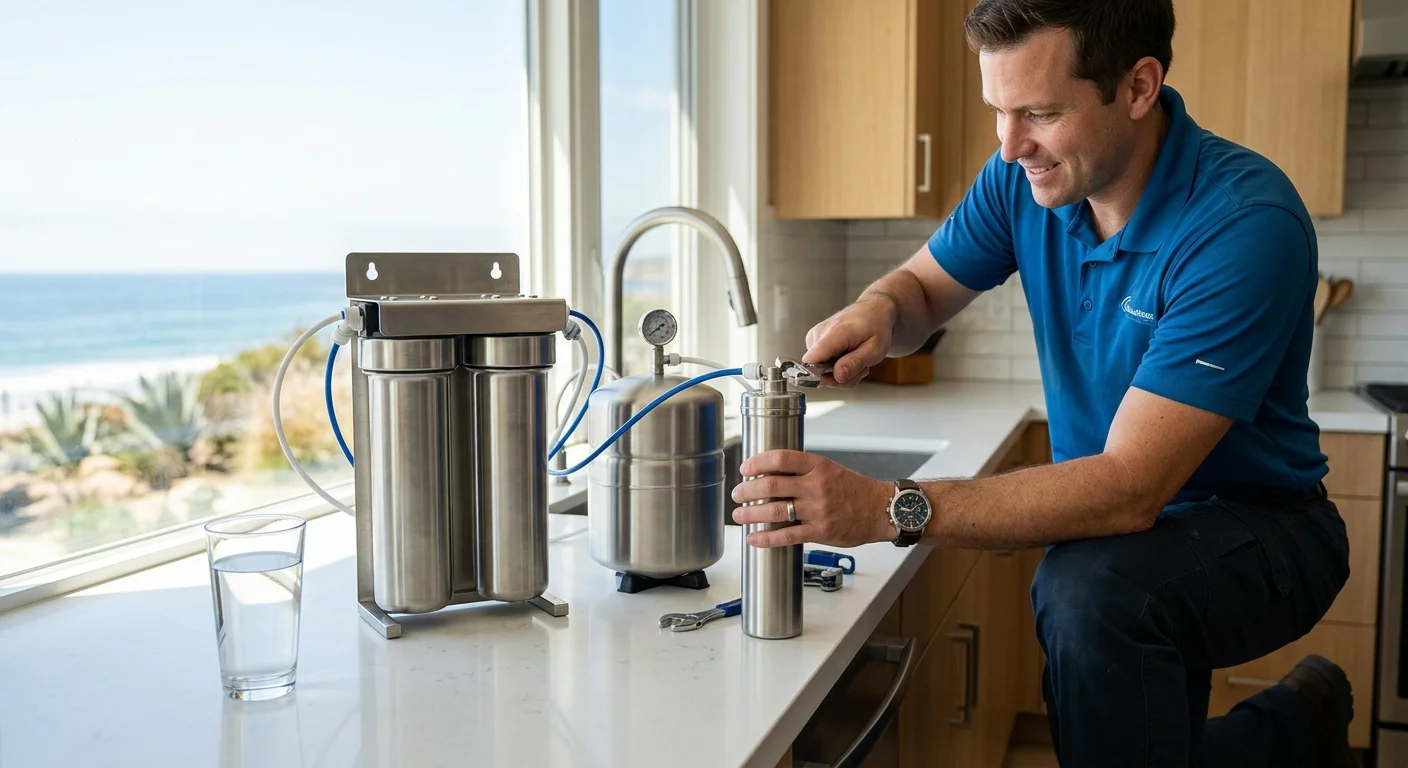
What remineralization changes after reverse osmosis
Products labeled for reverse osmosis remineralization are sold as post-treatment cartridges. Their makers may claim they add selected substances or adjust finished-water characteristics. The word “remineralization” alone doesn’t confirm what a specific cartridge contains or changes.
Start with the exact model and its current documentation. Ask the seller to identify every treatment medium and stated output range. The paperwork should also explain where the cartridge belongs in the system. Don’t transfer claims from another brand, model, or cartridge size.
The right decision begins with a clear goal. Some homeowners dislike the taste of their RO water. Others are responding to a pH or total dissolved solids reading. Write down the reason before buying another component. That keeps a taste preference from becoming an unsupported health claim.
San Diego’s source-water conditions provide useful context, but they don’t settle the decision. The City of San Diego says its drinking water averages about 16 grains per gallon, or 276 parts per million. It reports a range of 16 to 18 grains per gallon, or 272 to 284 parts per million. Those figures vary with water demand and the area served.
That City figure isn’t a countywide number. It also doesn’t describe the water leaving your RO faucet. Hardness can vary by service area and season, so confirm the agency serving your address. Backcountry and North County Inland homes using private wells need property-specific results.
Before modifying a reverse osmosis drinking-water system, compare its current output with your actual goal. A new stage should solve a defined problem, not merely add another housing beneath the sink.
Separate taste preferences from health claims
Keep taste and health in separate columns. A flavor you prefer is a valid personal goal. It isn’t proof of a medical benefit, better hydration, or a safer finished product.
We couldn’t confirm an approved authority stating that every household must remineralize RO water. We also couldn’t confirm a universal medical benefit from doing so. Don’t let a sales label turn either idea into an assumed fact.
Drinking-water contaminant limits are set federally by the EPA under the Safe Drinking Water Act. California’s Division of Drinking Water adds state limits. Your local Consumer Confidence Report is the authority for the public system serving your address. The San Diego County Water Authority can help you identify regional water information, but you should still confirm your specific retail agency.
Use different evidence for different decisions:
- For taste, compare water samples without seeing which is which.
- For a product claim, request the current model documentation.
- For a measured concern, review the test method and result.
- For a medical question, speak with a qualified healthcare professional.
- For a public-water question, check your agency’s current report.
A single sales term shouldn’t answer all five questions. The same caution applies when deciding whether alkaline water is worth it. Product language and personal preference aren’t substitutes for measured evidence.
If total dissolved solids appears in a proposal, read our guide to what TDS means in San Diego water. Then ask the seller to explain which result matters and why. Don’t accept a meter display as a complete health verdict.
Compare cartridges with untreated blending
A remineralization cartridge and an untreated-water blend aren’t interchangeable proposals. Ask a licensed pro to show either option on a plumbing diagram. You should understand what enters the drinking-water line before approving a change.
Reviewing a cartridge proposal
Request the cartridge’s manufacturer, model, treatment media, and current instructions. Ask what the maker says the cartridge changes. The answer should point to written product documentation, not a general statement about “healthy minerals.”
Also ask how the proposed cartridge matches your RO system. Compatibility shouldn’t be assumed from the housing’s appearance. Confirm the installation position, operating requirements, replacement instructions, and any effect on existing product coverage.
There’s no verified universal replacement schedule for every remineralization cartridge. Follow the current instructions for the exact model. If the seller can’t produce those instructions, that gap should be resolved before installation.
Reviewing an untreated-blending proposal
If a pro proposes untreated blending, request a diagram showing the complete water path. Ask which water bypasses the RO stage, where it rejoins the treated line, and how the finished water will be checked.
The feed-water result matters here because local conditions aren’t uniform. A City of San Diego hardness figure can’t be applied to another agency or a private well. It also can’t identify every substance at one kitchen tap.
Ask the pro what result would justify the blend and how that result will be confirmed afterward. If the proposal depends on an adjustable setting, get the intended setting and verification method in writing.
Leaving the system unchanged is also an option. If the current water meets the measured goal and tastes acceptable, another component needs a clear purpose. An under-sink drinking-water filtration consultation can compare configurations without assuming one setup fits every home.
Check maintenance and product documentation
A treatment stage creates another product record to manage. Before purchasing it, collect the exact model number, current manual, cartridge label, and written replacement criteria. Keep those documents with the records for the existing RO system.
Review the paperwork for these details:
- The substances or media listed by the manufacturer
- The intended installation location
- Compatible system models and operating conditions
- Replacement and sanitation instructions
- Any stated limits on source-water conditions
- Documentation supporting the exact performance claim
- Any effect on existing product coverage
Don’t rely on a certification acronym by itself. Ask which exact model was evaluated and which claim the documentation supports. We couldn’t confirm the scope of individual certification standards from the approved sources for this page, so the seller should provide current source material.
Avoid a generic maintenance date copied from another system. The correct instruction must come from the product installed in your home. Record the installation date and each later service date. Note any change that led you to inspect the system, such as taste, appearance, flow, or a measured result.
If installation work is contracted, verify who will perform it. Filter Pros San Diego is a referral service, not the contractor. We connect homeowners with separately licensed Water Filtration pros, and the homeowner contracts with that pro directly. You can confirm a contractor’s status through the California Contractors State License Board.
Get the proposed configuration in writing before work begins. It should name the components and explain the water path. That record will make later maintenance less dependent on memory or an unreadable label beneath the sink.
Test the water before changing the system
Test first, then choose the equipment. A useful starting record identifies the sample location, date, measurement, method, and person interpreting the result. Without those details, two readings may look comparable when their collection conditions differed.
For an RO decision, ask for clearly labeled samples from the relevant points. The proposal should state which sample represents incoming water and which represents the dedicated drinking-water faucet. If another point matters, it should be named rather than described vaguely as “the house water.”
Be clear about what the in-home test does and doesn’t measure. Ask the pro to list every reported item and explain the test’s limits. If a concern requires another method or laboratory analysis, the pro should say so plainly. Don’t infer an unmeasured contaminant from taste, a general meter reading, or the appearance of the water.
Public-water customers should also identify their retail water agency. San Diego County contains several service areas, and hardness varies by area and season. Review the agency’s current Consumer Confidence Report rather than applying a countywide assumption.
Private-well owners need results from their own water. City of San Diego figures don’t describe private wells in the backcountry or North County Inland. The proposed cartridge or blending approach should be evaluated against that property’s measured starting point.
Filter Pros San Diego arranges a free in-home water test and connects you with a licensed pro. Ask for a side-by-side explanation of three choices: keep the RO system unchanged, add the documented cartridge, or consider the proposed blend. Each choice should connect to a measured result or a clearly stated taste goal.
A test won’t make a personal taste decision for you. It gives that decision a defined starting point. The final setup should match your water, your existing equipment, and the result you’re trying to achieve.
When to call us
Call when you’re considering a new cartridge, untreated blending, or changes to the drinking-water line. A licensed Water Filtration pro can inspect the system, review its documentation, and explain the proposed configuration. Call us at (858) 400-6508 to set up a free in-home water test.