For salt free treatment, Bonita homeowners should start with their own tap water. Confirm the provider, measure hardness, and compare written performance claims before choosing equipment. Tank materials matter too, but terms like medical-grade stainless steel need supporting specifications.
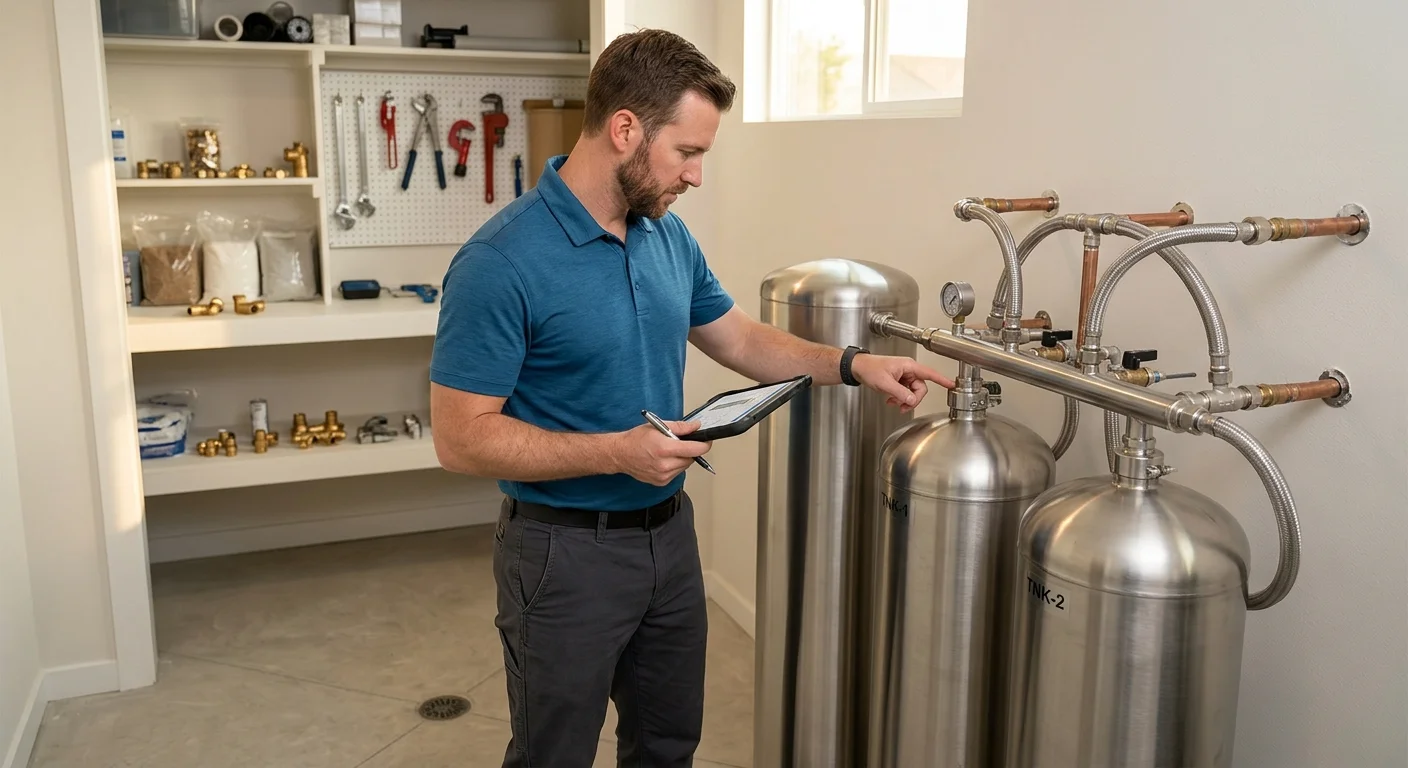
Filter Pros San Diego arranges a free in-home water test. We then connect you with a separately licensed Water Filtration pro who can assess the plumbing and prepare a proposal.
Identify the provider serving the Bonita address
Check the provider name and service address on your current water bill, then use that provider’s report for published water-quality information.
If you’ve just purchased the home, ask for the latest bill. A landlord, seller, or property manager may also have the account record. Don’t substitute a nearby city’s water report or a general county figure. Those sources might not describe the water reaching that property.
The San Diego County Water Authority can provide regional water information. Your serving provider’s current Consumer Confidence Report is the better authority for that address. Confirm the report year before using any contaminant or hardness figure.
The EPA sets federal drinking water contaminant limits under the Safe Drinking Water Act. California’s Division of Drinking Water adds state limits. Those standards address drinking water quality, but they don’t select a treatment system for one household.
Provider identification also prevents a common comparison error. The City of San Diego publishes figures for its own system, but those numbers aren’t countywide. They shouldn’t be assigned to a Bonita tap without confirming that the City serves the property.
Keep the provider name and report year with your test results. A licensed pro can then compare the household sample with the correct public report. That creates a better starting point than a sales claim based only on the ZIP code.
Measure hardness at the household tap
Salt-free conditioning decisions should begin with a hardness test at the home. Record where the sample was taken and the result shown by the test. Don’t replace that reading with an online estimate for Bonita or South Bay.
Helix Water District states that water with 10 or more grains per gallon is considered hard. Helix also reports that imported Colorado River and State Water Project supply averages about 14 grains per gallon. That second figure describes the imported supply, not every Bonita tap.
Measure hardness at the home when comparing equipment. Use the actual supplier’s report for context; a countywide label or another system’s figure does not establish the result at your tap.
A useful visit should also document what prompted the search. Show the pro any residue on fixtures, shower glass, or dishes. Note whether the concern affects one fixture or several. These observations don’t replace testing, but they help define what you want the proposal to address.
Our free in-home water test gives the conversation a measured starting point. You can also review how to test water hardness at home before the appointment.
Keep hardness separate from other water concerns. EPA and California contaminant limits are different questions. A hardness reading doesn’t establish the presence or absence of a regulated contaminant. Ask for the test name, result, and units whenever a proposal makes a water-quality claim.
For a broader look at treatment paths, review these hard water solutions. The right next step depends on the actual tap result and the outcome you expect.
Separate conditioning from traditional softening
Don’t treat “conditioner” and “softener” as interchangeable words on a proposal. Ask the pro to describe what the offered system does and how that result will be measured. The contract should use specific language rather than relying on the product category alone.
For each option, ask whether the post-installation hardness reading is expected to change. Then ask how the pro will verify performance. If the goal involves scale behavior instead, request a written description of that goal and its test method.
This distinction matters when comparing salt-free water conditioning with other treatment choices. Our guide to a water softener versus a salt-free conditioner can help organize the discussion. The household test and written product documents should still control the final choice.
If PF1025 or another product appears in a proposal, ask for its exact documentation. Verify any scale-reduction claim, operating limits and maintenance requirements. Salt-free conditioning leaves hardness minerals in the water, so compare that result with an ion-exchange softener if actual hardness removal is your goal.
Ask the pro for the current manufacturer specification sheet and an exact model identifier. If certification is claimed, request the public listing that matches that model. A product-family brochure isn’t enough when the installed unit has a different identifier.
The same care applies to tank construction. If a proposal describes medical-grade stainless steel, request the exact material specification. If another describes fiberglass with a plastic liner, request its construction details too. Compare documented materials, maintenance instructions, and written warranty terms. Don’t assume a material label proves treatment performance.
Ask the pro to document the proposed equipment’s consumables, any discharge or drain needs, maintenance and operating limits. Have those details included in the written scope before you sign.
Plan the installation space and plumbing path
A licensed pro should inspect the intended location before final equipment selection. The plan needs to match the home’s existing plumbing path, available space, and the exact equipment configuration.
Start by identifying where the supply line enters the home. The pro can trace which fixtures would receive treated water and which would remain outside the treatment path. Ask for that routing to appear on the proposal.
Measure the proposed equipment area with the pro present. Confirm room for the tank, prefilter, bypass components, connections, and future service access. Don’t rely only on a product photo. The installed arrangement may require more working space than the tank itself.
The proposal should answer practical questions:
- Where will each component sit?
- Which pipe sections will be changed?
- Will the offered model need a drain or electrical connection?
- How will the system be bypassed for service?
- Which fixtures will receive conditioned water?
- What access will future maintenance require?
Those aren’t invitations to assume an installation requirement. They’re items the licensed pro should verify for the chosen model and property.
Have the pro identify the building authority for the address and confirm whether the proposed work needs approval. A rule quoted for another community may not apply to your installation.
The same caution applies to local restrictions. We couldn’t confirm a Bonita rule restricting salt-based water softeners. The current authority should verify any applicable requirement. Our article about whether salt-based water softeners are restricted in San Diego explains why address-level confirmation matters.
A careful site plan makes proposals easier to compare. Ask each pro to price the same plumbing scope and equipment location, with maintenance and replacement parts identified separately. The actual layout and selected system affect your quote.
Questions for the separately licensed pro
A strong proposal should connect the Bonita tap result to a named system and installation plan. Ask the same questions during each appointment. Written answers make differences easier to spot.
Start with these:
- What hardness result did you measure, and where?
- Which provider and water report apply to this address?
- What exact system model are you proposing?
- What result does the system claim to produce?
- How will that result be checked after installation?
- Does the proposal cover the whole home or selected fixtures?
- What tank material and component materials are specified?
- What routine service does the manufacturer require?
- Which written warranty applies to this exact model?
- Who handles future service, and under what terms?
- Does the current building authority require approval?
- Who will contract with and receive payment from the homeowner?
Filter Pros San Diego arranges the test and referral. The homeowner contracts with and pays the separately licensed pro directly. Make sure the proposal identifies that contracting party clearly.
You can check the contractor’s license through the California Contractors State License Board. Match the business name and license details to the proposal before signing. Don’t rely on a logo, vehicle, or verbal statement as proof.
Ask for an itemized proposal without assuming a standard market price. Equipment, plumbing changes, and site conditions must be stated for that home. Any warranty or performance promise should appear in the written agreement.
Finally, keep copies of the water test, model sheet, installation plan, and contract. Those records show what was measured and what was promised. They’ll also help if the system needs adjustment or service later.
When to call us
Call when you’re ready to test the Bonita tap and review installed treatment options with a licensed Water Filtration pro. Filter Pros San Diego can arrange the test and referral without inventing a hardness figure or choosing from ZIP code alone. Call us at (858) 400-6508 to set up a free in-home water test.