The first Pacific storm after a dry summer is the time to test well water after rain, especially on inland parcels from Fallbrook and Valley Center across to Ramona and East County. Runoff can reach a wellhead long before the tap looks wrong. A private well is not on a city Consumer Confidence Report, so the bottle you fill after that storm is the record you have.
Why the first storms matter for a private well
San Diego County can go months without a soaking rain. Soil crusts. Dust, leaf litter, and manure sit in place. When the first cells finally hit inland North County or East County, water often sheets across the surface before it soaks in.
That private well first flush is the moment a well is most exposed. The CDC lists polluted stormwater runoff, fertilizers, farm runoff, animal waste, septic systems, wastewater, flooded sewers, and decaying plants among possible nitrate sources. Those are possible sources, never the cause or the concentration in a given San Diego well. Geology still decides what actually arrives at the pump.
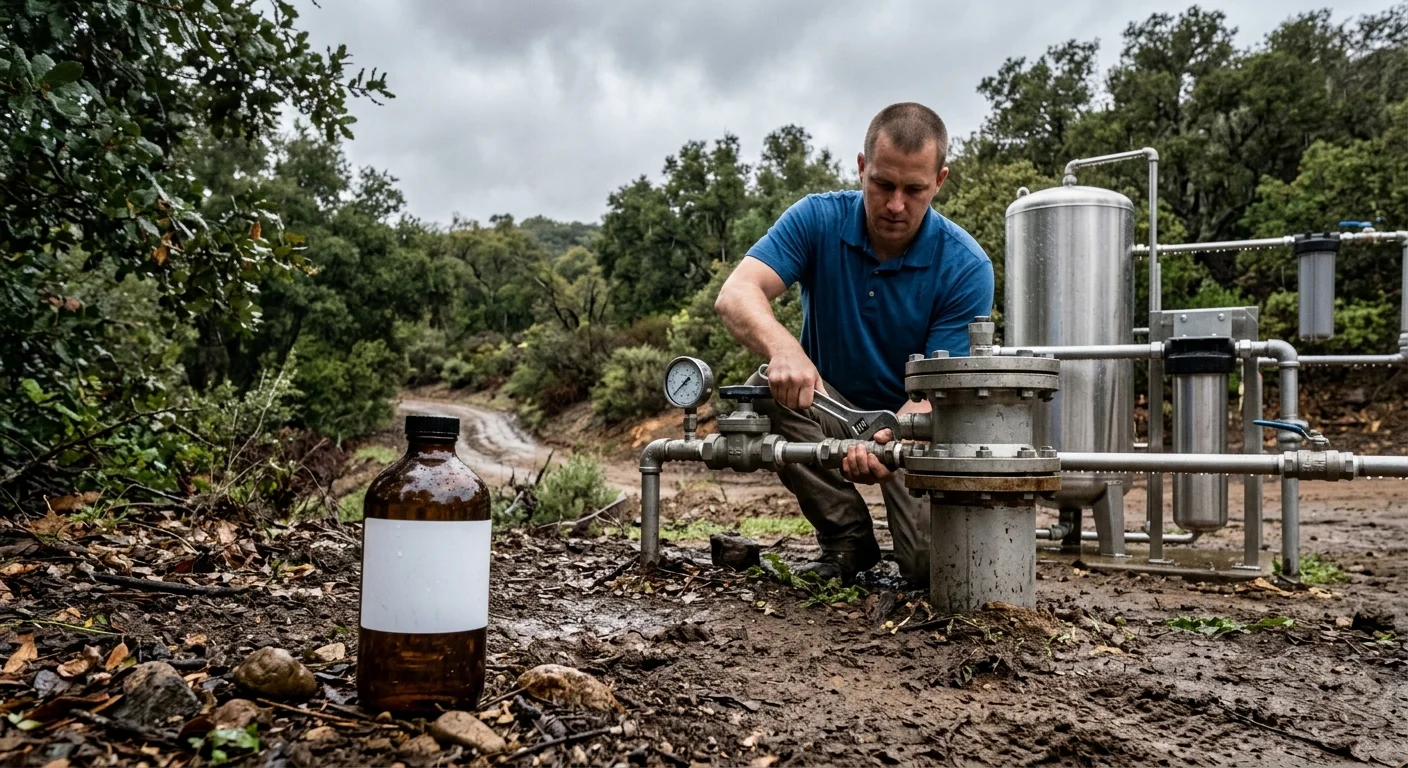
A well is supposed to keep surface water out. A loose cap, a cracked seal, a low spot that ponds against the casing, or grade that now slopes toward the head gives that flush a path. You do not need a named flood for the risk to be real. Water standing at the wellhead after an October storm is enough reason to inspect and sample.
Taste, color, and grit can change in the same window. Cloudy or brown water can mean sediment moved in the aquifer or the plumbing. A sulfur or earthy smell can show up too. Hydrogen sulfide can cause a rotten-egg odor that starts in the well, the plumbing, or the heater. That mechanism is general. It is not a San Diego prevalence figure. If the odor appears after rain, still test for coliform and nitrate.
Those changes are a reason to sample. They do not name the contaminant. Clear water can still carry bacteria. Cloudy water is not a lab report. There is no verified timeline for how long well water takes to look clear after heavy rain. Appearance can settle while bacteria remain.
Keep the yearly lab habit. First-rain sampling is extra. Follow how often to test private well water in San Diego for that annual cadence.
Not every home in Fallbrook, Valley Center, Ramona, or Alpine is on a well. Plenty of inland parcels are. If the kitchen tap is private well water, the first-rain sample is your job. The San Diego County Water Authority describes treated imported supply. It does not describe the well behind a Ramona or Valley Center house.
What to sample, and what an in-home screen cannot replace
CDC guidance is to use a state-certified laboratory. Ask local health or environmental staff which extra tests fit the property. CDC recommends annual testing for total coliform, nitrate, TDS, and pH. After well water testing after a storm, run that same set again. Then add what the county or the lab says fits a rural, septic, or agricultural setting.
Total coliform is an indicator, not a full pathogen list. A positive result means a pathway existed. It does not identify every organism. Before you jump to equipment, read coliform bacteria in well water in San Diego County.
Nitrate belongs in the same cooler. First-flush runoff can move fertilizer and animal waste across a Fallbrook grove or a Valley Center pasture. A grocery-store strip is not the record you want.
TDS and pH complete the CDC annual set. The EPA secondary guideline for TDS is 500 mg/L. That number speaks to taste and technical concerns. It is not a universal drinking-safety cutoff. You cannot infer that other contaminants are absent from a TDS reading. A conductivity estimate is not a constituent-specific laboratory analysis.
Iron can show up when sediment moves. The EPA secondary guideline for iron is 0.3 mg/L. It is associated with rusty color, sediment, metallic taste, and reddish or orange staining. It is not a health threshold and not a reading for your well until a proper test says so.
A free in-home water test can screen hardness, iron, and similar tap readings. Filter Pros San Diego arranges that screening and a referral to a licensed Water Filtration pro. The screen does not replace a state-certified bacteria result. Do not treat it as clearance to drink after flooding or a first flush.
A specific County of San Diego post-rain well protocol, fee, or certified-lab roster could not be confirmed from the sources used for this page. Ask County of San Diego environmental health staff which tests fit your location. Ask the lab how to sanitize the faucet, how to fill the bottle, and how soon to return it. A dirty tap can produce a false positive.
If contamination is suspected, CDC calls for another safe water source and health-department guidance. Boiling does not remove chemical contamination.
North County and East County well settings
Private wells cluster inland, off the coastal municipal grid. Think Fallbrook along the Santa Margarita drainage, Valley Center and Pauma on the way to Palomar, Ramona on SR-67, and East County pockets toward Alpine, Lakeside, and the Julian foothills. That is a map of where wells are common. It is not a claim that every address there uses one.
North County well settings often sit near groves, small farms, horses, and septic tanks on large lots. First-rain sheet flow can run off fertilized soil and corrals before the ground opens up. Grade around the casing matters. So does distance from a leach field, a barn, or a fuel tank. Those are site facts a lab and a licensed well contractor can work with. They are not a diagnosis from a ZIP code.
East County wells often sit in decomposed granite, clay pockets, and steeper drainages. A short, hard cell can move sediment down a driveway that was dust yesterday. Low spots at the wellhead collect that water. Older caps and settled soil show up after the first soak, when you can finally see the ruts.
Inland Escondido and the I-15 corridor can see sulfur odors after weather changes. The odor can start in the well, the plumbing, or the water heater. Test coliform and nitrate anyway. Do not skip the lab because the smell faded.
Timing differs across the county. A light coastal drizzle can miss a Ramona well that later takes a fast inland storm. Sample after the rain that actually hit your parcel, not after the one that hit the beaches.
City of San Diego tap hardness figures do not describe these wells. Helix imported-supply averages do not either. Do not copy a municipal grains-per-gallon number onto a private well. Measure that well.
When to retest after flooding or a repair
Standing water at the wellhead, a flooded pit, or a well that sat under runoff is suspected contamination. Switch to another safe water source for drinking and cooking until a lab and the health department say otherwise. Stay off wet pumps, wet wiring, and submerged controls. Do not handle wet electrical equipment. A licensed pump or well contractor should inspect that gear after the water drops.
Inspect the cap and casing once you can walk the site. Look for a loose or cracked cap, damaged conduit, new erosion, and soil that now funnels toward the pipe. Photograph what you see. That record helps the pro. It is not a substitute for a sample.
Retest after a repair too. Well work, pump replacement, plumbing cuts, and landscaping against the casing can open a pathway. Sample after the work is done and the system is running, following the lab’s hold times. If a treatment system was added or changed, CDC guidance is to match treatment to the identified problem and test again to confirm it worked before you resume normal use. A filter does not make flooded water safe on its own.
A positive total-coliform result still needs a plan, not a guess. Use the coliform guide linked above for that next step. This page does not prescribe chemical dosing. Disinfection, if it is even the right move, belongs to a licensed well or pump pro who will follow their own procedure and then retest.
A well that sputters, loses pressure, or stops producing is a different problem. That can be a pump, a drop in water level, or a clog. A licensed well contractor handles yield and mechanical issues. If the same storm also ponded at the head, you still need the bacteria and nitrate sample.
How results guide the separately licensed pro
Lab results tell the licensed Water Filtration pro what to size and what to skip. EPA home-treatment guidance is to identify the concern first. No single technology removes every contaminant. Point-of-entry systems treat water entering the house. Point-of-use devices treat a selected tap. Compare the exact model’s certified reduction claim, plus maintenance and replacement-filter cost.
NSF/ANSI 42 covers certified aesthetic reduction claims. NSF/ANSI 53 covers specified health-effect contaminant claims. NSF/ANSI 58 covers reverse osmosis systems. NSF/ANSI 44 covers ion-exchange softeners that reduce calcium and magnesium hardness. A standard is not a ranking, and it does not mean every contaminant is reduced. Verify the model.
Sediment and staining after a first flush often point toward whole-house water filtration once the lab names what is actually in the water. Bacteria is a well-integrity and disinfection problem first. Buy equipment after the test, not instead of it.
When a pro does install a tank, ask what the tank is made of. Stainless steel tanks differ from fiberglass tanks with a plastic liner. Construction is a durability and service question. It is not a contaminant-removal claim.
Check the contractor on the CSLB license lookup. Filter Pros San Diego connects you with licensed Water Filtration pros. You contract with that pro directly. The brand does not pull well permits, does not own a drilling rig, and does not perform the licensed trade work.
After install or repair, sample again. Confirm treatment worked before you go back to ordinary use. Keep the lab report with the well log. Next year’s first rains are easier to judge if you have last year’s numbers.
When to call us
If the first rains changed the tap, or if standing water sat at the wellhead, start with a screening and a plan for a certified lab sample. A licensed Water Filtration pro should match any filter or conditioner to those results, not to a guess. Call us at (858) 400-6508 to set up a free in-home water test.