An Oceanside water softener installation should start with your tap water, not a product pitch. Confirm what you want to change, test the water, and have a licensed pro inspect the proposed installation area. That sequence helps you compare written proposals without relying on an unverified citywide hardness number.
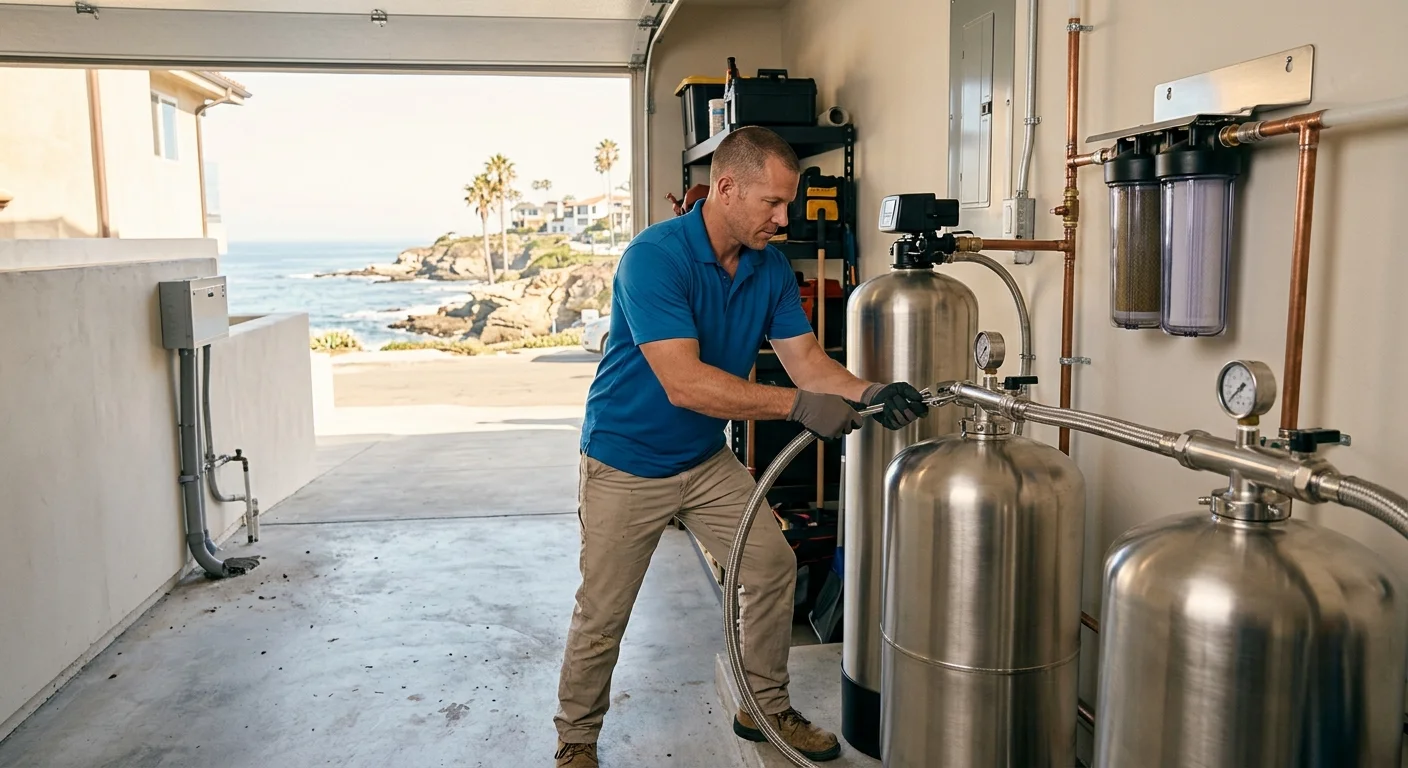
Start with the water at the Oceanside tap
San Diego County doesn’t have one dependable countywide hardness figure. Hardness can vary by service area and season. That makes a generic San Diego number a poor basis for choosing equipment in Oceanside.
The approved source record for this page didn’t confirm a current Oceanside hardness value. Check the Consumer Confidence Report issued by the water provider listed on your bill. The report is the local authority for hardness and source information. The San Diego County Water Authority can also provide regional context, but your provider’s current report should guide the conversation.
Federal drinking-water contaminant limits are set by the EPA under the Safe Drinking Water Act. California’s Division of Drinking Water adds state limits. Those standards shouldn’t be confused with hardness, taste, scale, or other household concerns.
Start by writing down the result you want. Note where residue appears and which fixtures are affected. Don’t treat those observations as a laboratory result. They’re simply details that help the pro plan the test and inspection.
Filter Pros San Diego arranges a free in-home water test and connects you with a separately licensed pro. The homeowner contracts with and pays that pro directly. You can also review our guides to hard water solutions and whether San Diego water is hard before the appointment.
Keep the test result, current water report, and written proposal together. If two recommendations differ, ask each pro to explain the difference using your results.
Choose between softening and salt-free conditioning
Don’t assume “softener” and “salt-free conditioner” promise the same result. Ask each pro to state the intended outcome in plain language. The proposal should connect that outcome to your test result and household priorities.
For a salt-based option, ask what the system changes and what ongoing supplies it needs. Request the product manual before signing. Have the pro identify every connection, discharge route, and maintenance task included in the scope.
For a product marketed as salt-free, request the same level of detail. Ask what “conditioning” means for that specific model. Get any claims about hardness, scale, sodium, salt, or discharge in writing. The approved claims record for this page doesn’t verify those performance claims or the details of a PF1025 model.
Product labels aren’t substitutes for documentation. If a proposal mentions a certification, ask for its full name and the exact model covered. The current source record doesn’t confirm what NSF/ANSI 42, 53, or 58 covers. Don’t accept a standard number as proof of an unrelated result.
Your decision should follow a short chain:
- Confirm the issue at your Oceanside tap.
- Define the result you expect.
- Match the proposed equipment to that result.
- Review installation and maintenance requirements.
- Put product claims and responsibilities in writing.
Our water softener installation service explains how the referral process begins. The licensed pro should make the equipment recommendation and perform the installation.
Plan for the drain, bypass, and available space
A site inspection should happen before the contract is final. Ask the licensed pro to map every proposed connection in the installation area. The written scope should identify the equipment location, bypass arrangement, drain plan, and any needed access.
Don’t rely on a quick photograph alone. A photograph can help with an early conversation, but it can’t confirm local requirements or hidden site conditions. The pro should inspect the location and compare it with the manufacturer’s instructions.
Walk through these planning points together:
- Where will each tank or component stand?
- How much working room will remain around it?
- Where will the incoming and outgoing connections be made?
- How will the bypass be reached and identified?
- What drain route does the proposed model call for?
- Does the selected equipment need another connection nearby?
- Which existing materials will connect to the new equipment?
- What changes are included in the written scope?
- Who will confirm whether local approval applies?
- Who handles corrections if the installed layout differs?
No Oceanside-specific permit rule or softener restriction was confirmed in the approved source record. Ask the City of Oceanside which office has jurisdiction over the address. Then have the licensed pro document what applies before work begins.
Location within Oceanside isn’t enough to determine water conditions or installation rules. Being near I-5 or SR-78 doesn’t replace a current water report, test, or site inspection. The source record doesn’t verify a hardness boundary between coastal and inland parts of the city.
Compare stainless steel and fiberglass tanks
Tank material deserves a line-by-line comparison. Don’t let one polished phrase decide the purchase. Ask for the exact construction of every tank included in each proposal.
For a stainless steel tank, request the material specification and manufacturer’s model sheet. If the phrase “medical-grade stainless steel” appears, ask which documented standard supports it. The approved source record doesn’t verify that phrase for a particular product.
For a fiberglass tank, ask whether it includes a liner. Request the liner material, tank specification, and manufacturer instructions. Don’t assume every fiberglass tank has the same construction.
Use the same checklist for both options:
- Exact manufacturer and model
- Tank body material
- Liner material, if present
- Connections and fitting materials
- Installation clearances
- Indoor or outdoor placement instructions
- Required maintenance
- Written warranty terms
- Parts covered by that warranty
- Labor coverage, if any
- Exclusions and owner responsibilities
The current claims record doesn’t confirm a lifespan for either construction. It also doesn’t establish that one tank material always performs better. A pro or seller should support any durability claim with model-specific documentation.
Warranty language also needs close attention. Ask who provides it, who handles a claim, and what paperwork you must keep. Don’t treat a verbal statement as a written warranty.
The useful comparison isn’t simply stainless steel against fiberglass. It’s one documented model, installation plan, and warranty against another. That approach keeps the decision tied to evidence rather than a broad material claim.
Questions to ask the pro before signing
A clear proposal should tell you what will be installed and who is responsible. It should also separate confirmed details from recommendations that may change after inspection.
Start with the contractor. Use the California Contractors State License Board lookup to check the license information provided. Confirm that the name on the proposal matches the contracting party.
Then ask these questions:
- What did the water test measure?
- Which result supports this recommendation?
- What change should this exact model produce?
- Which claims come from the manufacturer?
- Can I review the model sheet before signing?
- What tank materials and liners are included?
- Where will each component be installed?
- How will the bypass remain accessible?
- What drain arrangement is proposed?
- Who confirms applicable local requirements?
- What work is included in the quoted scope?
- Which possible changes aren’t included?
- What maintenance will the owner handle?
- What supplies will the system need?
- Who provides the written warranty?
- What happens if site conditions change the plan?
- Who performs future service or repair?
No verified Oceanside installation price was available in the approved claims record. Request an itemized proposal from the licensed pro. Compare equipment, labor, site changes, maintenance, and warranty terms rather than one total alone.
A retail package can look simpler until installation details surface. Our comparison of a big-box and professional water softener installation offers another framework for reviewing responsibilities.
Take time to read the final version before signing. Cross out blank spaces and keep a complete copy. If a product or performance claim matters to your decision, ask for its supporting document to be attached.
When to call us
Call when you need an Oceanside water test and a referral to a licensed Water Filtration pro. The pro can inspect the proposed location, recommend equipment, and provide the installation agreement. Call us at (858) 400-6508 to set up a free in-home water test.