Choosing between a salt-free water conditioner and an electronic descaler isn’t a tank-versus-gadget shortcut. The useful answer depends on measured hardness, the result you want, and the proof supplied for the exact model. Neither category label proves hardness removal, scale prevention, or equipment protection.
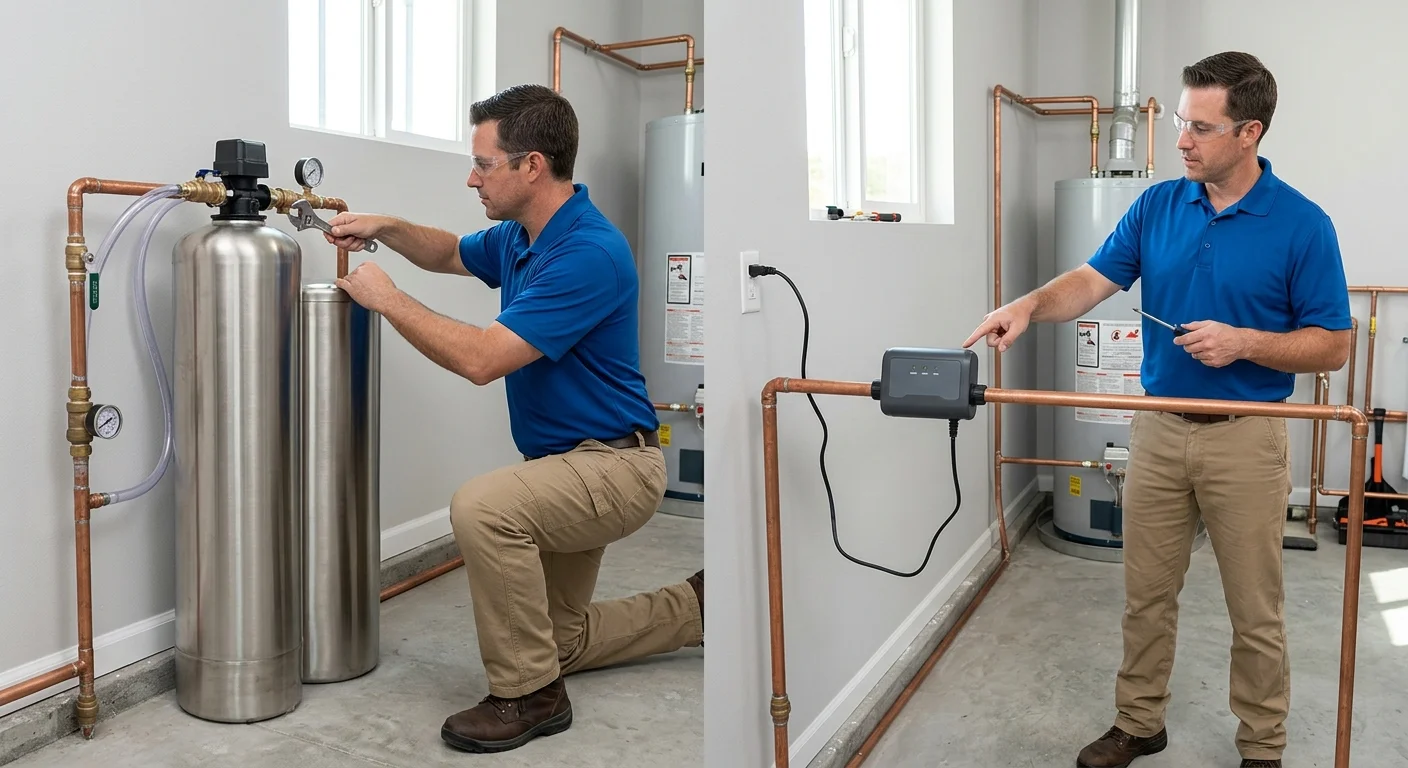
How media-based conditioning and electronic devices differ
A media-based conditioner routes water through a treatment vessel installed in the plumbing line. An electronic descaler is sold as a device mounted at the pipe, often with a controller and wrapped wiring. Those physical formats create different installation questions.
The approved claims record doesn’t confirm that either category removes hardness minerals. It also doesn’t establish that either prevents scale or protects appliances. Those results must be supported for the exact product being proposed.
Start by separating equipment format from promised performance. For a media-based proposal, ask for:
- The vessel material and internal construction
- The exact media name and model
- Required prefiltration
- Plumbing, drain, power, and bypass requirements
- A written maintenance schedule
- The test method supporting each performance claim
Some proposals describe medical-grade stainless-steel tanks. Others describe fiberglass vessels with plastic liners. Don’t judge either description from a sales phrase alone. Request the manufacturer’s material specifications, pressure rating, warranty terms, and model-specific documentation.
For an electronic proposal, request the device model, mounting instructions, pipe compatibility, power needs, and operating limits. Confirm whether the quoted price includes any electrical or plumbing work. The words “electronic” and “no plumbing changes” shouldn’t be treated as interchangeable without a site inspection.
The main distinction is therefore practical. One proposal centers on an in-line vessel and treatment media. The other centers on pipe-mounted electronic equipment. Performance remains a separate question that needs evidence.
Our salt-free water conditioning service explains how we arrange testing and connect homeowners with separately licensed local pros.
Define what each product claims to change
Sales language often blurs three different ideas: mineral concentration, mineral behavior, and visible residue. Those aren’t the same claim. A proposal should state exactly which one the product is meant to address.
Ask the seller to put the claimed result into one plain sentence. Then identify how that result can be measured. Useful questions include:
- Does the proposal claim a change in measured hardness?
- Does it claim a change in deposits without changing hardness?
- Where was that result tested?
- Does the evidence cover this exact model?
- Which water conditions were used during testing?
- Can the claimed result be checked at your home?
Salt-free scale-control equipment leaves hardness minerals in the water; it does not produce the same result as an ion-exchange softener. Compare documented performance for the exact conditioner or electronic device under conditions relevant to your water. A category name alone does not establish scale prevention.
If a proposal names PF1025 or another product, use the identifier to request the exact model documentation. Ask for independently verified performance and operating limits tied to the proposed media and equipment, rather than treating the name as proof of an outcome.
Visible white residue also shouldn’t become the only decision point. Its presence can help define the household’s concern, but it doesn’t identify a treatment method by itself. Record where it appears, how quickly it returns, and which fixtures are affected. Pair those observations with a measured water test.
A traditional softener’s a separate comparison. If that’s also under consideration, read our guide to a water softener versus a salt-free conditioner. It keeps the equipment categories separate before you review bids.
Compare installation needs and ongoing care
Installation should be compared at the actual property, not from a product photo. A Chula Vista garage, an El Cajon exterior service wall, and a central San Diego condominium can present different access, clearance, and ownership questions.
Photograph the main shutoff, exposed pipe, nearby outlets, drain locations, and available floor space. For shared plumbing, confirm which line serves the home before accepting a whole-house proposal. A licensed pro can then identify what the selected model requires.
A media-based quote should show the proposed vessel location and connection points. It should also state whether the system needs a bypass, prefilter, drain, or electrical supply. Don’t infer those details from the phrase “salt-free.”
An electronic quote should identify its mounting location and power source. Ask whether pipe material, pipe diameter, nearby fittings, or installation clearances affect the manufacturer’s instructions. Request those instructions before signing.
Ongoing care deserves the same detail. Get a written schedule covering inspections, media or component service, cleaning, replacement parts, and any homeowner tasks. Don’t accept “maintenance-free” without model-specific documentation defining that term.
Warranty language also needs close reading. Confirm who provides the warranty, which components it covers, and what maintenance records are required. Ask who handles labor if a covered component fails. No warranty term should be assumed from the equipment category.
If installation includes contracted plumbing or electrical work, check the installer’s current status through the California Contractors State License Board. The homeowner should contract with and pay the licensed pro directly.
Questions about local softener rules should also be verified instead of repeated from sales conversations. Our guide to salt-based water softener restrictions in San Diego explains where that verification starts.
Verify testing and certification claims
A logo, standard number, or laboratory name isn’t enough by itself. Ask for documentation that connects the claimed test to the exact model in your proposal.
The document should identify the manufacturer, model, tested configuration, standard, certifying organization, and current listing status. It should also state the result that’s being certified. Certification for one component doesn’t automatically prove every performance claim made for the complete installation.
NSF/ANSI 42 covers specified aesthetic claims, 53 covers specified health-effect contaminant claims, and 58 covers reverse-osmosis systems. Those numbers do not by themselves certify a scale-control outcome. Look up the exact model in the certifier’s public database and compare the listing with the claim in the quote.
Manufacturer charts deserve similar care. Check whether the document names the test water, hardness level, flow conditions, duration, and measurement method. A study involving another model or another configuration may not support the equipment being offered.
Testing at the home should begin with a recorded baseline. Write down the sampling location, date, water source, test method, units, and result. If a system is installed, use the same method and comparable sampling points for any follow-up comparison.
San Diego County contains many water service areas. Your bill is the clearest starting point for identifying the serving agency. The San Diego County Water Authority is another local starting point, but the serving agency’s current water-quality material should guide property-specific questions.
Keep copies of test results, product sheets, model numbers, installation instructions, and the signed proposal. That paper trail makes competing claims much easier to compare.
Match the choice to measured hardness and household goals
Start with the problem you can describe and measure. White marks on shower glass, residue around faucets, and concerns about a particular appliance may lead to different proposals. Write down the priority before discussing equipment.
Hardness varies by service area and season within San Diego County. A single countywide number would be misleading. Properties using private wells also need their own testing rather than a public-system average.
For the City of San Diego system, the city reports drinking water averages about 16 grains per gallon, or 276 parts per million. It reports a range of 16 to 18 grains per gallon, or 272 to 284 parts per million. The city says that range varies with water demand and location inside its service area. Those figures don’t describe every San Diego County tap.
Helix Water District states that water at 10 or more grains per gallon is considered hard. It also says imported Colorado River and State Water Project supply averages 14 grains. That imported-supply figure isn’t a measurement for a particular home.
Use your property’s result to frame the comparison. Then ask each seller to explain, in writing, how the proposed model addresses the stated goal. If the proposal claims a measurable change, request the expected measurement and supporting model-specific evidence.
The choice should also account for the installation site and maintenance plan. Compare vessel materials, electrical needs, plumbing changes, service access, written care, and warranty terms. Don’t rank equipment by footprint alone.
Our hard water solutions page covers the next step when the household goal is still unclear. We arrange a free in-home water test and connect you with a separately licensed Water Filtration pro. The homeowner reviews the proposal and contracts with that pro directly.
When to call us
Call when you need measured hardness, a site-specific equipment comparison, or help checking a proposal’s claims. A licensed Water Filtration pro should assess any installation involving changes to the home’s plumbing or electrical setup. Call us at (858) 400-6508 to set up a free in-home water test.