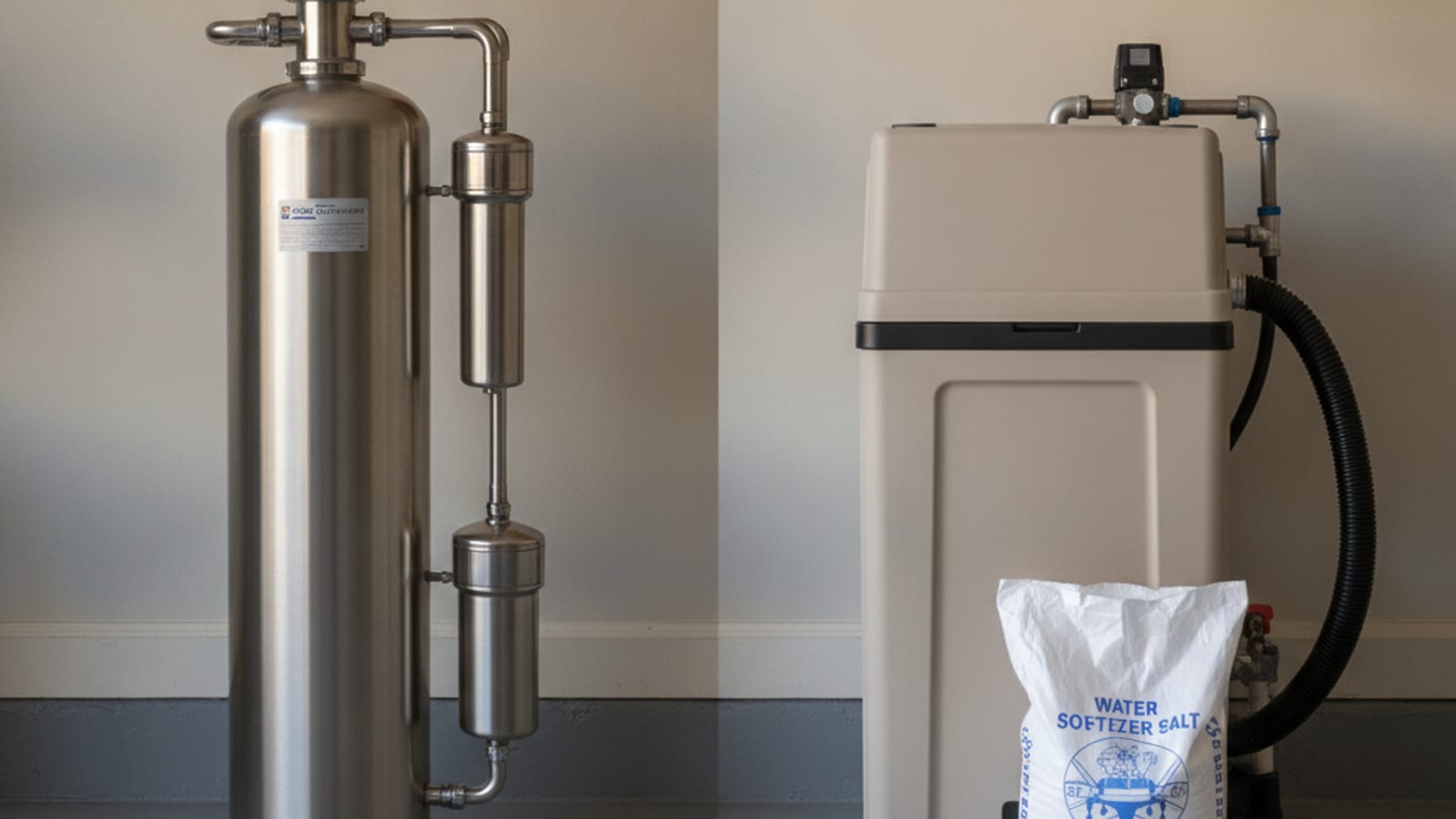
Kinetico built its reputation on twin-tank softeners, and if you’ve been shopping around, you’ve probably heard the pitch: continuous soft water, no electricity, regenerates only when you actually need it. All of that is true. What the pitch usually skips is whether your household actually needs it, or whether a well-sized single-tank system would do the job for less money.
Here’s how to tell the difference.
What a twin-tank softener actually does
A standard single-tank softener has one resin tank. When that resin gets full of hardness minerals and needs to regenerate (flush and recharge with brine), the system either bypasses hard water through the house for an hour or two, or it schedules the regeneration for the middle of the night when nobody’s likely to notice.
A twin-tank system uses two resin tanks. While one tank is actively softening your water, the second sits in reserve. When the working tank needs to regenerate, the system switches to the reserve tank automatically, so you always have soft water coming out of the tap, day or night, no bypass period at all. Kinetico’s design also uses water pressure rather than electricity to drive the valve and initiate regeneration, and it regenerates based on actual metered water use rather than a fixed timer.
That’s the whole value proposition in one sentence: continuous soft water, regeneration tied to real usage instead of a clock.
The real benefit, and who actually feels it
If you’ve got a household where water demand is heavy and constant, several people showering back to back in the morning, laundry running while the dishwasher’s going, a large family with overlapping schedules, a single-tank system’s regeneration window can create a noticeable stretch of harder water right when you need it least. A twin-tank system removes that gap entirely.
It also means you’re not scheduling your life around a regeneration cycle. Some single-tank owners learn to avoid heavy water use late at night because that’s when their system recharges. With twin-tank, that constraint disappears.
The real trade-off: cost and footprint
None of that comes free. Twin-tank systems cost more upfront because you’re paying for two full resin tanks and additional control hardware instead of one. They also take up more physical space, you need room for two tanks side by side, which matters in a smaller garage or utility closet, a common constraint in San Diego homes on smaller lots.
For a household of one or two people with moderate water use, that second tank often sits mostly idle. A well-sized single-tank metered softener, set to regenerate overnight, can deliver essentially the same day-to-day experience for a lower installed cost. You can see typical cost ranges for both configurations in our water softener cost guide for San Diego.
Where twin-tank earns its price in San Diego specifically
San Diego’s water is very hard, commonly in the hard-water range depending on your neighborhood and which treatment plant serves your area. That’s harder than what softeners in a lot of the country are built to handle regularly, which means the resin in any softener here works through more regeneration cycles over time than the same system would in a moderate-hardness region.
For a larger family in a high-hardness pocket of the county with heavy simultaneous demand, that combination, hard water plus high usage, is exactly where a single-tank system’s regeneration window becomes most noticeable, and where twin-tank’s continuous supply pays for itself in daily convenience. For a smaller household in that same hard-water area, a properly sized single-tank metered system can still keep up fine, because it has more idle time between regeneration cycles even with tough water.
Kinetico is well known for this, but it isn’t the only option
Kinetico deserves credit here. The brand pioneered a lot of the non-electric, demand-initiated twin-tank technology that’s now considered the gold standard for continuous soft water. But the twin-tank configuration itself isn’t exclusive to one manufacturer. Several quality softener brands and installers can spec a twin-tank system when it’s the right call for your household, and Filter Pros can match you with one. The technology matters more than the badge on the tank, ask any installer directly whether twin-tank is something they offer and why they’re recommending it (or not) for your specific situation.
How to actually decide
Don’t guess based on how many people live in your house. The right sizing comes from three real numbers: your actual water hardness (measured, not assumed), your household’s peak simultaneous demand (showers, laundry, dishwasher, hose bibs all running close together), and your daily water usage total. We measure all three with a free in-home water test before recommending single-tank or twin-tank, and we’ll tell you honestly if the extra cost of twin-tank isn’t going to buy you a noticeably different experience.
Frequently Asked Questions
What’s the difference between a twin-tank and single-tank water softener? A twin-tank system has two resin tanks and switches between them so soft water never stops, even during regeneration. A single-tank system uses one tank and either bypasses hard water briefly or regenerates overnight to minimize disruption.
Is Kinetico the only twin-tank brand? No. Kinetico is the best-known name in twin-tank, non-electric softener technology, but the twin-tank configuration is available through other manufacturers and installers as well.
Do twin-tank softeners need electricity? Many, including Kinetico’s design, use water pressure to operate the control valve, so they don’t require an electrical outlet near the install location. Some other twin-tank configurations do use electric controls, ask your installer which type you’re getting.
Is a twin-tank system worth it for a small household? Usually not. A properly sized single-tank metered softener regenerating overnight typically handles one- to two-person households without a noticeable hard-water gap, at a lower installed cost.
How hard is San Diego’s water, really? Hardness varies by neighborhood, but much of the county runs in the hard-water range, which is considered very hard. That’s a major factor in sizing any softener correctly here.
Find out what your household actually needs
Before you spend more on a twin-tank system, or under-spend on a tank that can’t keep up, get your water tested. Call Filter Pros San Diego at (858) 400-6508 for a free in-home water test and an honest read on whether twin-tank makes sense for your home, or check our full water softener guide to compare options first. The pros we send also handle professional water softener installation for both single- and twin-tank configurations, sized to your real numbers.