White crust on a Cardiff-by-the-Sea shower door, stiff towels in Leucadia, and a tankless heater that scales sooner than the manual likes are the Encinitas buying decision. This is not El Cajon, and it is not the City of San Diego’s tap. Read the retailer on the bill, measure hardness at your own fixture, then have a separately licensed pro size the equipment to this house. Filter Pros San Diego arranges the free in-home water test and the referral. You contract with that pro, and you pay that pro.
Identify the provider on an Encinitas water bill
Encinitas sits on the North County coast along Highway 101 and I-5, from Swami’s and Moonlight Beach inland through New Encinitas and Olivenhain. It is its own city. It is not on the City of San Diego water system. A meter on a Cardiff condo, a Leucadia cottage, and an Olivenhain lot can sit under different retail names. A verified Encinitas-wide hardness figure is not in our claims ledger, so this page will not invent one.
Pull last month’s bill. The utility name in the header is the serving retailer. That retailer publishes a Consumer Confidence Report for its public system. Read the current report for that system. Do not use a blog’s mashed-up “Encinitas” table, and do not copy another city’s plant results onto your kitchen tap. The San Diego County Water Authority is the regional wholesaler for much of the county’s imported supply. Confirm on the bill and the report whether your retailer buys that mix.
Helix Water District does not serve Encinitas. It does publish a useful fact about the imported water the county buys. Water at 10 or more grains per gallon is considered hard, and imported Colorado River and State Water Project water averages about 14 grains. That is Helix’s statement about imported supply, not a Moonlight Beach tap reading. The City of San Diego’s plumbing page says its own drinking water typically averages about 16 grains per gallon, or 276 ppm, and can range from 16 to 18 grains, or 272 to 284 ppm, depending on demand and area. That figure is for the City of San Diego only. The City’s 2025 Consumer Confidence Report lists different plant totals for Alvarado, Miramar, Otay, and purchased treated water. Those rows are still City of San Diego measurements. They are not Encinitas, and they are not a private well.
If the bill is silent and the property uses a well, tell the pro. This ledger does not establish how many Encinitas homes are on wells. A well is a different source than a public system. The serving utility’s report does not describe it. For public-system questions, start with the retailer named on the bill. For well questions, start with a state-certified lab and the county health department, not a city average.
Measure hardness at the household tap
Hardness is calcium and magnesium at the fixture you actually use. USGS classifies hardness as calcium carbonate: 0–60 mg/L is soft, 61–120 is moderately hard, 121–180 is hard, and over 180 is very hard. Helix’s 10-grain threshold is the local imported-supply line for “hard.” Neither scale is a health certification. Neither predicts the number at your Encinitas tap. There is no verified ranking of the hardest city in California on this page, and no verified claim that Encinitas water is harder than East County water.
A cheap TDS pen is not a hardness test. EPA’s secondary guideline for total dissolved solids is 500 mg/L. It speaks to taste and technical effects. It is not a hardness number, and it is not a drinking-safety cutoff. USGS notes that conductivity can approximate dissolved solids, but the relation changes with the ions present. Ask for hardness in grains per gallon or in mg/L as calcium carbonate.
Test cold water at an interior tap. Irrigation often sits on a separate line in coastal yards and on Olivenhain lots. EPA’s water-softener guide says size from measured hardness and indoor household use, and exclude irrigation when that water will not pass through the unit. Oversizing wastes water. Demand-initiated regeneration follows use and hardness instead of a fixed timer.
Filter Pros San Diego offers a free in-home water test. That test is the start of hard water solutions for this address. It is not a laboratory clearance of every contaminant, and it is not a promise that the water is safe. For county context that still is not your meter, see whether San Diego water is hard.
If the house is on a well, CDC recommends a state-certified laboratory. CDC also recommends annual testing for total coliform, nitrate, TDS, and pH, and says to ask local health officials which extra tests fit the location. A positive total-coliform result is an indicator, not a full pathogen list. Boiling does not remove chemical contamination. Match treatment to the identified problem, then test again before you rely on the water.
Coastal plumbing, condos, and installation space
Coastal North County housing is not East County stucco on a wide lot. West of I-5 you get 1940s and 1950s cottages on 101, stacked condos near Moonlight Beach, and HOA closets with almost no floor. East of the freeway, Olivenhain and the inland edge of Encinitas run larger lots, longer service lines, and more garage depth. Salt air, tight side yards, and shared walls change where a tank can sit and how a drain can leave the building.
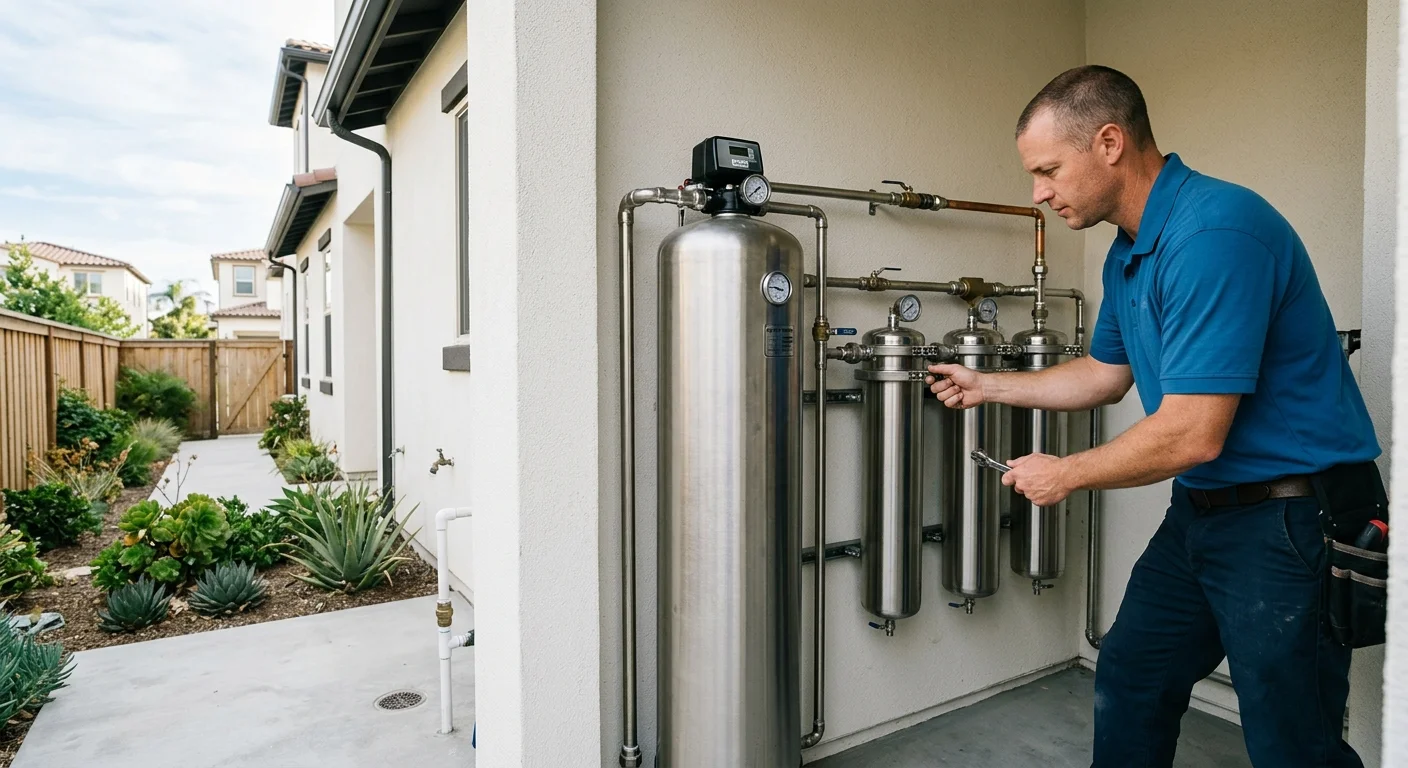
A whole-house unit needs a bypass, room to service the valve, and, if it is a salt softener, a legal drain for regeneration. Salt-free equipment still needs a place to land and a way to isolate it. Ask whether the quote is a stainless steel tank or a fiberglass tank with a plastic liner. The vessel is the difference. It is not a hardness rating.
Many Encinitas remodels put in tankless heaters. Navien’s maintenance notes include annual flushing and descaling of heat exchangers, and they say hard water may need more frequent service. Anti-scale equipment or a softener can reduce mineral buildup. Failure to follow that brand’s manual, including scale, can void its warranty. Other heater brands write their own terms. This is not a Filter Pros warranty.
City of Encinitas permit rules for water softeners were not confirmed in the verified ledger. The City of San Diego lists water-softener installation among Simple No-Plan plumbing work for eligible properties in that city’s jurisdiction. That is not an Encinitas rule, and it is not a countywide permit. Call the City of Encinitas building counter before anyone cuts pipe. If you are in an HOA, read the CC&Rs on exterior equipment, brine discharge, and mechanical-closet work. A water softener Encinitas install that ignores the association still fails even if the chemistry is right.
If the property uses a septic system, EPA advises checking with the septic manufacturer or service provider about overload, warranty, and performance before a softener goes in. Do not assume every Encinitas lot has septic. Do not assume a conditioner is required.
Softening versus salt-free versus whole-house carbon
Match the tool to the complaint.
An ion-exchange softener swaps calcium and magnesium for sodium or potassium. NSF/ANSI 44 is the certification standard for those softeners when they claim hardness reduction. Compare the exact model’s rated working capacity and its water and salt efficiency. University of Nebraska–Lincoln Extension estimates sodium is added at about 8 mg/L for each grain per gallon of hardness removed. People on a restricted sodium diet should talk to a physician. Drinking and cooking water often comes from a kitchen cold line that bypasses the softener. Potassium chloride can replace sodium chloride in some units, with professional guidance. Follow the model manual for salt type. Do not use rock salt. Do not fill a brine tank to the lid, which can cause bridging.
Salt-free water conditioning does not remove hardness ions. EPA says evaluate the exact scale-reduction claim, not a promise of softened water, and look at IAPMO/ANSI Z601 scale-reduction requirements where they apply. No salt bags. No brine discharge. No sodium added by the process. That is why some Cardiff condos and HOAs look at it first. It is not the same job as a softener. The longer comparison is water softener versus salt-free conditioner.
Whole-house carbon is Encinitas water filtration for taste and odor, not hardness. NSF/ANSI 42 covers certified aesthetic reduction claims, such as chlorine-related taste. NSF/ANSI 53 covers specified health-effect claims on the exact model. A standard is not a ranking, and it does not prove reduction of every contaminant. Carbon does not move the USGS hardness class. If the complaint is spotted glass and crusty shower valves, carbon alone is the wrong primary unit.
Point-of-use reverse osmosis sits at a drinking tap. NSF/ANSI 58 covers those systems. EPA’s WaterSense pages are one place to compare certified efficiency. A labeled WaterSense unit demonstrates at most 2.3 gallons of reject water per gallon treated under its test conditions. That is a label criterion, not field performance for every install. EPA also gives national examples of less efficient units. Those examples are not a promise for your kitchen. RO can lower treated-water pH in treatment applications. Exact output depends on the model, feedwater, and upkeep. Do not treat RO as whole-house hardness control unless the pro is quoting that scope in writing.
No single technology removes every contaminant. EPA’s home treatment guide says identify the goal from the utility report and testing, then compare point-of-entry versus point-of-use, certified claims, maintenance, and water use. Include replacement-filter cost when you compare ownership. Pitchers and tap filters, RO, and point-of-entry systems sit in different EPA cost categories in that guide. Those categories are not a San Diego quote and not a Filter Pros price.
Questions for the separately licensed pro
Bring the bill, the current Consumer Confidence Report, and any HOA rules. Then ask the installer, not the referral brand, to put answers on the quote.
What hardness did you measure at this tap, in grains per gallon. Which NSF/ANSI standard and which exact reduction claim apply to the model on the page. Is the vessel stainless steel or fiberglass with a plastic liner. Where does the bypass sit, and how do we isolate the unit. Culligan describes bypass as routing water around the softener so the house still has water while the unit is isolated. Valve types differ. Follow the model manual. Do not force a stuck handle. Confirm bypass by running a cold tap.
Where does the drain discharge, and is that allowed on this Encinitas lot or in this condo. If this is a salt unit, what salt type does the manual allow, and where will bags live in a tight garage. Who pulls any City of Encinitas permit, if one is required. May I check the installer’s license on the CSLB license lookup.
Filter Pros San Diego is not the contractor. The brand does not hold the trade license for the install. The separately licensed pro does the work. You sign that contract. You pay that invoice. Ask for a written scope that names the model, the certified claim, the tank material, and the maintenance the manufacturer requires. Persistent drain flow can mean a malfunction. Do not open pressurized assemblies, and do not handle wet electrical parts.
When to call us
Call when scale, soap scum, or a tankless heater’s descaling interval is the problem, and you want a measured hardness result before anyone sells a tank. Call us at (858) 400-6508 to set up a free in-home water test.