Osmosis is the movement of water across a selective membrane in response to a difference in dissolved-solute concentration. Reverse osmosis, or RO, applies pressure to move water in the opposite direction and separates the incoming stream into treated water and a more concentrated reject stream.
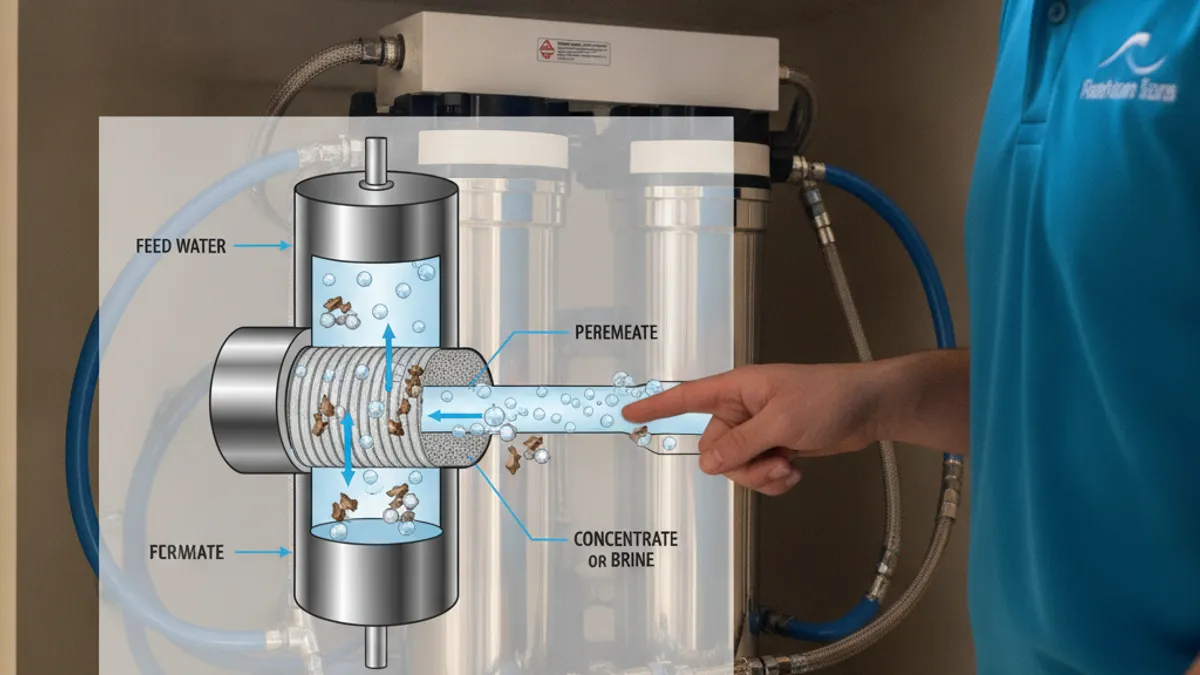
Osmosis in plain language
Imagine two water solutions separated by a membrane that allows water to pass more readily than the dissolved material. Water tends to move toward the side with the higher solute concentration. The pressure associated with that tendency is called osmotic pressure.
Real membranes and solutions are more complicated than a kitchen-strainer analogy. Separation depends on membrane chemistry, pressure, temperature, the incoming water, and operating conditions. It should not be reduced to a claim that every unwanted molecule is simply too large to pass through a fixed pore.
How reverse osmosis changes the direction
An RO system applies pressure on the feed-water side of the membrane. Part of the water crosses the membrane and becomes treated water. The rest carries concentrated dissolved material away as reject water.
An under-sink system may rely on incoming water pressure or use a pump, depending on its design and installation conditions. Higher salinity increases osmotic pressure, but the pressure, pretreatment, recovery, and other limits must come from the exact system documentation. A household unit should not be treated as interchangeable with equipment designed for brackish water or seawater.
Why exact-model performance matters
NSF/ANSI 58 covers point-of-use reverse osmosis systems. It includes required TDS-reduction performance and allows optional contaminant-reduction claims. A model certified under the standard is not automatically certified for every optional contaminant.
Before choosing a unit, verify:
- the exact model and certified reduction claims;
- the feed-water and pressure limits for those claims;
- rated flow, recovery, and efficiency under the stated test conditions;
- pretreatment and installation requirements;
- the manufacturer’s filter and membrane replacement instructions;
- the availability and cost of replacement elements.
No single home treatment technology removes every contaminant. Match the model’s documented claim to the concern identified in the serving utility’s report or appropriate testing.
Why RO produces reject water
The reject stream carries concentrated dissolved material away from the membrane. The amount varies by model and operating conditions. EPA notes that a WaterSense-labeled point-of-use RO system must meet its efficiency criteria, including no more than 2.3 gallons of reject water per gallon of treated water under the label’s test conditions. That criterion is not a promise about every RO system or every installation.
What this means for a San Diego home
For public water, the serving utility’s current Consumer Confidence Report and notices are the starting point. They describe the public system, not the exact water at a household tap or the condition of private plumbing. If there is a specific health concern, use the appropriate laboratory test rather than assuming a field reading or utility report identifies everything present at the tap.
Point-of-use RO treats water at a selected tap. Whole-house, or point-of-entry, equipment treats water entering the residence. Choose the scope from the treatment goal and compare the exact model’s certified claims and maintenance requirements.
Frequently asked questions
Does reverse osmosis remove everything from water?
No. NSF/ANSI 58 includes required and optional claims, and optional contaminant claims vary by model. Check the certification listing and performance data sheet for the exact unit.
Why does an RO system produce wastewater?
The reject stream carries concentrated dissolved material away from the membrane. The ratio depends on the system and operating conditions.
How is reverse osmosis different from a carbon filter?
RO uses pressure and a selective membrane. Carbon filtration uses adsorption and has its own exact-model claims. Either technology should be selected for the identified concern rather than from the category name alone.
How often does an RO membrane need replacement?
Follow the manufacturer instructions for the exact model. Inlet water, use, pretreatment, and system performance affect service intervals; there is no universal replacement schedule.
If you want to compare an RO system for a selected tap, call Filter Pros San Diego at (858) 400-6508. The independent licensed provider can explain the field assessment, exact equipment, certified claims, maintenance, and written price.