Distillation boils water, captures the vapor, and condenses it into a separate container. It can leave many germs and chemicals behind, but it does not make every source water suitable for every use. The CDC notes that distillation does not remove some volatile organic compounds, volatile solvents, and certain pesticides. Clean equipment and storage also matter because treated water can be contaminated again.
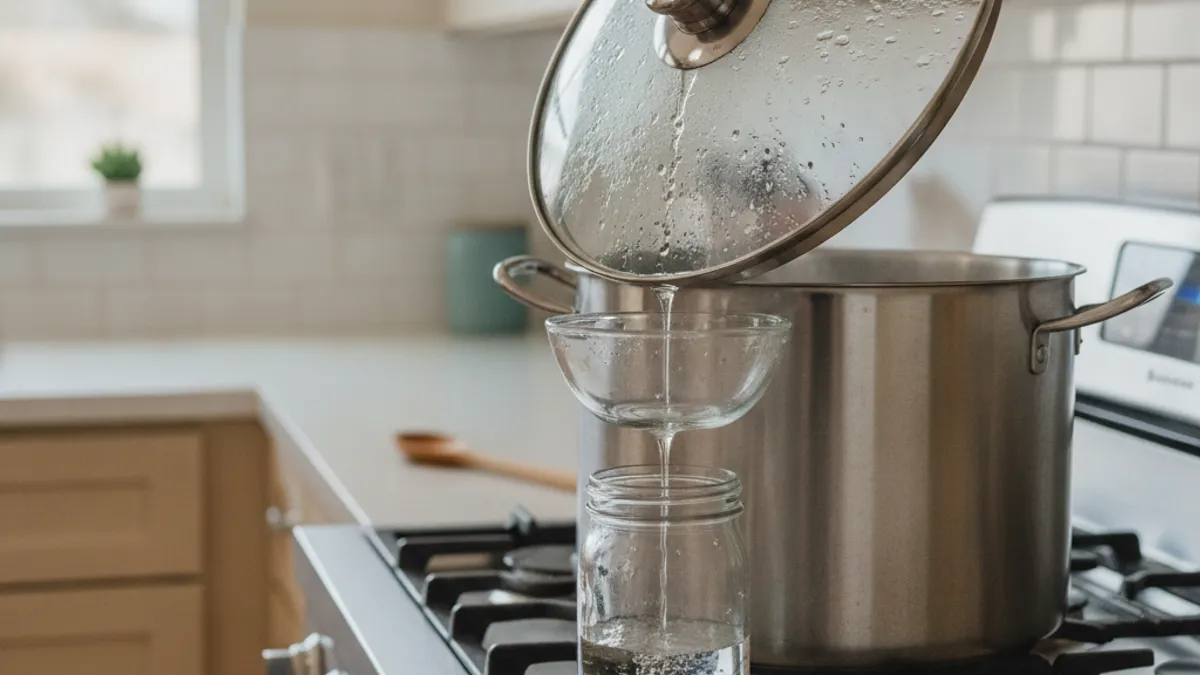
The basic stovetop method
The Science Buddies distillation demonstration uses a deep pot, a supported ceramic collection bowl, and an inverted sloping lid. For a small water demonstration, keep source water outside the bowl and heat it gently. Ice above the lid cools the vapor, which condenses and drips into the bowl. Turn off the heat and let the setup cool before handling it with oven mitts. This demonstrates separation; it does not certify the collected water for drinking or medical use.
Use food-safe, heat-resistant equipment. Keep the boil gentle to reduce splashing or boil-over into the collection side. Make sure the setup is stable, ventilate the room, and never leave a hot stove unattended. Stop before the source pot boils dry, allow every part to cool before handling it, and store the collected water in a clean, covered container.
If a public authority has issued a water advisory, follow that authority’s instructions. Do not improvise a stovetop treatment for a suspected chemical release or a do-not-use advisory.
What distillation can and cannot do
Water changes phase during distillation, so many dissolved materials remain in the boiling vessel. That does not mean the condensate is free of every contaminant. Some volatile chemicals can travel with the vapor and condense into the collected water. The CDC also cautions that bacteria can grow on cooling coils while a distiller is not being used.
The CDC’s guide to home water treatment systems recommends testing the water and choosing a system based on the germs or chemicals you want to remove. It also makes clear that different treatment systems remove different substances. If a particular contaminant matters, use a suitable laboratory result and verify the exact treatment model’s documented claim rather than treating “distilled” as a complete test result.
Where a DIY setup can go wrong
A hard boil can splash untreated water into the collection bowl. An unstable bowl or lid creates spill and burn hazards. Materials not designed for food contact and sustained heat can affect the collected water, and residue in the collection vessel can reintroduce contamination. Leaving the setup unattended creates a fire and burn risk if the pot boils dry.
Clean and dry the equipment according to its manufacturer or material instructions. Discard a batch if untreated water splashes into the collection container. A stovetop method has no built-in monitor confirming the composition of its output.
Why it does not scale well for a household
A stovetop setup makes a limited batch and requires supervision, heating energy, cooling time, and cleaning. Production time varies with the pot, heat input, lid temperature, starting volume, and collection design, so a fixed gallons-per-hour promise would be misleading.
Countertop distillers automate parts of the process, but their capacity, cleaning procedure, and contaminant claims still vary by model. Check the product instructions and performance documentation rather than assuming a countertop unit removes everything.
Match the treatment method to the job
If the goal is one drinking-water tap, compare point-of-use systems by their exact reduction claims, rated capacity, wastewater or energy use, maintenance, and full installed cost. If the concern appears at multiple fixtures, a provider can explain point-of-entry options and the household flow data needed for sizing. A whole-house filtration system and an under-sink reverse osmosis system have different purposes and do not have universal contaminant-removal claims.
Start with the serving utility’s water quality report or an appropriate laboratory test. That evidence defines the treatment question more clearly than taste or a general desire for “pure” water.
What about appliances, CPAP equipment, and aquariums?
Use the water type named by the device manufacturer. Do not assume a DIY batch meets a CPAP, humidifier, battery, steam iron, or other appliance specification simply because it was distilled on a stove. For CPAP equipment or another medical device, follow the device instructions and guidance from the treating clinician.
Aquarium water must fit the species and the tank’s target chemistry. Low-mineral water may need controlled remineralization and conditioning, so a homemade batch is not universally suitable. Follow the equipment maker’s instructions and species-specific husbandry guidance.
Frequently asked questions
Is homemade distilled water as pure as store-bought distilled water?
You cannot establish equivalence from the method alone. Source-water chemistry, volatile compounds, splashing, equipment cleanliness, and storage all affect the output. A laboratory test is the way to answer a specific composition question.
Can I assume homemade distilled water is safe to drink every day?
No general article can establish that for an unknown source and process. Check current utility notices, use appropriate source water, keep the equipment and storage container clean, and seek qualified guidance for a health-specific question.
How long does it take to distill a gallon at home?
There is no reliable universal time. Yield depends on the equipment and operating conditions, and the setup needs continuous supervision while it is hot.
What’s the difference between distillation and whole-house filtration?
Distillation is a batch process that boils and condenses water. A point-of-entry filter treats flowing water for multiple fixtures. Performance for either approach depends on the exact design and documented contaminant claims.
Filter Pros San Diego can connect you with a separately licensed provider to compare options for a defined water-quality concern. Request the proposed model, its documented reduction claims, maintenance requirements, and complete quote before deciding.